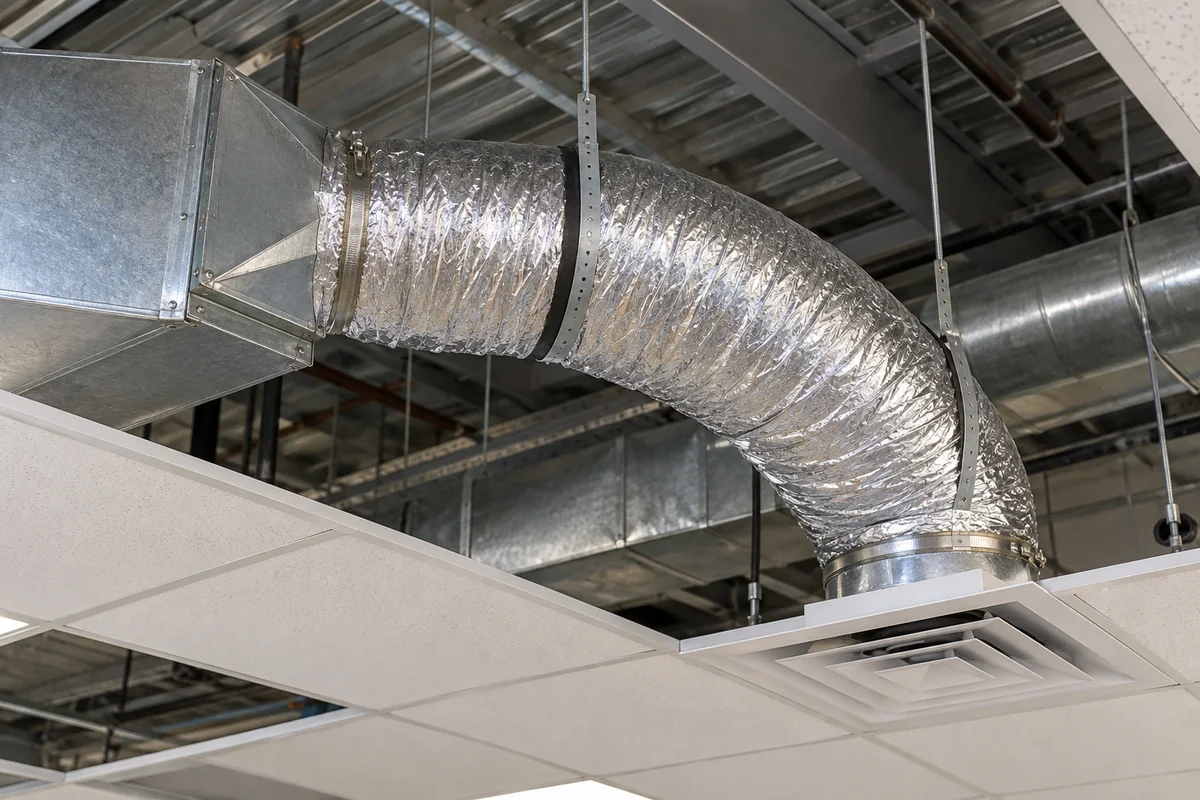
Flexible air ducts for HVAC and ventilation · UL 181 air duct versus air connector, insulation R-value, diameter sizing against pressure loss, support spacing and sag
A flexible duct is a round air duct made of an inner core on a wire helix, with or without insulation and an outer vapour barrier, used to carry supply and return air to diffusers and grilles and to make connections in tight spaces. Fix three things before ordering: the fire-safety listing and length rules that apply, the insulation and vapour barrier the climate and code require, and the diameter needed for the airflow once the duct's pressure loss is allowed for.
Insulated and non-insulated flexible air ducts and air connectors for heating, ventilation and air-conditioning, including aluminium-foil, PVC and fabric types, and flexible industrial ventilation ducts. Clothes-dryer transition ducts, rigid sheet-metal and duct-board systems, kitchen exhaust ducts and fabric air-dispersion ducts are outside this page.
CNFX editorial research · Sources checked October 11, 2026 · 4 sources
The Air Duct Council (ADC), a trade association of flexible duct makers, explains that UL 181 defines two categories: a UL-listed flexible air duct must pass all 15 tests in the standard, carries a square or rectangular label and has no limit on run length, while a UL-listed flexible air connector passes only 12 of the 15 tests, carries a round label and is limited by NFPA 90A and 90B to installed lengths of 14 ft, which may not be extended by splicing sections together. [1]
ADC gives 4.2, 6.0 and 8.0 as the standard R-values for insulated flexible air duct, says values above 8.0 are considered a special order, and states that R-values are reported from the insulation's k-value at installed wall thickness tested to ASTM C518, not from the core or vapour barrier; its Thermal Performance Program certifies these ratings. [1][2]
It adds that UL 181 listing includes mold-growth and humidity testing; that tapes, mastics and non-metallic ties used to seal flexible duct must be listed to UL 181B; that metal screws are not recommended for non-metallic flexible duct; that Class 1 ducts are for comfort-air heating and cooling, not clothes-dryer exhaust, which needs a listed transition duct limited to 8 ft; and that outer jackets and inner cores may degrade under prolonged UV exposure unless designed for it. [1]
Editorial note: check which listing the local code requires before choosing between air duct and air connector, since the 14 ft limit can rule out connectors for long branches.
Give the supplier the listing required (UL 181 Class 1 air duct or connector, or the local equivalent), inner diameter and lengths, insulation R-value, core and vapour-barrier materials, operating temperature and pressure, UV exposure, end fittings or plain ends, and quantity per size.
02
Size the diameter and support the run
ADC lists diameters of 2” through 12” in 1-inch increments and 14” through 22” in 2-inch increments, and says ducts must be supported at the maker's recommended intervals but no more than 4 ft apart, with sag of no more than ½ in per foot of spacing between supports. [2]
On sizing, ADC notes that pressure drop in flexible duct is higher than in smooth sheet metal because of the convolutions from the wire helix, gives a rule of thumb of going 1 in larger in diameter for the same straight length, and says ducts should be sized with pressure-drop data from makers or bodies such as ADC, ACCA and ASHRAE, following ACCA Manual D. [1]
In an ADC-commissioned laboratory study of light-commercial branch systems tested to ASHRAE Standard 120-2017, doubling the flexible run in 8 in branches added about 3% pressure loss, while replacing the branches with 9 in flexible duct over 16 ft gave about 22% lower loss than the code-length baseline. The flex was fully stretched before installation, bends held at least one duct diameter radius and supports kept within 4 ft. [3]
Editorial calculation: 4 ft is about 1.22 m, and ½ in per foot is about 42 mm per metre, so a run supported every 1.2 m should sag no more than about 50 mm between supports. ADC's sizes of 2–12 in correspond to about 50–300 mm. [2]
03
Core materials in the listings and the test data to request
The listings reviewed cover aluminium-foil, PET and PVC flexible ducts, insulated HVAC ducts and industrial ventilation ducts; ask each for the listing or test report, R-value basis, diameter tolerance and pressure-loss data.
04
Pull the duct fully stretched: compression multiplies pressure loss
Researchers at Lawrence Berkeley National Laboratory tested spiral wire-helix core flexible ducts of 6, 8 and 10 in (150, 200 and 250 mm) nominal diameter in different compression configurations, following ASHRAE Standard 120-1999. They report that "moderate compression in flexible ducts … could increase the pressure drop by a factor of four, while further compression could increase the pressure drop by factors close to ten." [4]
The study found that the pressure-drop correction factor for compressed duct cannot be independent of duct size, as ASHRAE Fundamentals suggests, so the authors developed a new relationship. The paper was published in HVAC&R Research in 2004 (vol. 10, no. 3, pp. 275–290). [4]
Editorial note: ADC's own branch tests also used flex that was fully stretched before installation [3]. Ask the installer how slack will be removed, and the supplier for pressure-drop data stating the extension at which it was measured.
05
Core, helix, insulation, jacket, joints and hangers
The wire helix is what forms the convolutions behind flexible duct's higher pressure drop, and the supports row carries ADC's 4 ft limit. [1][2]
Diameter, insulation, bend radius and listing per size
Tensile strength, weight per metre and noise reduction have no published value in the ADC or LBNL material, so ask the supplier for test data on all three.
Field
What it means and published values
Ask the supplier for
Inner Diameter (mm)
2–12 in (≈50–300 mm) by 1 in; 14–22 in by 2 in. [2]
Explore company information and manufacturing capabilities, then discuss the scope of your project with a relevant supplier.
Share this page
Compiled and source-reviewed by the CNFX editorial team.
Each manufacturer above links to the page on that company's own website where the product is listed, with the date we checked it. How we source and review
· Page last updated 13 October 2026
Buyer questions
What is the difference between a flexible air duct and an air connector?
ADC says UL 181 air ducts pass all 15 tests with no length limit; air connectors pass 12 and are limited to 14 ft. [1]
What R-values does flexible duct come in?
ADC lists 4.2, 6.0 and 8.0 as standard, with higher values special order. [1][2]
How far apart should flexible duct be supported?
ADC says no more than 4 ft, with sag of at most ½ in per foot of spacing. [2]
Should flexible duct be larger than sheet-metal duct?
ADC's rule of thumb is about 1 in larger for the same straight length, sized with pressure-drop data. [1]
How much does compressing flexible duct raise pressure loss?
Lawrence Berkeley National Laboratory tests found moderate compression could raise pressure drop by a factor of four, and further compression by factors close to ten. [4]
Sources and what still needs a direct check
Sources checked 2026-10-11. The Air Duct Council is a trade association of flexible duct makers publishing technical FAQs, product guidance and a commissioned pressure-loss study; the linked suppliers publish product pages.