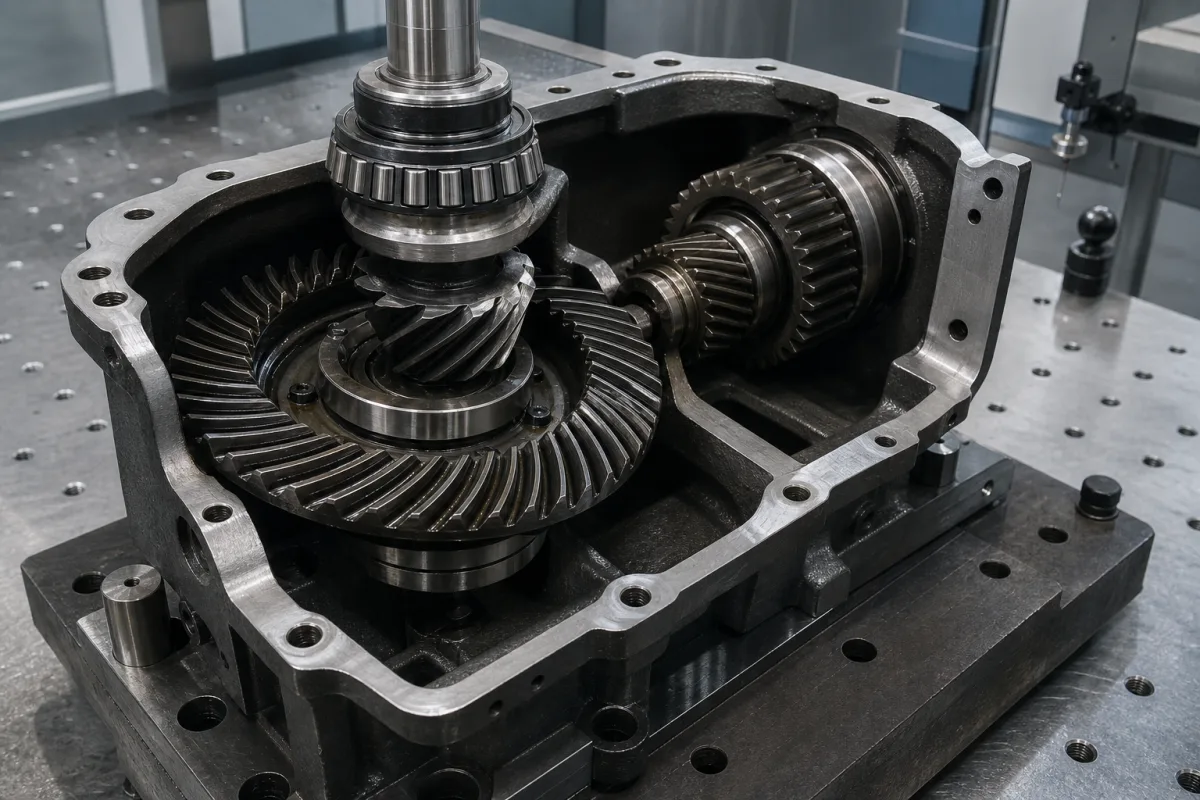
Bevel gears · Straight or spiral by pitch-line speed, Gleason geometry and face width, hand of spiral and thrust direction
Bevel gears are cone-shaped gears that transmit power between intersecting shafts, such as the 90° right-angle stage of the gearbox pictured. Ask three things first: whether the pitch-line speed and load call for straight or spiral teeth, which tooth system and geometry (module, teeth, cone angles, face width) the pair is cut to, and which spiral hand and rotation the pair runs in, because that sets the thrust the bearings must carry.
Straight, spiral and Zerol bevel gear pairs, including miter gears, supplied as gears or matched sets. Complete bevel gearboxes and geared motors, hypoid gears, parallel-shaft helical gears and worm gears are outside this page.
CNFX editorial research · Sources checked October 12, 2026 · 4 sources
KHK's bevel gear guide says “Straight bevel gears are generally used in relatively slow speed applications (less than 2m/s circumferential speed). They are often not used when it is necessary to transmit large forces.”; they are easier to make and their teeth cannot be ground after heat treatment. Spiral bevel gears can be ground after heat treatment, mesh gradually and smoothly, are stronger, and at operating speeds above 10 m/s give markedly lower noise and vibration. [1]
KHK reproduces a textbook view that above about 5 m/s peripheral velocity spiral bevel gears are considered desirable for quiet running. It also notes that “presently most gears use the Gleason method”, and that for spiral bevel gears “in Germany, the Klingelnberg type with equal toe and heel tooth depth is still deeply rooted in use”. [1]
Editorial calculation: a 60 mm reference diameter pinion turning at 1,500 min⁻¹ has a pitch-line speed of π × 0.060 × 1,500 ÷ 60 ≈ 4.7 m/s, already above the 2 m/s range KHK gives for straight bevel gears; at 3,000 min⁻¹ it reaches about 9.4 m/s.
Give the supplier the power or torque, input speed, ratio, shaft angle, rotation directions and which shaft drives, duty and shock, required accuracy and noise, lubrication, space for the pair, and whether teeth must be ground after hardening.
02
Fix the Gleason geometry and face width
KHK's technical reference gives Gleason tooth proportions: straight bevel gears have tooth depth 2.188m with working depth 2.000m, while Gleason spiral bevel gears are a stub system with tooth depth 1.888m and working depth 1.700m, applicable to modules above 2.1. In the Gleason straight system the pinion is positively and the gear negatively profile-shifted to balance strength. [2]
KHK's worked spiral bevel example uses module 3, 20° normal pressure angle, 35° mean spiral angle and 20 (left-hand) and 40 (right-hand) teeth, giving reference diameters of 60 and 120 mm, cone angles of 26.565° and 63.435° and a cone distance of 67.08 mm; face width should be less than 0.3R or 10m, and 20 mm is used. Its straight bevel example with the same teeth limits face width to R/3 and uses 22 mm. [2]
KHK notes that the straight bevel gear with Gleason crowning (Coniflex) tolerates poor tooth contact from improper mounting and assembly, and that its spiral bevel equations apply only to Gleason Spread Blade or Single Side cutting; gears cut by another method need different equations. [2]
03
Plan the spiral hand, rotation and thrust
Gear Solutions' technical column explains that a spiral bevel pair only runs with one gear, “typically the pinion”, left-handed and the mating gear right-handed. The pinion's thrust can point either way depending on rotation and whether it drives or is driven, while the gear's thrust always tends to pull it out of mesh. [3]
The same column notes that in a straight bevel pair the axial force on one gear equals the radial force on its mate, while in a spiral pair rotation and spiral hand both set the axial loads. Reversing rotation swaps which tooth faces mesh; if thrust bearings exist only on the hub side, reversing will cause premature wear, so bearing location and size must account for both directions. [4] KHK likewise lists the change of thrust direction with rotation and twist angle as a disadvantage of spiral bevel gears. [1]
04
Compare what suppliers offer
Suppliers linked to this page list bevel gears; each card links to the page reviewed.
Listings include straight, spiral and miter bevel gears made to drawing, alongside spur, helical and worm gears, sprockets and gearboxes. Ask each supplier whether the pair is cut to the Gleason or Klingelnberg system, whether teeth are ground or lapped after hardening, and for a tooth contact pattern report.
05
Trace the gear pair
This is a functional reference built from the sources cited; it is not one maker's specification.
Fill the specification fields with values for your pair
A bevel gear quotation needs values for your drive. The table explains each field, gives published values where a reviewed source states them, and says what to obtain from the supplier.
Field
What it means and published values
Ask the supplier for
Module (mm)
Gleason spiral system for m > 2.1; example m 3. [2]
Explore company information and manufacturing capabilities, then discuss the scope of your project with a relevant supplier.
Share this page
Compiled and source-reviewed by the CNFX editorial team.
Published product pages show what a company offers, not tested performance. Confirm the legal seller, factory and scope for your order. How we source and review
· Page last updated 13 October 2026
Buyer questions
When should I use spiral instead of straight bevel gears?
KHK places straight bevel gears in slow duty below 2 m/s and notes markedly lower spiral bevel noise above 10 m/s; spiral teeth can also be ground after hardening. [1]
How wide can a bevel gear face be?
KHK's Gleason spiral bevel example limits face width to less than 0.3 times the cone distance or 10 modules. [2]
Which way does a spiral bevel gear thrust?
Per Gear Solutions, the pinion's thrust depends on rotation and whether it drives, while the gear's thrust always pulls it out of mesh. [3]
Sources and what still needs a direct check
Sources checked 2026-10-12. KHK is a gear maker; its technical reference and bevel gear guide describe Gleason-system geometry and reproduce textbook guidance. Gear Solutions is a gear industry magazine; the columns cited explain hand and thrust.