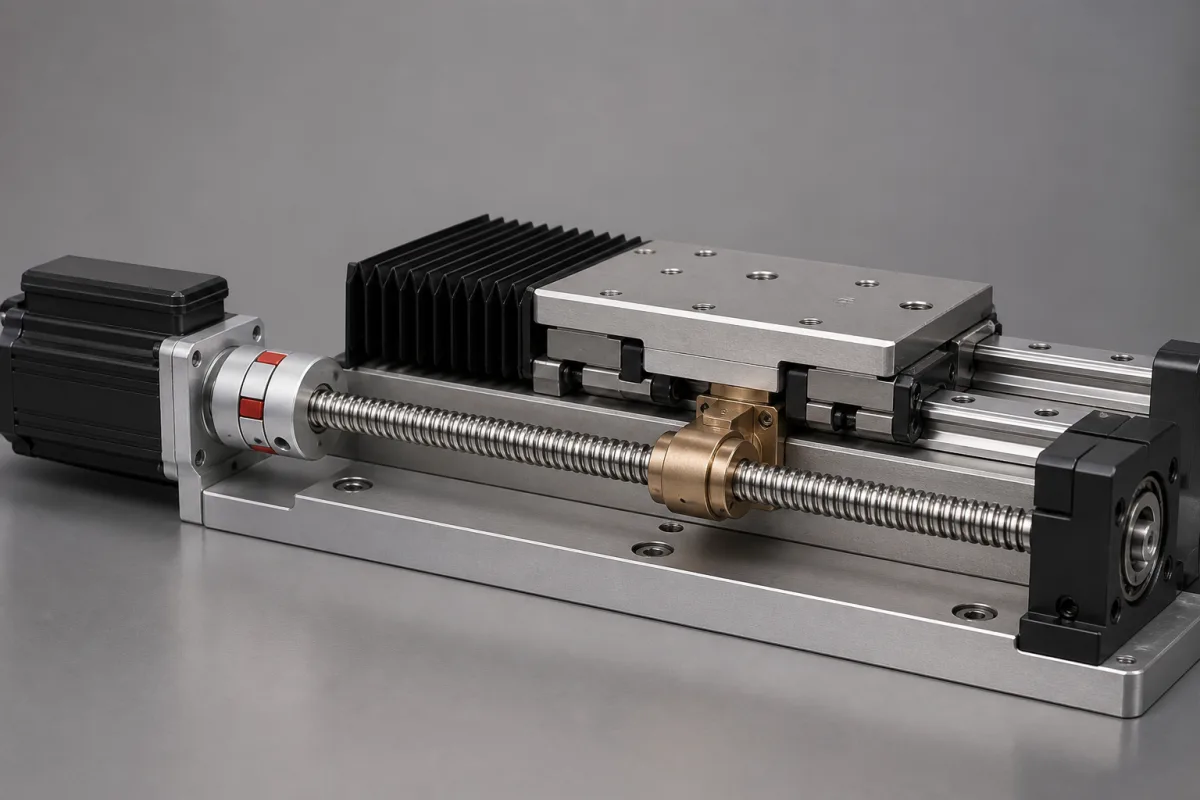
Lead screw assemblies (screw and nut) for linear axes, stages and actuators · load and nut material (plastic vs bronze), PV and duty cycle, efficiency and back-driving, lead and speed, backlash and anti-backlash nuts, lubrication, life
A lead screw assembly is a threaded screw and a sliding nut that turn rotary motion into linear motion, driving stages, actuators, lifts and machine axes, driven by a stepper or servo motor. Ask three things first: the load, speed and duty cycle the nut must carry, which decide plastic or bronze; whether the axis must hold position without a brake, which depends on efficiency and back-driving; and how much backlash and accuracy the motion can tolerate.
Lead (sliding) screw assemblies — ACME and trapezoidal screws with plastic, bronze or anti-backlash nuts, end machining and supports — including fine-pitch screws for instruments. Ball screws (separate page), complete linear actuators and stages, and threaded rod sold as fastener stock are outside this page except where compared.
CNFX editorial research · Sources checked October 12, 2026 · 5 sources
Choose the nut material for load, speed and duty cycle
Motion Control Tips, an engineering publication, explains that lead screws use the thread's helix angle to convert rotary to linear motion, and that their performance depends on friction between nut and screw, set by the materials used. Plastic nuts carry light loads — under about 100 lb, with designs for 300 lb and beyond possible — while bronze nuts suit applications above thousands of pounds. The pressure-velocity (PV) factor, the product of contact pressure and sliding velocity, determines the load, speed and duty cycle a nut can handle; plastics have an intrinsic PV rating beyond which frictional heat deforms them, so more load means lower allowable speed. Plastic and stainless assemblies are limited to about a 50% duty cycle at rated load, and bronze-nut assemblies, carrying heavier loads with more frictional heat, may be limited to as little as 10%. [1]
MISUMI's lead screw selection procedure checks the nut against a pressure-velocity (PV) graph: for a 16 mm screw with 3 mm pitch and a brass flanged nut carrying 300 N at 500 min⁻¹, it calculates contact pressure of 0.44 N/mm² and sliding speed of 22.8 m/min, finds the point inside the steel-on-brass (lubricated) limit line and concludes no abnormal wear will occur. It gives dynamic friction coefficients of 0.21 for lubricated steel on brass and 0.13 for unlubricated steel on polyacetal or sliding-grade PPS. [3]
Haydon Kerk's WDG anti-backlash series uses a polyacetal nut rated for 0–93 °C (32–200 °F), with nut-to-screw friction of 0.08 static and 0.15 dynamic (0.09 dynamic with its TFE screw coating); the flange-mount nuts for 3/16–1/4 in screws list a dynamic load of 10 lb (4.5 kg) and drag torque of 4 oz-in, and the 1/2 in size 75 lb (34 kg) and 9 oz-in. Its patented wedge locks the anti-backlash nut at preload without excessive drag. [2]
Editorial note: give the supplier the load profile and duty cycle rather than a single peak load, so it can check PV and heat for the nut material it proposes. [1]
Give the supplier the axial load (static and moving), orientation (horizontal or vertical), speed and stroke, duty cycle, required life, lead, screw diameter and length, thread form (ACME or trapezoidal), nut material and anti-backlash need, accuracy and backlash limits, end machining and supports, lubrication and environment (dust, washdown, clean room), motor and coupling, and quantity.
02
Check efficiency, back-driving, lead, backlash and lubrication
Motion Control Tips gives lead screw efficiency as ranging from about 20% to 80%, rising with helix angle because less energy goes into friction. Above 50% efficiency a lead screw becomes back-drivable — the load can drive it backwards — which on a vertical axis may need a brake to hold the load. Leads range from under 0.050 in to 2.00 in per revolution or more, giving jog speeds up to 70 in/s. Standard configurations have backlash of 0.002–0.010 in; anti-backlash nuts place a spring or compliant member between two nut halves to remove free play. Life has no reliable closed-form calculation because wear is non-linear, so it is estimated from case studies under controlled conditions. Bronze nuts need lubricant, such as a thick damping grease; plastic nuts can run dry thanks to internal lubricants, though a gel lubricant raises allowable load and life; and in dusty environments grease can become an abrasive slurry, so a dry film such as PTFE coating is preferred. [1]
Editorial calculation: linear speed equals lead times rotational speed, so with an assumed 0.2 in (about 5 mm) lead at 600 rpm (10 rev/s) the nut travels 2 in/s (about 51 mm/s); a 2.00 in lead at the same speed would travel 20 in/s. Higher leads raise speed but, by the same source, also efficiency and the tendency to back-drive. [1]
Haydon Kerk lists theoretical efficiency by lead for a 3/16 in screw rising from 30% at 0.02 in (0.5 mm) lead through 58% at 0.05 in and 69% at 0.1 in to 86% at 0.5 in (12.7 mm). MISUMI's worked example calculates efficiency of 0.24 for the 16 mm × 3 mm brass-nut screw and a load torque of 59.7 N·cm for 300 N. [2][3]
Editorial calculation: by the 50% back-driving threshold, the 3/16 in screw becomes back-drivable between the 0.039 in lead (47%) and the 0.05 in lead (58%), so on a vertical axis choose the finer lead or add a brake. [2][1]
igus, a maker of polymer lead screw nuts, describes its dryspin high-helix thread as covering screw diameters from 4 to 20 mm and pitches from 2.4 to 100 mm, with a flatter flank angle than conventional high-helix threads. It states efficiencies of up to 82% for this geometry, and that wear tests showed up to 25% lower wear and up to 30% longer service life than conventional trapezoidal threads. Its iglidur nuts are rated for −20 °C to +150 °C, standard pitch accuracy is given as 0.1 on 300 mm, and its support blocks fit thread sizes 6–24 mm. igus notes that self-locking depends on pitch and coefficient of friction. [4][5]
Editorial calculation: igus's 82% maximum is above the 50% efficiency at which Motion Control Tips says a lead screw becomes back-drivable, so a high-helix polymer-nut assembly on a vertical axis needs a brake or a self-locking lead; a pitch accuracy of 0.1 mm per 300 mm is about 0.033 mm per 100 mm of travel. [4][5][1]
03
Compare what suppliers offer
The companies in the manufacturer list below show this product on their own websites. Confirm the legal seller, factory and scope for your order.
When requesting quotations, ask each supplier for nut PV and duty-cycle ratings, efficiency at your lead, backlash or anti-backlash options, straightness and lead-accuracy grades, and end-machining drawings.
04
Trace the assembly
This is a functional reference built from the source cited; it is not one maker's design.
Fill the specification fields with values for your project
A lead screw quotation needs values for your project. The table explains each field, gives published values where a reviewed source states them, and says what to obtain from the supplier.
Field
What it means and published values
Ask the supplier for
Screw diameter
Not stated in reviewed sources.
Diameter.
Lead
Under 0.050 in to 2.00 in/rev. [1] E.g. 0.02–0.5 in on a 3/16 in screw. [2]
Explore company information and manufacturing capabilities, then discuss the scope of your project with a relevant supplier.
Share this page
Compiled and source-reviewed by the CNFX editorial team.
Published product pages show what a company offers, not tested performance. Confirm the legal seller, factory and scope for your order. How we source and review
· Page last updated 13 October 2026
Buyer questions
When does a lead screw back-drive?
Motion Control Tips says above about 50% efficiency the load can drive the screw backwards. [1]
Plastic or bronze nut?
Plastic nuts suit loads under about 100 lb; bronze nuts carry thousands of pounds but at lower duty cycles, as low as 10%. [1]
How much backlash does a standard lead screw have?
0.002–0.010 in; anti-backlash nuts remove the free play. [1]
How do I check that a plastic or bronze lead screw nut will not wear out fast?
Calculate contact pressure and sliding speed and check the point against the nut material's PV limit; one worked example gives 0.44 N/mm² at 22.8 m/min for a brass nut. [3]
How efficient can a lead screw with a plastic nut be?
igus states up to 82% for its dryspin high-helix thread with polymer nuts, in diameters of 4 to 20 mm and pitches of 2.4 to 100 mm; at that efficiency the screw is back-drivable. [5][4]
Sources and what still needs a direct check
Sources checked 2026-10-12. Motion Control Tips is an engineering publication whose guide reflects lead screw makers' general data; Haydon Kerk, MISUMI and igus publish data for their own products.