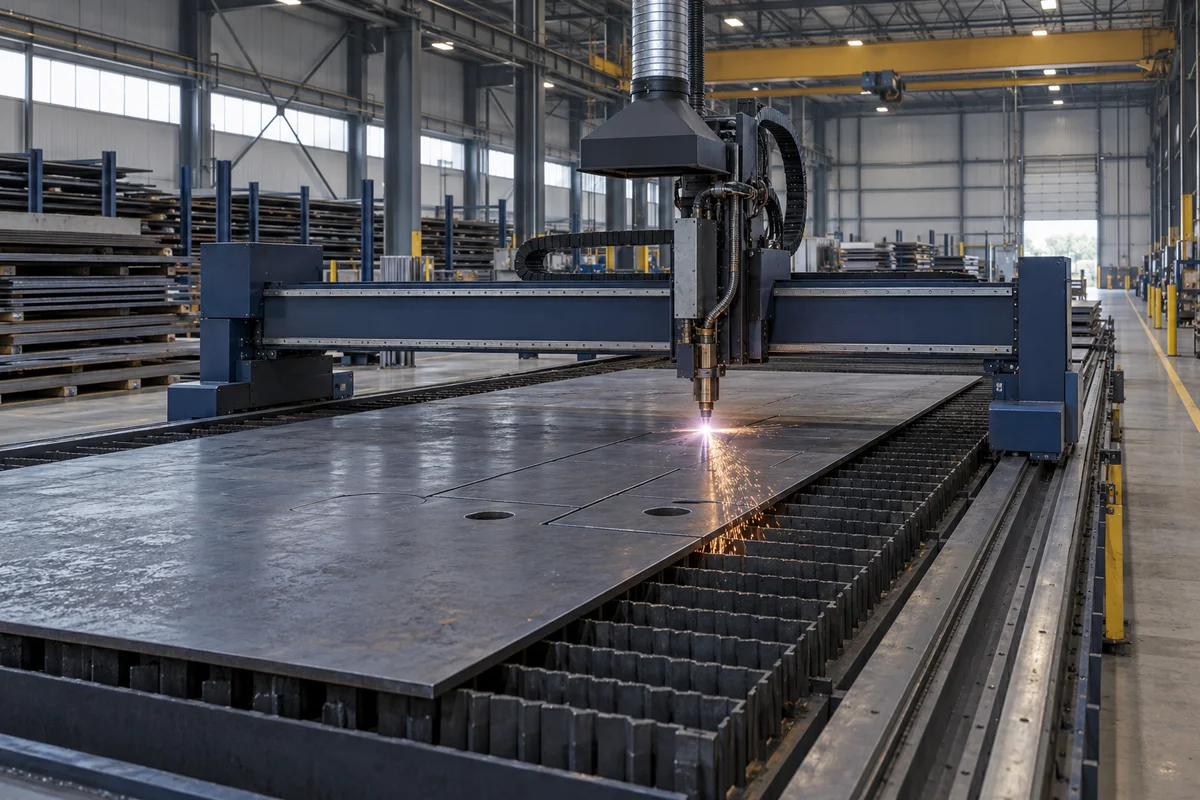
A wide gantry and a high-current source solve different problems. Choose the plate envelope and motion system, then match the source, machine torch and cut chart to the material and the starts inside each plate. This guide keeps the gantry catalogue, a named 65 A source and your acceptance cuts separate.
CNFX editorial research · Sources checked October 10, 2026 · 7 sources
Separate what the gantry sets from what the source sets
STYLECNC publishes its STP3000-G large gantry machine with these lines [1].
Name the plasma source in the contract
Because thickness depends on the source [1], the quotation must state the source brand, model and amperage, the torch and consumables, and who supplies cut charts.
Confirm both table dimensions
Only 3000 mm is given for the cutting area [1]; state width and length of the plates you cut, plus margins for clamping.
Standard; with part drawer; or with fume extraction and drawer [1]
The supplier describes a steel hollow beam, double-driven gantry and rack-and-gear motion, but its table does not state positioning accuracy or name the plasma height-control sensor type. Its general “no deformation” and “no engagement gap” claims are not measured tolerances. Obtain the effective X/Y envelope and delivered source/torch/controller list [1].
02
Follow the commands from the drawing to the cut edge
The CNC and drives position the torch; the source, torch and gas form the cutting package, while height control and the table affect how it is applied. These are functional assembly roles, not a spare-part BOM with certified quantities and material grades. STYLECNC’s listed configurations and Hypertherm’s named source explain the boundaries [1][2].
Assembly
Function and delivered-equipment check
CNC controller and cutting programme
STYLECNC names a CNC controller with optocoupler isolation. Identify its actual model, supported programme files, nesting interface and source-start/height-control signals. No controller brand or safety approval follows from that description [1].
Gantry, rails and rack drive
The maker describes a steel hollow beam, a double-driven gantry and rack/gear transmission, with steppers or optional servos. Ask for rail foundations/alignment and the motion acceptance test; the catalogue gives no steel grade, backlash tolerance or machine accuracy [1].
Plasma power source
STYLECNC leaves plasma thickness dependent on the chosen source. The Powermax65 SYNC figures below are a separate manufacturer example, not proof that it is supplied, interfaced or approved with this gantry [1][2].
Torch and consumables
Hypertherm distinguishes hand, machine and robotic SmartSYNC torches and cartridges by process/current. Specify the machine torch, leads, cartridge and mounting actually quoted. The model-specific parts reference below identifies replacement kits; material grades are not stated in that catalogue [2][7].
Torch lift and height control
STYLECNC lists 200 mm lift and automatic plasma height control, without establishing its sensor type. Hypertherm’s chart explanation separates initial pierce height, pierce delay and cut height, and notes arc-voltage changes as consumables wear. Ask for the delivered initial sensing and height-control behaviour [1][3].
Gas preparation and supply
The Powermax65 SYNC page specifies clean, dry, oil-free air or nitrogen and a cutting inlet flow of 210 L/min at 5.9 bar. These are that source’s inlet requirements, not a compressor nameplate rating or permission to use every plasma gas with every source [2].
Plate support, scrap and extraction
STYLECNC lists a standard table, drawer table, or smoke/dust-collector table with drawer. Define the included table, extraction connections and scrap access in the quote. A water table and extraction flow rating are not established by that model table [1].
Keep torch/cartridge identifiers and the source’s own service instructions with the machine handover. Use the supplied gas/filter, torch and motion inspection limits; the reviewed model pages do not provide a universal consumable life, rack service interval or safe servicing procedure.
03
Order machine-torch spares by the torch and part number
Hypertherm’s 2023 torch and consumable catalogue gives this actual replacement-parts breakdown for the SmartSYNC 180° full-length machine torch used with Powermax65 SYNC, 85 SYNC and 105 SYNC. It is a model-specific service-parts reference, not a manufacturing BOM for the gantry or proof of any supplier’s delivered package. The catalogue does not give material grades for these kits [7].
Two 65 A cartridges serve different processes
Printed page 18 lists 428930 for 65 A mechanized cutting and 428931 for 65 A drag cutting. Matching amperage alone does not identify the correct cartridge. Select the process and torch in the approved chart; the 2023 catalogue is not a claim about today’s stock or every earlier Powermax torch [7].
Catalogue position / part
Replacement kit and ordering boundary
1 · 428874
Shell for the full-length machine torch.
2 · 428703
Gear rack for the full-length machine torch.
3 · 428872
Torch-lock slider, with yellow and green label.
4 · lead length determines part number
428847: 4.6 m; 428848: 7.6 m; 428849: 10.7 m; 428850: 15 m; 428851: 23 m. These are replacement lead kits, not the complete torch assembly numbers.
5 · 428863
Quick-disconnect shell with button, lever and four screws. The catalogue explicitly excludes the torch lead and connector.
6 · 428148
Torch-shell screws, seven per kit.
7 · 428877
Clips for RFID wires, two per kit.
8 · 528066
Torch contact rings for the torch head, two per kit.
9 · 428950
O-rings for the torch head, five per kit.
10 · 428859
Full-length machine-torch body, with terminal screw, seven handle screws and silicone lubricant.
11 · 428866
Cap-sensor switch for the full-length machine torch.
12 · 428870
Radio-frequency printed circuit board.
13 · 428868
Switch assembly for the full-length machine-torch lock slider.
The numbered positions follow the manufacturer’s exploded drawing on printed page 22 (PDF page 24). Kit pack counts are not quantities to install in one torch. The complete assembly with a 7.6 m lead is 059719; the 7.6 m replacement lead alone is 428848. Verify the installed torch label and current service/parts instructions before ordering [7].
04
Read plasma capacity ratings correctly
Hypertherm’s Powermax65 SYNC page separates recommended cutting, hand-cut severance and piercing. These figures illustrate rating labels; they do not establish a STYLECNC package or the settings for every plate material, torch or cartridge [2].
Check the pierce limit, not only the cut limit, on a CNC table
Internal starts require a piercing rating that matches the actual source, machine torch and height-control setup. Hypertherm’s 16 mm rating is footnoted for handheld use or automatic torch height control. The 32 mm hand-severance figure does not establish 32 mm mechanized piercing, hole quality or continuous production [2].
Duty cycle sets continuous cutting
For the CE/CCC 380–400 V three-phase version, Hypertherm lists 50% at 65 A and 100% at 46 A, measured at 40 °C. Its CSA table separately gives 40% at 65 A on 200–208 V. Do not transfer a duty rating between supply variants or treat the test temperature as a complete site operating-temperature specification [2].
50% at 65 A, 100% at 46 A (CE/CCC, 380–400 V, 3-phase) [2]
Input (CE/CCC)
Input current @ 9 kW: 15.5/15 A at 380/400 V, three-phase CE/CCC version [2]
The same source page advertises recommended cutting up to 20 mm in its introduction while its table also lists 25 mm at 250 mm/min. Keep the speeds and rating categories with the thicknesses. Request the cut chart for the selected alloy, cartridge and machine torch before promising a cycle time or edge-quality range [2].
05
Check speed, drives and height control
The cutting stage needs the speed and torch-to-work distance specified by the selected source chart. Initial sensing, piercing and steady cutting use different height/delay settings [3].
Match the chart speed to the drive
STYLECNC lists 0–4,000 mm/min for steppers and 0–10,000 mm/min for servos. Compare those limits with the actual source cut chart, then require a representative contour test; a higher maximum speed alone does not establish acceleration, corner quality or better thin-sheet parts [1].
Check the thick-plate end
Hypertherm’s rated 25 mm cut point is 250 mm/min. That source figure is a reference, not a measured STYLECNC cutting result; prove the actual programme, source and material combination [2].
Use height control
Ask for initial height sensing, pierce height/delay and cut-height control as separate functions. Hypertherm’s Powermax125 retrofit-torch guide explains these chart fields and voltage changes with consumable wear; its numerical settings must not be imported into a Powermax65 SYNC setup [3].
Consider flame for thick mild steel
STYLECNC advertises plasma/flame configurations and flame cutting of mild steel. Define the gas train, torch and material/thickness duty of that option; a flame option does not extend the plasma source’s pierce rating [1].
06
Keep the source supply separate from the gantry specification
The power source and rail-mounted gantry need separate specification schedules. Keep source voltage, mass and duty conditions attached to the named source, then document the complete installation.
Specification / unit
Evidence and quotation boundary
Cutting thickness · mm
Name material, recommended cut at a stated speed, edge-start/severance and internal pierce separately. The gantry catalogue delegates plasma thickness to its source; Hypertherm’s 20/25/32/16 mm labels are different duties [1][2].
Working area · mm
STYLECNC gives only 3000 mm. Specify effective X/Y cutting dimensions, rail travel, torch offsets, plate support and access clearances on a layout [1].
Plasma output current · A
Current is not electrical power in kW. Powermax65 SYNC lists 20–65 A and rated output voltage 139 VDC; the quoted source must be identified rather than selected by a generic amperage alone [2].
Positioning accuracy · mm
STYLECNC’s model table gives no numeric accuracy. Agree mechanical positioning tests separately from finished-part tolerances and thermal-cut edge quality [1].
Cutting speed · mm/min
Separate the drive’s listed 4,000/10,000 mm/min limits from material-specific chart speeds and full nesting-cycle time. Rapid travel, pierce delays and corner motion also need an agreed test [1][3].
Input voltage · V
STYLECNC lists machine supply 220 V ±10%; Powermax65 SYNC CE/CCC lists 380–400 V three-phase ±10%. These are distinct supplies. Gusheng’s separate TPL3×6 page lists 800 W excluding the plasma source and air compressor—another reason to request the full load list [1][2][6].
Input frequency · Hz
Both reviewed STYLECNC and CE/CCC source tables list 50/60 Hz. This does not establish one universal auto-sensing supply or an alternative-voltage option for all equipment [1][2].
Operating temperature · °C
40 °C is the Hypertherm duty-cycle test condition. Obtain the source, CNC/drive, extraction and site ambient limits separately; that test temperature is not a complete operating-environment specification [2].
Relative humidity · %
Obtain the permitted humidity/condensation conditions for the supplied cabinets and source. No numeric limit is given in the reviewed gantry table [1].
Ingress protection
Specify the individual source/control/drive enclosure ratings and their installation environment. No complete-machine IP rating is established by the reviewed model page [1].
Machine weight · kg
Request gantry, rails/table, source and shipping masses separately. Hypertherm lists 24.1 kg with a 7.6 m torch for CE/CCC; that is not the gantry mass or a floor-load calculation [2].
Overall dimensions · mm
Require a rail/table and service-access layout. Hypertherm’s 483 × 233 × 430 mm source dimensions with handles do not define the installed cutting machine envelope [2].
For the named Powermax65 SYNC source, 210 L/min at 5.9 bar is the cutting inlet flow; its 4.8 bar figure belongs to gouging. Include pressure at the source under flow and the agreed gas-treatment equipment in the utility schedule, rather than copying a static compressor pressure [2].
07
Define cut quality before acceptance
ISO’s current catalogue lists ISO 9013:2017, confirmed in 2022, with Amendment 1:2024. Its public abstract covers geometrical specifications and quality tolerances for thermal cuts and says the specifications apply when the standard is referenced in drawings or delivery conditions. The published plasma scope of 0.5–150 mm is a standard’s scope, not any quoted machine’s capacity [4][5]. The sample-cut checks below are suggested acceptance tasks, not quotations from the paid standard.
Agree flatness separately
ISO’s public abstract explicitly says it does not address flatness defects as such and points to the material standards. A cutting-machine acceptance plan therefore needs an agreed stock/finished-part flatness basis separately from the thermal-cut classification; do not invent an ISO 9013 flatness tolerance [4].
State the agreed ISO 9013 classification and applicable edition/amendment in the drawing or delivery terms. Obtain the applicable measurement rules and tolerance ranges from the standard; the public catalogue does not supply the full acceptance clauses [4][5].
Agree test cuts on your materials and thicknesses: a straight cut, a circle, small holes and a sharp corner.
Measure part dimensions after cooling, at the centre and at each corner of the table.
Check bevel on both sides of the cut and dross on the bottom edge.
Use the selected source/torch’s own chart. Hypertherm’s Powermax125 retrofit guide distinguishes best-quality from highest-production settings and warns that highest-production speed does not necessarily give the best cut quality; it supplies terminology, not Powermax65 settings [3].
08
Copy this RFQ and fill in the brackets
Paste it into your enquiry below or into an email to a maker, then replace every bracket.
Product: rail-mounted CNC gantry thermal cutting machine, quantity [ ]
Stock: material/grade [ ], plate X×Y [mm], thickness mix [ ], flatness basis [ ]
Source/torch: brand/model/version, current, machine torch/leads/cartridge, interface [ ]
Cut duties: chart cut speed, internal pierce/edge starts, quality/output priority [ ]
Motion: effective X/Y envelope, drive/contour test and positioning tolerance [ ]
THC: sensing method, initial pierce height/delay, cut height and voltage control [ ]
Optional flame: approved material/thickness, gas train and included torches [ ]
Table/extraction: support, scrap handling, ventilation connections and supply scope [ ]
Utilities: separate gantry/source/extraction/compressor electrical loads; inlet gas under flow [ ]
Acceptance: plate/circle/hole/corner samples, dimensions, agreed ISO9013 classification, flatness [ ]
Handover: charts/programmes, spares, service/isolation documents; destination/date [ ]
Manufacturers of Heavy-Duty CNC Plasma Cutting Machine
The companies below cover rail-mounted gantries and table machines. Read each advertised configuration; product-page review is not company verification, certification review or a witnessed cutting trial.
Jinan Style Machinery Co., Ltd. (STYLECNC)
Shandong (Jinan headquarters and Qihe, Dezhou manufacturing site listed separately), CN
The STP3000-G page lists a double-driven rack/gear gantry, steppers or optional servos, automatic plasma height control and alternative tables. Its 3000 mm cutting-area entry gives only one dimension; plasma thickness depends on the selected source. Obtain the effective X/Y envelope and named torch/source package.
Product scope checked 2026-10-10
Listed on the company's own website · profile compiled by CNFX from public sources
The TPL3×6 gantry page lists an effective 2500×5500 mm area and up to 6000 mm/min cutting speed. Its 800 W entry explicitly excludes the plasma source and air compressor. The source is not named, so the advertised plasma thickness is not a verified pierce or quality rating.
Product scope checked 2026-10-10
Listed on the company's own website · profile compiled by CNFX from public sources
Listed there as: “portable gantry cnc plasma cutter” View source page ↗anhuigusheng.com · recorded 2026-09-17
The flat-plate plasma page describes a 1300×2500 mm table machine with a welded square-tube frame, sawtooth support and STARFIRE height control. The parameter table lists Huayuan source options; Hypertherm is conditional in the prose. Confirm the actual table/source configuration rather than treating it as a large rail-mounted gantry.
Product scope checked 2026-10-10
Listed on the company's own website · profile compiled by CNFX from public sources
Listed there as: “CNC plasma cutter” View source page ↗igoldencnc.com · recorded 2026-09-03
The heavy-duty plasma/oxy-fuel page specifies a bilateral-drive gantry, arc-voltage height control and cutting width/length tailored to the project. Its FAQ says the source can be supplied if required, with Hypertherm or Huayuan options. Confirm the source/version and utility schedule; the page’s broad 220 V claim is not a substitute for the selected source’s own input table.
Product scope checked 2026-10-10
Listed on the company's own website · profile compiled by CNFX from public sources
Listed there as: “CNC plasma cutter machine” View source page ↗jeesuncnc.com · recorded 2026-09-05
The CA2060 page lists 2000×6000 mm effective cutting size, distinct from its 2500 mm crossbeam and 8000 mm rails. It describes arc-voltage height control and stepper/optional servo configurations. Obtain the selected plasma source and delivered drive layout; positioning and repeatability labels are different measurements.
Product scope checked 2026-10-10
Listed on the company's own website · profile compiled by CNFX from public sources
Listed there as: “CNC Plasma Cutter For Sale” View source page ↗mytcnc.com · recorded 2026-09-07
The accessible www product page separately describes portable, table and gantry plasma machines. Its gantry description names AC servo drive and a dedicated CNC system; the table-machine stepper configuration is a different variant. Request a model-specific source, working-envelope and utility schedule.
Product scope checked 2026-10-10
Listed on the company's own website · profile compiled by CNFX from public sources
Listed there as: “cnc plasma cutter” View source page ↗rongwinmachinery.com · recorded 2026-09-04
Its current www site lists complete machines as well as spare parts. The economical gantry page separates 3000/4000 mm gantry width from effective 2200×6000/3200×6000 mm areas, and 12000 mm/min travel from 6000 mm/min cutting speed. It lists bilateral Panasonic servo drive and F1621 or HYD height-control options; obtain the plasma-source model.
Product scope checked 2026-10-10
Listed on the company's own website · profile compiled by CNFX from public sources
Listed there as: “Spare Parts of CNC Plasma Cutter” View source page ↗cutprofession.com · recorded 2026-09-04
Its plasma-table page lists 4×4, 4×8, 5×10 and 6×12 ft tables, controller/software choices and Huayuan/Hypertherm source options. Those are advertised options, not one delivered configuration. The amperage/thickness list gives no exact source models or pierce/quality duty; use the selected source’s own ratings.
Product scope checked 2026-10-10
Listed on the company's own website · profile compiled by CNFX from public sources
Listed there as: “How does a CNC plasma cutter work?” View source page ↗techpro-cnc.com · recorded 2026-08-29
Explore company information and manufacturing capabilities, then discuss the scope of your project with a relevant supplier.
Share this page
Compiled and source-reviewed by the CNFX editorial team.
Each manufacturer above links to the page on that company's own website where the product is listed, with the date we checked it. How we source and review
· Page last updated 13 October 2026
Buyer questions
How thick can a CNC plasma cutter cut?
It depends on the named source, torch, material and rating. Powermax65 SYNC publishes 20 mm at 500 mm/min and 25 mm at 250 mm/min as recommended points, 32 mm hand severance at 125 mm/min, and a 16 mm pierce rating with a height-control footnote. These are not a guaranteed STYLECNC machine configuration. [2]
What is the difference between recommended, severance and pierce capacity?
The source lists recommended cuts at particular speeds, severance explicitly for hand cutting, and piercing for handheld use or automatic torch height control. Those labels do not establish the same contour quality, mechanized pierce limit or continuous duty. [2]
Stepper or servo drives on a plasma table?
STYLECNC lists up to 4,000 mm/min with steppers and 10,000 mm/min with optional servos. Compare the actual cut chart and contour duty with those limits. The maximum alone does not prove a servo is necessary for every thin plate or guarantee finished-part accuracy. [1]
Which standard defines plasma cut quality?
ISO 9013:2017 with Amendment 1:2024 classifies thermal cuts; its geometrical specifications apply when referenced in drawings or delivery conditions. The public abstract excludes flatness defects as such, so agree flatness separately. [4][5]
Sources and what still needs a direct check
Sources checked 2026-10-10. Standards bodies and regulations define the requirements; manufacturer pages show published ranges for those models only. CNFX does not certify products or suppliers.
The STP3000-G table gives one cutting-area dimension and no numerical positioning accuracy or complete installed utility schedule.
Its plasma THC sensor type, initial sensing, delivered source/machine torch and interface must be confirmed. The Powermax65 example is not evidence of a supplied package.
The publicly reviewed ISO catalogue gives scope, not full tolerance/measurement clauses; use the actual standard and agreed acceptance documents.
Source/torch service instructions and cabinet environmental limits are required; no universal service intervals or consumable life are asserted.
Buyer enquiry
Request manufacturing insight
for Heavy-Duty CNC Plasma Cutting Machine
Ask for use case, specification boundaries, supplier type, and RFQ preparation
information for this product.
Where it goes
Straight to the CNFX editorial desk, and to the manufacturer if this product is
linked to a claimed profile. Nothing is broadcast to a supplier list.
Your details stay here
We do not sell or rent enquiry data, and we do not add you to a mailing list.
Used only to answer this request.
No commission, no middleman
CNFX is a directory. We take no cut of any order and never negotiate on a
supplier's behalf.
What to include
Share your product specifications, quantity, destination and target delivery date.
Need to Manufacture Heavy-Duty CNC Plasma Cutting Machine?
Compare manufacturer profiles with relevant product and process capability.