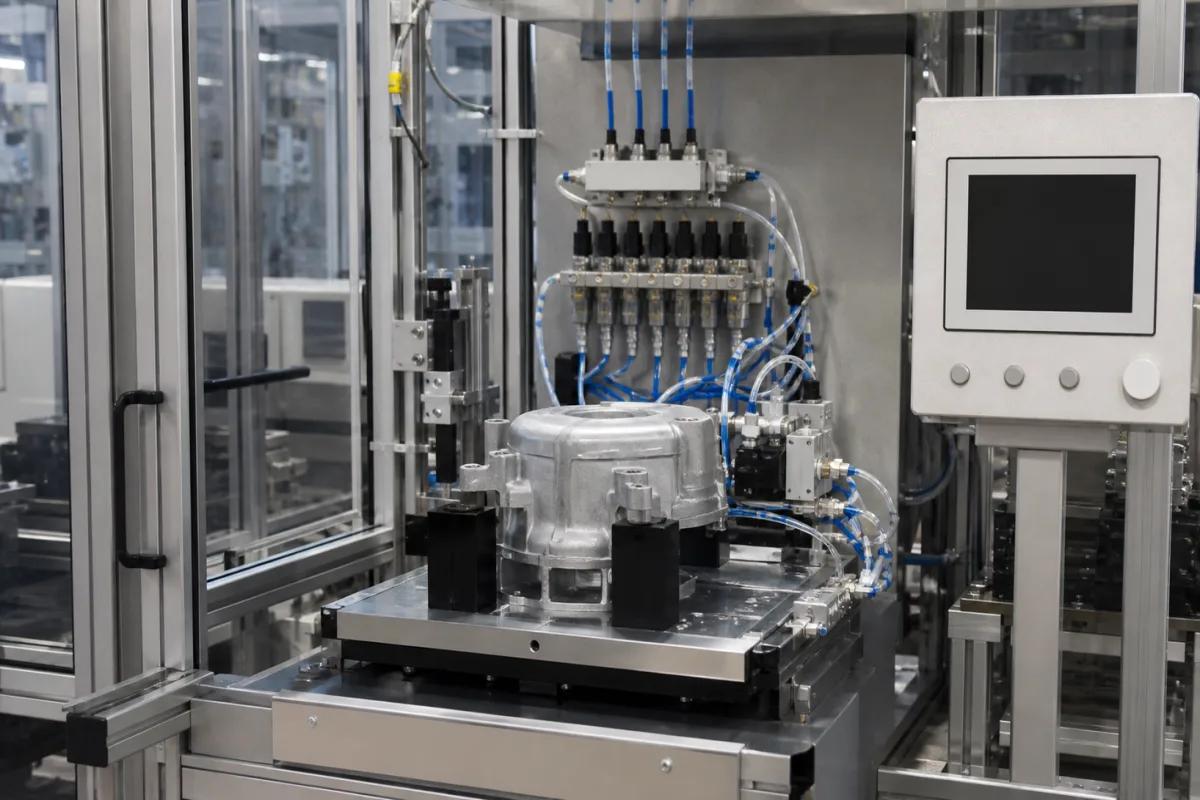
Industrial leak testers and leak test stations · Pressure decay and differential pressure decay instruments, from vacuum to 20 bar, resolving pressure drops down to 0.01 Pa, built into fixtures that seal and test housings, castings and assemblies on the line
A leak testing module checks that a manufactured part or assembly — a casting, housing, tank, valve or appliance — is tight before it leaves the line. It seals the part in a fixture, pressurises or evacuates it with air, and measures the pressure change or flow that a leak causes against a reject limit. Ask three things first: what leak rate is acceptable at what test pressure, how the part will be sealed and connected in the fixture, and how fast and how automated the test must be.
Air leak test instruments and leak test stations for manufactured parts and assemblies: pressure decay, differential pressure decay, vacuum decay and flow testers with their fixtures, seals, valves and automation. Food package integrity testers (see automated food packaging integrity tester), water-leak detection sensors for buildings (see leak sensor), tracer-gas and helium leak detectors and gas detection systems are outside this page except where compared.
CNFX editorial research · Sources checked October 12, 2026 · 4 sources
Choose the test method, pressure and measuring range
ATEQ describes differential pressure decay as using a reference volume alongside the part: both are filled to the same pressure and a differential sensor measures the pressure difference between them, so ambient pressure or temperature changes act on both and only a leak in the test part moves the transducer membrane; it says accuracy does not fall with test pressure because the sensor measures the difference between the two circuits rather than a drop against atmosphere, and that a desensitized mode measures large leaks beyond the differential sensor's full scale. [1]
The F28+ measures from vacuum to 20 bar and reports ΔP in Pa or 1/10 Pa, ΔP/t in Pa/s, or flow in sccm, mm³/s, cm³/s, cm³/min or cm³/h, with blockage, burst and sealed-component tests; its pressure-drop ranges are 0–50 Pa (± 1.5 % of reading + 0.5 Pa, resolution 0.01 Pa, maximum test pressure 3 bar), 0–500 Pa (± 1.0 % + 1 Pa, 0.1 Pa) and 0–5,000 Pa (± 1.0 % + 10 Pa, 1 Pa), where accuracy combines linearity, repeatability and hysteresis. [1] The F28 LP is a pressure- or vacuum-decay instrument from vacuum to 20 bar with full-scale ranges from 500 Pa to 100 kPa and Pa, Pa/s and sccm units. [2]
Editorial calculation: at 100 Pa the 0–500 Pa range's accuracy is ± (1 Pa + 1 Pa) = ± 2 Pa; 20 bar is 2 MPa. [1]
ASTM E2930 (Standard Practice for Pressure Decay Leak Rate Test Method; the store page lists E2930-13(2021), with E2930-26 shown as active) describes determining the leakage rate of a vessel under positive pressure difference from the change of mass inside it, using the ideal gas equation of state with measured pressures, temperatures and time. The practice does not apply to deformable vessels. [3]
Editorial calculation: on an ideal-gas, constant-temperature basis, a 1 L test volume losing 10 Pa in 10 s leaks about 0.001 m³ × 10 Pa ÷ (101,325 Pa × 10 s) ≈ 0.59 standard cm³/min. A temperature change during the test shifts pressure as well, which is why the method measures temperature; and a part that flexes under pressure changes its own volume, which is why deformable vessels fall outside the practice. Ask the supplier for the leak rate its test detects on your part's volume, not only the pressure resolution. [3]
A second maker's instrument shows how the order is split by pressure band. Cincinnati Test Systems lists its wall-mount Sentinel C28WE for pressure decay, vacuum decay and occlusion testing over −14.5 to 200 psig, quoted in vacuum or in 0.2–2, 1–30, 1–100 and 2–200 psig ranges, with reject limits set in scc/min, scc/s or pressure drop per time, and tests based on pressure change, pressure change per time or a certified mass-flow leak standard. [4] Editorial calculation: 200 psig is about 13.8 bar gauge, below the F28+'s 20 bar, so the top test pressure narrows the instrument choice before resolution does. [4][1]
Give the supplier the part drawing and internal volume, material and temperature at test, test pressure or vacuum, acceptable leak rate and units, cycle time target, sealing points and connection, number of stations, automation (PLC, fieldbus, part tracking), air quality available, and the calibration or master-leak procedure required.
02
Plan the fixture, air supply and automation
The F28+ is built for manual, semi-automatic and fully automated testing with integrated electronics and pneumatics, 128 programs, barcode, RS232 and USB communication, data storage, 9 inputs and 5 outputs, optional fieldbuses (Profibus, DeviceNet, Profinet, EtherNet/IP, EtherCAT, Modbus RTU) and electronic regulation; it weighs about 3.5 kg, runs on 24 V DC (1.6 A) or 100–240 V AC, needs clean, dry air to ISO 8573-1 with an external regulator for the test pressure, and operates at +5 to +45 °C. [1]
The F28 LP is 141.5 × 225 × 97 mm, is small enough to mount near the test part for the best measurement conditions, fits a DIN rail, integrates fill and dump valves, and links up to 50 modules on Ethernet (Modbus IP). [2]
Cincinnati Test Systems lists 32 stored test sequences selectable from the keypad or by binary inputs, 6 inputs and 3 outputs with one programmable tooling motion, EtherNet/IP communication and fixed Fail/Pass/Fail evaluation, and states that its standard instruments are CE certified with a two-year limited warranty and two weeks' normal delivery plus shipping time. [4]
03
Find leak tester manufacturers
The companies in the manufacturer list below show this product on their own websites. Confirm the legal seller, factory and scope for your order.
Ask any supplier for test methods offered, pressure and vacuum ranges, measuring ranges with accuracy and resolution, cycle time on your part, fixture and seal design, calibration with master leaks, air quality needed, interfaces and data recording, and a test on sample parts with known leaks.
04
Trace what each part does
This is a functional reference built from the sources cited; it is not one maker's specification.
Fill the specification fields with values for your order
A leak tester quotation needs values for your part and line. The table explains each field, gives published values where a reviewed source states them, and says what to obtain from the supplier.
Field
What it means and published values
Ask the supplier for
Test Pressure Range (MPa)
e.g. vacuum to 20 bar (2 MPa). [1] −14.5 to 200 psig in four quoted bands on another instrument. [4]
Explore company information and manufacturing capabilities, then discuss the scope of your project with a relevant supplier.
Share this page
Compiled and source-reviewed by the CNFX editorial team.
Published product pages show what a company offers, not tested performance. Confirm the legal seller, factory and scope for your order. How we source and review
· Page last updated 13 October 2026
Buyer questions
Why use differential pressure decay?
ATEQ says the reference volume cancels ambient changes so only a leak in the part moves the sensor. [1]
How small a pressure drop can a leak tester read?
ATEQ's F28+ resolves 0.01 Pa on its 0–50 Pa range at up to 3 bar test pressure. [1]
What air does a leak tester need?
Clean, dry air to ISO 8573-1, with an external regulator for the test pressure. [1]
How is a pressure drop converted to a leak rate?
ASTM E2930 uses the ideal gas equation with measured pressures, temperatures and time; for example a 10 Pa drop in 10 s on 1 L is about 0.59 standard cm³/min (editorial calculation). [3]
Sources and what still needs a direct check
Sources checked 2026-10-12. ATEQ and Cincinnati Test Systems make industrial leak testers and publish the instrument figures cited; ASTM E2930's scope covers the pressure decay calculation.