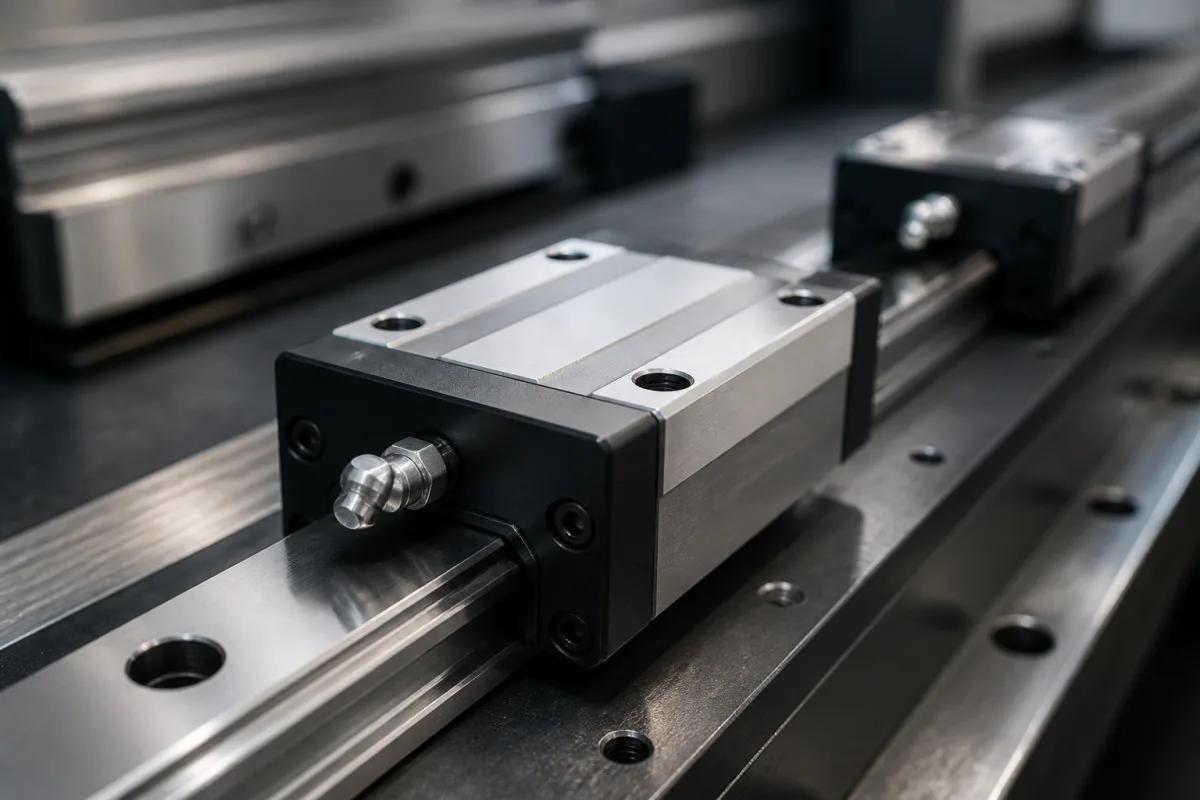
Linear guideway carriage block ordered separately for an existing profile rail
Ball carriage blocks ordered on their own · flange or square body, standard or long, interchangeable codes, seal and scraper sets, clearance by preload class
A carriage block is the part of a profile rail guide that runs on the rail: a steel body with ball circuits, plastic end caps, seals and a grease fitting. Blocks are bought on their own when a machine needs a replacement after wear or damage, an extra block for more load, or a different body shape. The questions are which body fits the table bolts and height, whether the maker sells that block as interchangeable with your rail, which preload and seal set to order, and how to get the block onto the rail without losing balls.
Ball-type carriage blocks (runner blocks) for profile rail linear guides, specified and ordered as separate parts to fit a rail of the same series and size: body shapes and lengths, interchangeable ordering codes, preload and clearance, seals, scrapers and end caps, and handling. Rail-and-block guide selection by load rating, life and raceway hardness is covered on the Precision linear guide rail page; guideways installed with ball screws on one axis on the Linear guideways and ball screws page; long butt-jointed rails on the Linear guideways for long axes page; roller-type runner blocks on the Linear guide system with rollers page; complete rail-and-slide guidance for a carriage table on the Linear motion system page. Polymer slide carriages and round-shaft linear bearings are outside this page.
CNFX editorial research · Sources checked October 12, 2026 · 3 sources
Flange or square body, in 81, 92 and 110 mm lengths (TBI TRH25)
TBI's size 25 TRH data sheet shows how one rail takes six block bodies. F blocks have a wide flange (70 mm) and stand 36 mm high on the rail; V blocks are square, 48 mm wide and 40 mm high. Each comes in N, L and E lengths, and the load rating rises with length, not with body shape. [1]
TBI states that the ratings are calculated to ISO 14728 on a 100 km rated life, that the dynamic rating should be multiplied by 1.26 when the 50 km standard is applied, and that all standard blocks come with a bottom seal and double-lip end seals. [1]
PMI uses the same split in its MSA series: the A type is a flange block fastened from above, the E type a flange block that can also be bolted from below where the table cannot take through-holes, the S type a narrower square block fastened from above, and LA, LE and LS long versions with more load-carrying balls on the same cross-section. [3]
Editorial calculation: going from the 81 mm to the 110 mm block adds 29 mm of length and raises C from 25.3 to 31.9 kN, about 26% more; the square VE weighs 1.7 lb, about 0.77 kg. A replacement block must match the height H as well, since a square block stands 4 mm higher than a flange block on this rail. [1]
Before ordering, read the series and size from the old block or rail marking, and measure body width, height from the rail base, length over end seals and the top hole pattern. A block from another series or maker can share the rail size but not the raceway profile or height.
02
Ordering a single block for a rail already in the machine: interchangeable codes and preload
PMI writes interchangeable blocks and rails as separate part numbers: a block code such as MSA 25 A SS FC N (series, size, body, seal set, preload, accuracy) and a rail code of its own, while matched sets carry one combined code. Interchangeable MSA blocks come in accuracy classes N, H and P only; the SP and UP classes are reserved for matched sets. PMI defines this interchangeability as swapping blocks on one rail only; it does not cover mixing blocks and rails between rails. [3]
TBI explains that preload is produced by fitting larger balls in the same raceway, which removes clearance and adds stiffness but acts as a load that shortens life and raises the force needed to move the block. Its combination table offers Z1 in every precision class, including interchangeable H and N blocks. It suggests ZF to Z0 where load direction is fixed and two parallel axes are fitted, and Z1 for offset loads, moment loads and single-rail layouts. [2]
PMI gives FC light preload as 0 to 0.02 C and F0 medium preload as 0.03 to 0.05 C for the MSA series; its interchangeable block code lists FC, F0 and F1 heavy preload, with F1 not offered on MSA15. [3] Editorial calculation: on a TRH25 block with C = 25.3 kN, Z1 preload is about 0.02 × 25.3 = 0.5 kN of internal load. [2][1]
Seal codes from UU to HD, metal scrapers and the 80 °C limit on end caps
The seal set is chosen when the block is ordered, and its code is part of the block number. PMI's codes for MSA and MSB blocks:
PMI's standard seal material is NBR; FKM and HNBR seals are made to order and not stocked. Metal scrapers keep hot chips and welding spatter off the rubber end seals, and the inner seal stops dirt entering through the bolt holes. PMI ran an MSA25SHD block for 150 km at 1.7 m/min with circulating wood chips and reports that it still ran smoothly with smooth ball surfaces, and lists woodworking as the HD set's application. [3] Editorial calculation: 150 km at 1.7 m/min is about 88,000 minutes, roughly 1,470 hours of travel. [3]
TBI warns that ambient temperature should not exceed 80 °C because the plastic end cap can be damaged, and that above 80 °C seals and recirculation parts must be changed for heat-resistant materials. It gives a friction coefficient of 0.002–0.003 for profile rail guides and notes that scrapers, preload and lubricant viscosity change the running resistance. [2]
Low-resistance end seals; RR adds bottom seals [3]
HD
High-dust end seals with double lips, plus inner (top) and bottom seals [3]
04
Getting a block onto the rail without losing balls
TBI's handling notes warn that tilting a rail can let blocks slide off under their own weight, that a rail which has been knocked or dropped can be damaged even if it looks intact, and that blocks should only be taken off the rail by experienced staff and protected from dirt once removed. [2]
Before use, TBI asks for the anti-corrosion coating to be removed and the guide lubricated, and says lubricants should not be mixed; a replacement block should therefore be greased with the same lubricant already on the rail. [2] PMI's MSA blocks have upper and lower ball retainers in their construction drawing; ask whether the block you are buying is delivered on a plastic assembly rail and whether its retainers hold the balls if it is slid off. [3]
Send the old block's full marking (or a photo of it), the rail size and series, body type, length, seal code, preload, accuracy class and the lubricant already on the rail.
05
Data to send with a carriage block enquiry
Paste it into your enquiry below or into an email to a maker, then replace every bracket.
Explore company information and manufacturing capabilities, then discuss the scope of your project with a relevant supplier.
Share this page
Compiled and source-reviewed by the CNFX editorial team.
Each manufacturer above links to the page on that company's own website where the product is listed, with the date we checked it. How we source and review
· Page last updated 13 October 2026
Buyer questions
Can I fit a single new carriage block to my existing rail?
Only if the maker sells that series as interchangeable. PMI codes interchangeable blocks separately (for example MSA 25 A SS FC N) in N, H and P classes, and defines interchangeability as block swaps on a single rail. [3]
What is the difference between flange and square blocks?
On TBI's size 25 TRH guide, flange blocks are 70 mm wide and 36 mm high with M8 top threads; square blocks are 48 mm wide and 40 mm high with M6 threads. Load ratings depend on block length, 25.3 to 31.9 kN dynamic. [1]
How much clearance does each preload class leave?
TBI gives TR25 radial clearance of 7 to 16 µm for ZF, −6 to 6 µm for Z0 and −16 to −7 µm for Z1, with preload forces of 0, 0 and 0.02 C. [2]
Which seal set suits dusty work?
PMI offers double end seals with bottom seals (DD), DD with metal scrapers (KK), and an HD high-dust set tested for 150 km in circulating wood chips. [3]
Sources and what still needs a direct check
Sources checked 2026-10-12. TBI Motion and PMI are Taiwanese makers of profile rail guides. The TRH25 sheet is TBI data distributed by Anaheim Automation; the technical notes are a German-language section of TBI's catalogue. PMI's catalogue is in traditional Chinese.