Industry-Verified Manufacturing Data (2026)

Moving Bridge Structure

Based on aggregated insights from multiple verified factory profiles within the CNFX directory, the standard Moving Bridge Structure used in the Machinery and Equipment Manufacturing sector typically supports operational capacities ranging from standard industrial configurations to heavy-duty production requirements.

Technical Definition & Core Assembly

A canonical Moving Bridge Structure is characterized by the integration of Bridge Beam and Carriage/End Supports. In industrial production environments, manufacturers listed on CNFX commonly emphasize Aluminum alloy (e.g., 6061-T6) construction to support stable, high-cycle operation across diverse manufacturing scenarios.

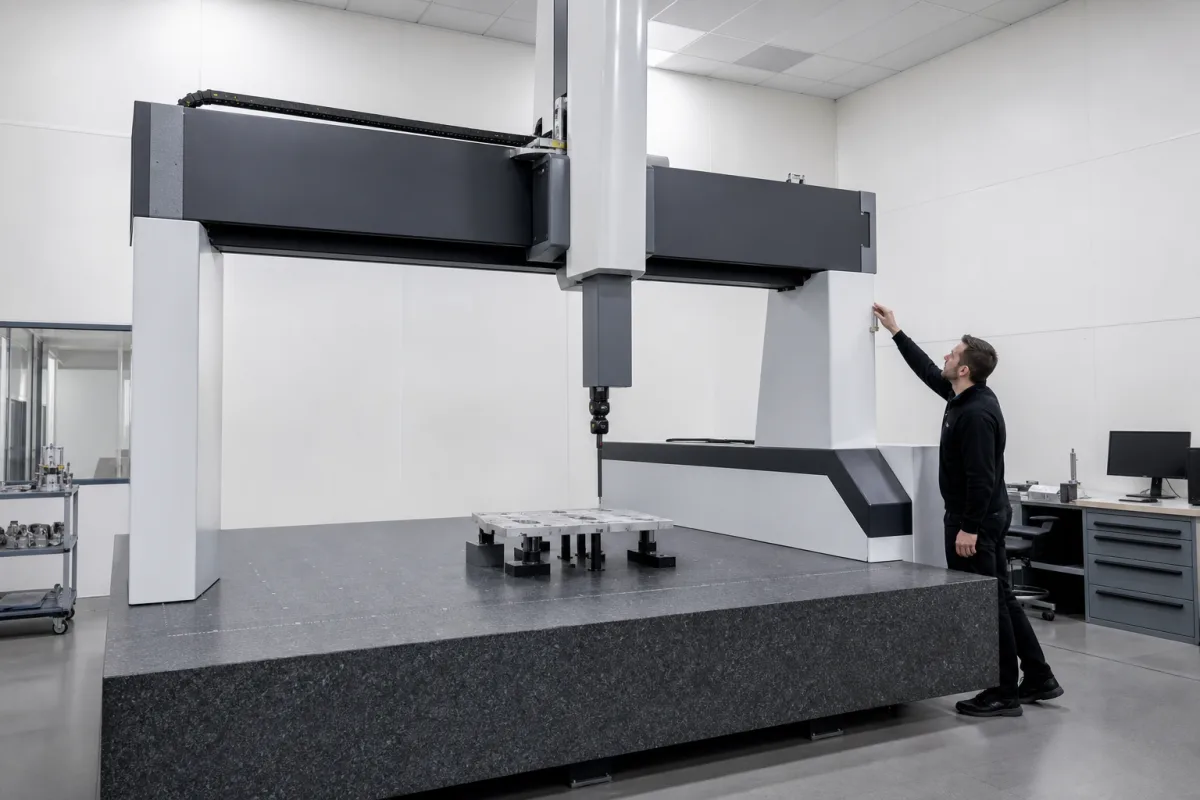
The structural framework that supports and enables precise movement of the measuring probe along the X-axis in a coordinate measuring machine.
Product Specifications

Technical details and manufacturing context for Moving Bridge Structure

Definition
The moving bridge structure is a critical component of automated coordinate measuring machine (CMM) systems, serving as the primary structural element that carries the Z-axis ram and probe assembly. It moves with high precision along the machine's granite base (X-axis guideways), providing the necessary rigidity and stability to maintain measurement accuracy while traversing the measurement volume. Its design minimizes deflection and vibration to ensure repeatable positioning of the measuring probe.
Working Principle
The structure is mounted on precision air bearings or mechanical bearings that ride along hardened and ground guideways on the machine base. A servo motor drives the bridge via a precision ballscrew or linear motor system. Position feedback from linear encoders ensures accurate movement to programmed coordinates, allowing the probe to access any point within the machine's X-axis travel range.
Common Materials
Aluminum alloy (e.g., 6061-T6), Granite composite, Precision steel components
Technical Parameters
  • X-axis travel length, defining the maximum measurable part size in the X-direction (mm) Per Request
Components / BOM
  • Bridge Beam
    Main horizontal structural member that spans the machine base and carries the Z-axis
    Material: Aluminum alloy or granite composite
  • Carriage/End Supports
    Vertical structures at each end of the bridge beam that house the bearing systems and connect to drive mechanisms
    Material: Aluminum alloy or cast iron
  • Bearing System
    Precision air bearings or linear roller bearings that enable smooth, frictionless movement along guideways
    Material: Ceramic, steel, or composite materials
  • Drive Connection
    Interface point for the ballscrew nut or linear motor primary that transmits motion from the drive system
    Material: Steel
Engineering Reasoning
0.1-1.5 m/s linear velocity, 0.5-2.0 kN axial load capacity, ±0.5 μm positioning accuracy
Structural deflection exceeding 2.5 μm/m under 2.5 kN load, bearing temperature exceeding 80°C, vibration amplitude surpassing 15 μm RMS at 100 Hz
Design Rationale: Thermal expansion mismatch between aluminum alloy bridge (α=23.1×10⁻⁶/K) and steel guideways (α=11.7×10⁻⁶/K) causing binding at ΔT>15°C, Hertzian contact stress exceeding 1.2 GPa in linear bearings leading to Brinell deformation
Risk Mitigation (FMEA)
Trigger Inadequate preload adjustment in recirculating ball bearings causing 0.05 mm axial play
Mode: Positional hysteresis error of 3.2 μm during bidirectional X-axis travel
Strategy: Integrate piezoelectric preload compensation system maintaining 150 N constant bearing preload via closed-loop control
Trigger Resonant excitation at 85 Hz matching bridge natural frequency from servo motor cogging torque harmonics
Mode: Accelerated wear of linear encoder scale with position error exceeding 8 μm peak-to-peak
Strategy: Implement active vibration damping using magnetorheological fluid mounts with 40 ms response time and 90% vibration attenuation at 70-100 Hz

Industry Taxonomies & Aliases

Commonly used trade names and technical identifiers for Moving Bridge Structure.

Industrial Ecosystem & Supply Chain DNA

Complementary Systems
Downstream Applications
Specialized Tooling

Application Fit & Sizing Matrix

Operational Limits
pressure: Atmospheric (non-pressure application)
other spec: Max bridge travel: 500-2000mm, Positioning accuracy: ±0.5-2μm, Max load capacity: 50-200kg
temperature: 15-25°C (operating), 10-35°C (storage)
Media Compatibility
✓ Clean room air environments ✓ Non-corrosive industrial atmospheres ✓ Temperature-controlled manufacturing facilities
Unsuitable: High-vibration environments or areas with particulate contamination
Sizing Data Required
  • Required X-axis travel distance
  • Maximum probe/stylus load weight
  • Required positioning accuracy and repeatability specifications

Reliability & Engineering Risk Analysis

Failure Mode & Root Cause
Structural fatigue cracking
Cause: Cyclic loading from vehicle traffic, wind forces, and thermal expansion/contraction leading to stress concentration at welded joints and connection points
Bearing seizure or excessive wear
Cause: Inadequate lubrication, contamination from environmental debris, misalignment from foundation settlement, or corrosion from moisture ingress at pivot points
Maintenance Indicators
  • Audible grinding, popping, or cracking sounds during bridge movement operations
  • Visible excessive vibration or irregular movement patterns during opening/closing cycles
Engineering Tips
  • Implement regular non-destructive testing (ultrasonic, magnetic particle) at high-stress areas to detect subsurface cracks before catastrophic failure
  • Establish automated lubrication systems with moisture-resistant grease for bearings and install protective covers/seals at pivot points to prevent contamination

Compliance & Manufacturing Standards

Reference Standards
ISO 8686-1:2012 Cranes - Design principles for loads and load combinations ANSI/AISC 360-16 Specification for Structural Steel Buildings DIN 18800-1:2008--11 Steel structures - Part 1: Design and construction
Manufacturing Precision
  • Span length tolerance: +/-10mm per 10m span
  • Vertical alignment of rail tracks: +/-2mm over 10m length
Quality Inspection
  • Non-Destructive Testing (NDT) - Ultrasonic Testing for weld integrity
  • Load Testing - Dynamic and static load tests to verify structural performance

Factories Producing Moving Bridge Structure

Verified manufacturers with capability to produce this product in China

✓ 98% Supplier Capability Match Found

P Project Engineer from Singapore Jan 01, 2026
★★★★★
"Standard OEM quality for Machinery and Equipment Manufacturing applications. The Moving Bridge Structure arrived with full certification."
Technical Specifications Verified
S Sourcing Manager from Germany Dec 29, 2025
★★★★★
"Great transparency on the Moving Bridge Structure components. Essential for our Machinery and Equipment Manufacturing supply chain."
Technical Specifications Verified
P Procurement Specialist from Brazil Dec 26, 2025
★★★★★
"The Moving Bridge Structure we sourced perfectly fits our Machinery and Equipment Manufacturing production line requirements."
Technical Specifications Verified
Verification Protocol

“Feedback is collected from verified sourcing managers during RFQ (Request for Quote) and factory evaluation processes on CNFX. These reports represent historical performance data and technical audit summaries from our B2B manufacturing network.”

12 sourcing managers are analyzing this specification now. Last inquiry for Moving Bridge Structure from Thailand (13m ago).

Supply Chain Compatible Machinery & Devices

Automated Assembly Line System

Integrated production system for sequential component assembly operations

Explore Specs →
Automated Powder Coating System

Integrated industrial system for applying dry powder coatings to metal substrates.

Explore Specs →
Centrifugal Pump Impeller

Rotating component that transfers energy to fluid in centrifugal pumps.

Explore Specs →
High-Precision CNC Laser Cutting Machine

Computer-controlled industrial machine using focused laser beams to cut sheet metal with micron-level accuracy.

Explore Specs →

Frequently Asked Questions

What materials are used in the moving bridge structure for durability and precision?

The structure uses aluminum alloy (6061-T6) for lightweight rigidity, granite composite for thermal stability, and precision steel components for wear resistance and accuracy.

How does the moving bridge structure ensure precise X-axis movement in CMMs?

It incorporates a precision bearing system, rigid bridge beam, and optimized carriage/support design to minimize deflection and vibration while maintaining smooth, accurate probe positioning.

What maintenance does the CMM moving bridge structure require?

Regular lubrication of bearing systems, inspection of drive connections, and cleaning of guide surfaces to prevent contamination and ensure long-term accuracy and reliability.

Can I contact factories directly on CNFX?

CNFX is an open directory, not a transaction platform. Each factory profile provides direct contact information and production details to help you initiate direct inquiries with Chinese suppliers.

Get Quote for Moving Bridge Structure

Request technical pricing, lead times, or customized specifications for Moving Bridge Structure directly from verified manufacturing units.

Your business information is encrypted and only shared with verified Moving Bridge Structure suppliers.

Thank you! Your message has been sent. We'll respond within 1–3 business days.

Need to Manufacture Moving Bridge Structure?

Connect with verified factories specializing in this product category

Add Your Factory Contact Us
Previous Product
Mover/Forcer
Next Product
Moving Carriage/Platform