Industry-Verified Manufacturing Data (2026)

Bearing System

Based on aggregated insights from multiple verified factory profiles within the CNFX directory, the standard Bearing System used in the Machinery and Equipment Manufacturing sector typically supports operational capacities ranging from standard industrial configurations to heavy-duty production requirements.

Technical Definition & Core Assembly

A canonical Bearing System is characterized by the integration of Inner Race and Outer Race. In industrial production environments, manufacturers listed on CNFX commonly emphasize High-carbon chromium steel construction to support stable, high-cycle operation across diverse manufacturing scenarios.

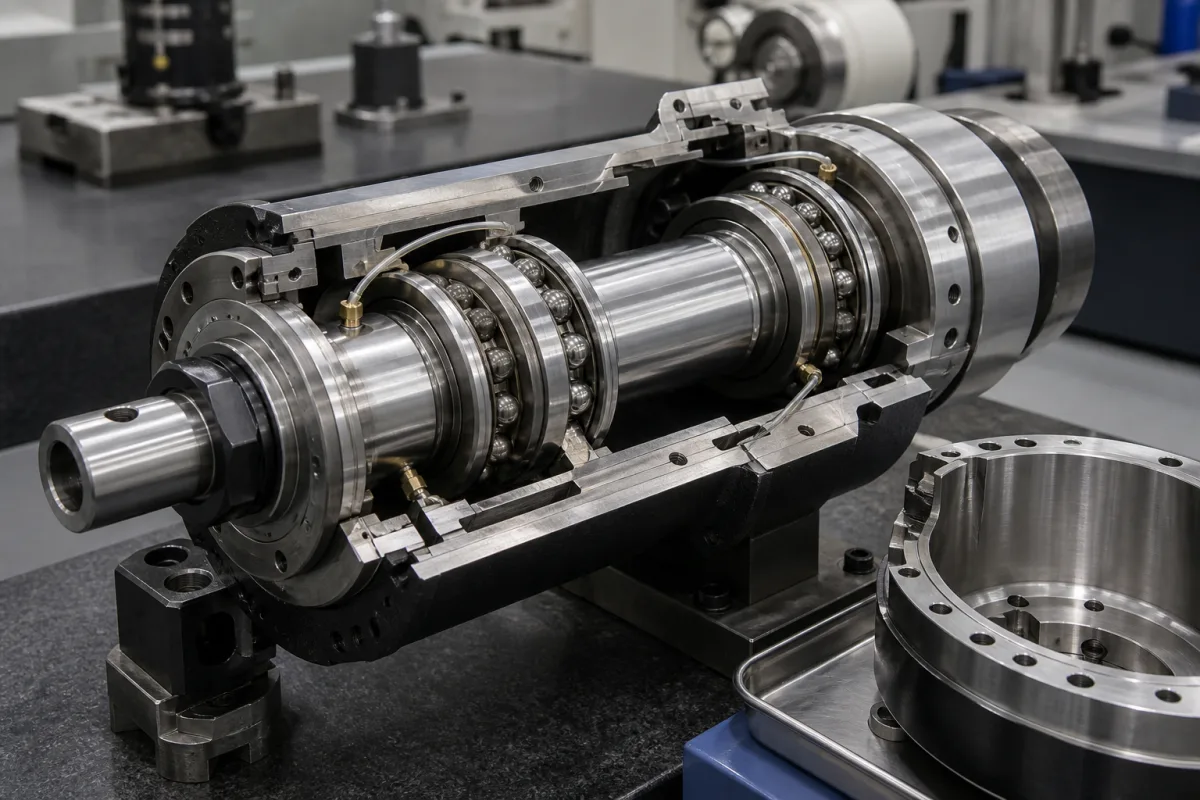
A mechanical assembly that supports and facilitates rotational or linear motion between moving parts while reducing friction and wear.
Product Specifications

Technical details and manufacturing context for Bearing System

Definition
Within a Moving Bridge Structure, the bearing system is a critical component that supports the bridge's movable sections, allowing them to rotate, lift, or translate smoothly during opening and closing operations. It manages loads (vertical, horizontal, and rotational) from the bridge deck and machinery, ensuring structural stability and precise movement alignment.
Working Principle
The bearing system operates by using rolling elements (e.g., balls, rollers) or sliding surfaces to separate moving parts, minimizing direct metal-to-metal contact. This reduces friction, distributes loads evenly, and accommodates thermal expansion and structural deflections. In a moving bridge, it typically interfaces between the fixed pier and the movable span, enabling controlled motion driven by mechanical actuators.
Common Materials
High-carbon chromium steel, Stainless steel, Bronze alloys, Polymer composites
Technical Parameters
  • Bore diameter, outer diameter, and width/thickness dimensions critical for fit and load capacity. (mm) Standard Spec
Components / BOM
  • Inner Race
    Attaches to the rotating shaft or movable bridge component, providing a smooth surface for rolling elements.
    Material: High-carbon chromium steel
  • Outer Race
    Fixed to the stationary structure (e.g., bridge pier), forming the outer track for rolling elements.
    Material: High-carbon chromium steel
  • Rolling Elements
    Balls or rollers that reduce friction by rolling between the inner and outer races.
    Material: Hardened steel or ceramic
  • Cage/Retainer
    Separates and guides rolling elements, preventing contact and ensuring even distribution.
    Material: Steel, brass, or polymer
  • Seals
    Protect internal components from contaminants (e.g., dust, water) and retain lubrication.
    Material: Rubber or synthetic elastomers
Engineering Reasoning
0-15000 rpm rotational speed, -40°C to 150°C temperature, 0-100 kN axial load
Contact stress exceeds 4.2 GPa (Hertzian contact theory), lubricant film thickness <0.1 μm (λ ratio <1), temperature >180°C (lubricant breakdown)
Design Rationale: Fatigue spalling due to subsurface shear stress exceeding material endurance limit (σ_max > 0.55×UTS), adhesive wear from boundary lubrication failure (Stribeck curve transition), thermal degradation of lubricant base oil at Arrhenius rate (k = A·e^(-Ea/RT))
Risk Mitigation (FMEA)
Trigger Contaminant ingress (ISO 4406 particle count >18/15/12)
Mode: Three-body abrasive wear causing surface pitting and increased vibration (RMS velocity >4.5 mm/s)
Strategy: Labyrinth seals with 0.05 mm radial clearance, magnetic particle detection system with 50 μm sensitivity
Trigger Lubricant starvation (oil film thickness <0.5 μm at 1000 rpm)
Mode: Mixed lubrication regime transition leading to scuffing (friction coefficient >0.15)
Strategy: Forced lubrication system with 0.3 MPa minimum pressure, temperature-compensated viscosity index >95

Industry Taxonomies & Aliases

Commonly used trade names and technical identifiers for Bearing System.

Applied To / Applications

This component is essential for the following industrial systems and equipment:

Industrial Ecosystem & Supply Chain DNA

Complementary Systems
Downstream Applications
Specialized Tooling

Application Fit & Sizing Matrix

Operational Limits
pressure: Up to 100 MPa static, 50 MPa dynamic
other spec: Maximum rotational speed: 20,000 RPM (depending on size and lubrication)
temperature: -40°C to +150°C (standard), up to +250°C with special materials
Media Compatibility
✓ Lubricated steel-on-steel applications ✓ Clean hydraulic oil systems ✓ Dry polymer-on-polymer low-load applications
Unsuitable: High-concentration abrasive slurry environments without protective seals
Sizing Data Required
  • Radial load capacity (N)
  • Axial load capacity (N)
  • Required rotational speed (RPM)

Reliability & Engineering Risk Analysis

Failure Mode & Root Cause
Fatigue spalling
Cause: Cyclic loading exceeding material endurance limit, leading to subsurface crack initiation and propagation to surface, often due to improper installation, misalignment, or overloading.
Lubrication failure
Cause: Insufficient, contaminated, or degraded lubricant causing metal-to-metal contact, resulting in overheating, wear, and eventual seizure; common causes include improper lubricant selection, water ingress, or particle contamination.
Maintenance Indicators
  • Abnormal high-frequency vibration or audible squealing during operation
  • Excessive heat generation detected via infrared thermography or touch, indicating lubrication issues or overload
Engineering Tips
  • Implement precision alignment during installation and periodic laser alignment checks to minimize radial and axial loads from misalignment.
  • Establish a condition-based lubrication program using oil analysis and automated greasing systems to maintain optimal lubricant quality and quantity.

Compliance & Manufacturing Standards

Reference Standards
ISO 492:2014 - Rolling bearings - Radial bearings - Tolerances ANSI/ABMA 20:1996 - Radial Bearings of Ball, Cylindrical Roller and Spherical Roller Types - Metric Design DIN 620:1994 - Rolling bearings - Tolerances
Manufacturing Precision
  • Bore diameter: ±0.0025 mm for precision class P4
  • Radial runout: 0.003 mm for ABEC 7 class
Quality Inspection
  • Vibration analysis for noise and defect detection
  • Coordinate Measuring Machine (CMM) dimensional verification

Factories Producing Bearing System

Verified manufacturers with capability to produce this product in China

✓ 97% Supplier Capability Match Found

P Project Engineer from Canada Feb 22, 2026
★★★★★
"The technical documentation for this Bearing System is very thorough, especially regarding technical reliability."
Technical Specifications Verified
S Sourcing Manager from United States Feb 19, 2026
★★★★★
"Reliable performance in harsh Machinery and Equipment Manufacturing environments. No issues with the Bearing System so far."
Technical Specifications Verified
P Procurement Specialist from United Arab Emirates Feb 16, 2026
★★★★★
"Testing the Bearing System now; the technical reliability results are within 1% of the laboratory datasheet."
Technical Specifications Verified
Verification Protocol

“Feedback is collected from verified sourcing managers during RFQ (Request for Quote) and factory evaluation processes on CNFX. These reports represent historical performance data and technical audit summaries from our B2B manufacturing network.”

17 sourcing managers are analyzing this specification now. Last inquiry for Bearing System from Turkey (1h ago).

Supply Chain Compatible Machinery & Devices

Heavy-Duty CNC Plasma Cutting Machine

Industrial machine for precision metal cutting using plasma arc technology

Explore Specs →
Automated Assembly Line System

Integrated production system for sequential component assembly operations

Explore Specs →
Automated Powder Coating System

Integrated industrial system for applying dry powder coatings to metal substrates.

Explore Specs →
Centrifugal Pump Impeller

Rotating component that transfers energy to fluid in centrifugal pumps.

Explore Specs →

Frequently Asked Questions

What materials are best for bearing systems in high-temperature applications?

For high-temperature applications, stainless steel bearing systems offer excellent heat resistance and corrosion protection, while bronze alloys provide good thermal conductivity and wear resistance under elevated temperatures.

How do bearing system seals affect performance and maintenance?

Seals in bearing systems prevent contamination from dust and debris while retaining lubrication, significantly extending service life and reducing maintenance frequency by protecting rolling elements and raceways.

What factors determine the choice between different rolling element types in bearing systems?

The choice depends on load capacity requirements (balls for lighter loads, rollers for heavier), speed capabilities, precision needs, and space constraints, with each rolling element type offering distinct performance characteristics for specific machinery applications.

Can I contact factories directly on CNFX?

CNFX is an open directory, not a transaction platform. Each factory profile provides direct contact information and production details to help you initiate direct inquiries with Chinese suppliers.

Get Quote for Bearing System

Request technical pricing, lead times, or customized specifications for Bearing System directly from verified manufacturing units.

Your business information is encrypted and only shared with verified Bearing System suppliers.

Thank you! Your message has been sent. We'll respond within 1–3 business days.

Need to Manufacture Bearing System?

Connect with verified factories specializing in this product category

Add Your Factory Contact Us
Previous Product
Bearing Set
Next Product
Bearing/Housing