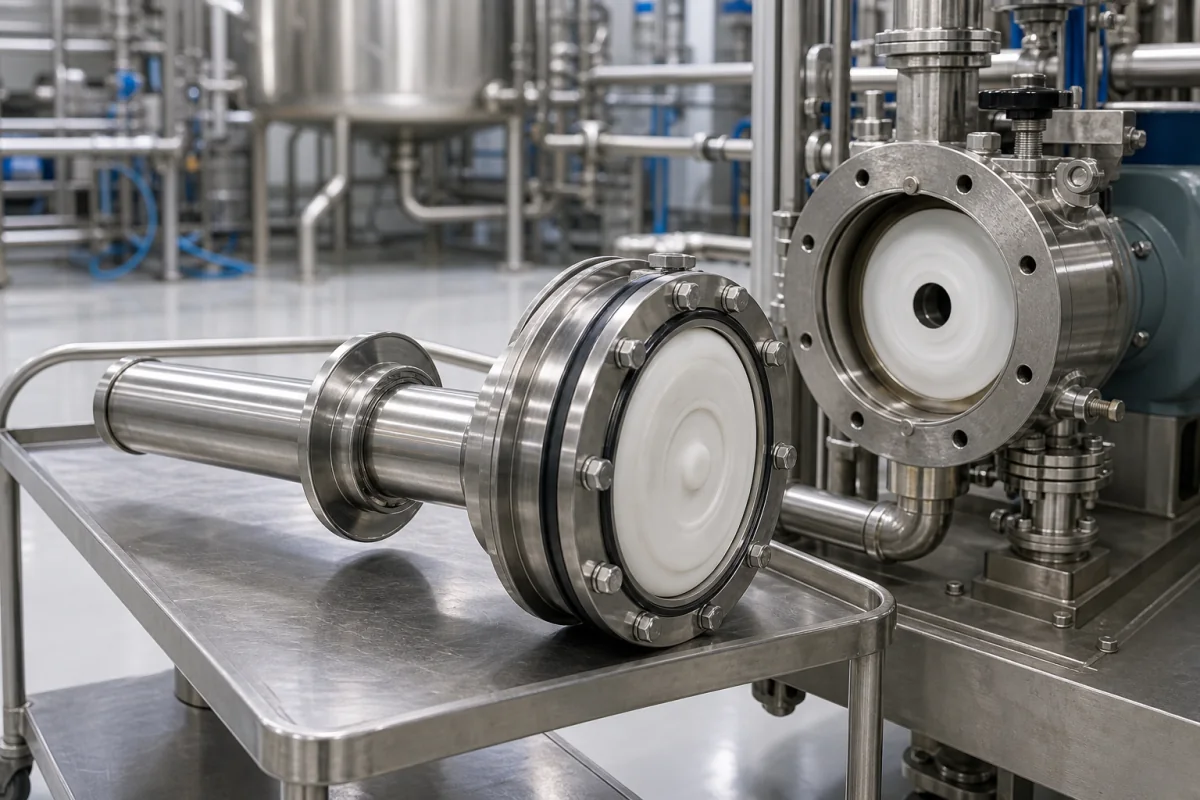
Piston and PTFE diaphragm assembly of a hydraulically actuated metering pump: how the oil chamber sets the stroke, protects the diaphragm and holds ±1 % over a 10:1 turndown
The liquid end of a hydraulically actuated diaphragm metering pump: a reciprocating piston pushes oil, the oil flexes a PTFE diaphragm, and the diaphragm alone touches the chemical being dosed
A diaphragm metering pump with hydraulic actuation has no seal between its moving parts and the chemical it pumps. A piston driven from the gearbox reciprocates in an oil-filled chamber; on each stroke the oil it displaces pushes a diaphragm, flat PTFE in two of the three specifications on this page, which in turn displaces the process liquid through suction and discharge check valves. The oil side carries the relief and air-bleed valves that protect the diaphragm. The piston-diaphragm assembly is the part that has to be specified, inspected and replaced: the diaphragm material and construction, how stroke length is set through the oil, what protects the diaphragm from over- and under-pressure, and how a leak is detected. This page covers that assembly from three makers' published specifications.
Hydraulically actuated diaphragm liquid ends of reciprocating metering pumps: the drive piston or plunger, hydraulic displacement chamber, relief and air-bleed valves, flat PTFE or sandwich diaphragms, double-diaphragm leak detection and the stroke-length control that sets flow. Hygienic diaphragm valves for dairy and process lines are covered on the Sanitary diaphragm valve for dairy processing page, with their diaphragms, actuators and control heads on the Sanitary diaphragm valve core, Pneumatic actuator for sanitary diaphragm valves and Control head pages; hydraulic cylinder pistons and seals on the Piston assembly for hydraulic cylinders page; complete metering pumps, diaphragm pumps and dosing skids on the Metering pump, Diaphragm pump, Chemical dosing pump skid and Reagent feed system (metering pump skid) for continuous chemical reactors pages; pulsation dampeners on their own page.
CNFX editorial research · Sources checked October 13, 2026 · 3 sources
Constant piston stroke, variable oil displacement: how lost-motion control sets flow through the diaphragm
Grundfos's specification for its DMH hydraulic diaphragm metering pumps describes the drive: a worm gear reduces motor speed and turns it into the reciprocating motion of a hollow drive piston, which forms the hydraulic connection between the oil and the diaphragm. [1]
Stroke volume is set by a hydraulic lost-motion system with a constant piston stroke and an adjustable control slide. Oil flows back to the reservoir through radial holes in the hollow piston until the fixed control slider covers them; from that point pressure builds in the piston and displacement chamber and flexes the diaphragm. A hand micrometer adjusts from 0 to 100 % while the pump runs or is stopped, and the specification calls for repeatable metering accuracy of ±1 % of full scale at constant hydraulic conditions and a 10:1 turndown. [1]
Pulsafeeder's Series 680, built to API 675, instead uses a full-motion stroke length mechanism, manual or with an electronic stroke length controller, for 0–100 % flow adjustment. [2]
Published performance
Pulsafeeder Series 680
Grundfos DMH specification
Accuracy
Steady state ±1.0 % of set point; repeatability ±1.0 % of rated capacity [2]
Repeatable ±1 % of full scale at constant hydraulic conditions [1]
Full-motion stroke length, manual or electronic [2]
Lost motion: constant stroke, adjustable control slide; 4–20 mA servo actuator option [1]
Fluid temperature
Up to 121 °C (79 °C with ATEX); minimum −23 °C (−20 °C with ATEX) [2]
—
Viscosity / NPIP
Up to 1,000 cP; NPIP required 5 psi (0.31 bar) [2]
—
Give flow range and turndown needed, discharge and suction pressure, fluid viscosity and temperature, and whether stroke length is set by hand or by a 4–20 mA actuator.
02
Keeping the diaphragm intact: oil-side relief and air bleed, Grundfos's AMS valve and LEWA's spring-held start position
Each maker puts the diaphragm's protection on the oil side. Grundfos requires an internal hydraulic relief valve and an air-bleed valve, both vertically oriented, and an AMS (active membrane system) valve that seats in either direction on discharge overpressure or suction under-pressure, removing the energy that would overstretch the diaphragm. [1]
LEWA states that its DPS technology gives the ecoflow pump head a suction capability down to 0.1 bar absolute, and that with regular maintenance its diaphragm pumps can run 40 years or more. [3] Pulsafeeder describes its diaphragm as hydraulically balanced. [2]
Protection
Published description
Hydraulic relief / bypass
Internal hydraulic relief valve (Grundfos) [1]; internal hydraulic bypass plus an externally adjustable bypass valve against system over-pressurisation (Pulsafeeder) [2]; individually adjustable relief valve in the hydraulic part (LEWA) [3]
AMS valve seats on discharge overpressure or suction under-pressure [1]; DPS diaphragm protection system [3]
Position at standstill
A spring pulls the diaphragm into a safe position whenever the pump is not running [3]
Contour plates
Not permitted on either side of the diaphragm in the Grundfos specification [1]
Oil
A single oil shared by gear and hydraulics; two-oil designs not acceptable (Grundfos) [1]
Ask which valves sit in the oil chamber (relief, air bleed, refill or protection valve), their settings, and what the diaphragm sees at start-up and if the suction line is blocked.
03
The diaphragm itself: flat solid PTFE, PTFE sandwich up to 800 bar, and double diaphragms with leak detection
Grundfos specifies a flat PTFE process diaphragm and rejects PTFE-coated diaphragms, with an optional double-diaphragm configuration whose leak detection is indicated by a pressure switch contact and a pressure gauge; liquid end and check valves are 316 stainless steel with stainless balls and wetted gaskets in PTFE, FKM or EPDM. [1]
Editorial calculation: 800 bar is about 11,600 psi. [3] Editorial note: a single solid diaphragm with no monitoring gives no signal before it fails; Grundfos's double diaphragm with leak detection and LEWA's monitored sandwich diaphragm are the published options that do.
Monitored by a diaphragm monitoring system; high-pressure head geometry allows PTFE diaphragms up to 800 bar
State the fluid and its hazards, the maximum discharge pressure, whether a double or monitored diaphragm is required, and the wetted materials for diaphragm, head, valves and gaskets.
04
What to send for a hydraulic diaphragm metering pump liquid end
Paste it into your enquiry below or into an email to a maker, then replace every bracket.
Fluid: [name; concentration; viscosity; temperature; hazards]
Flow: [maximum and minimum; turndown]
Pressure: [suction; discharge; relief setting]
Diaphragm: [flat PTFE, sandwich or double with leak detection]
Materials: [head; check valves; balls; gaskets]
Control: [manual stroke or 4–20 mA actuator; standard such as API 675]
Explore company information and manufacturing capabilities, then discuss the scope of your project with a relevant supplier.
Share this page
Compiled and source-reviewed by the CNFX editorial team.
Each manufacturer above links to the page on that company's own website where the product is listed, with the date we checked it. How we source and review
· Page last updated 13 October 2026
Buyer questions
How does a hydraulic diaphragm metering pump set its flow?
In Grundfos's DMH design the piston stroke is constant and oil bypasses through radial holes until a control slide covers them, so the slide position sets how much oil flexes the diaphragm. [1]
How accurate is a hydraulic diaphragm metering pump?
Pulsafeeder lists ±1.0 % steady-state accuracy and ±1.0 % linearity over 10:1 for the Series 680; Grundfos specifies ±1 % repeatability at constant hydraulic conditions. [2][1]
How high a pressure can a PTFE diaphragm take?
LEWA states its high-pressure diaphragm clamping geometry allows PTFE sandwich diaphragms up to 800 bar. [3]
Sources and what still needs a direct check
Sources checked 2026-10-13. Three sources: Grundfos's guide specification for DMH hydraulic diaphragm metering pumps, Pulsafeeder's Pulsa Series 680 product specification, and LEWA's ecoflow diaphragm metering pump page.