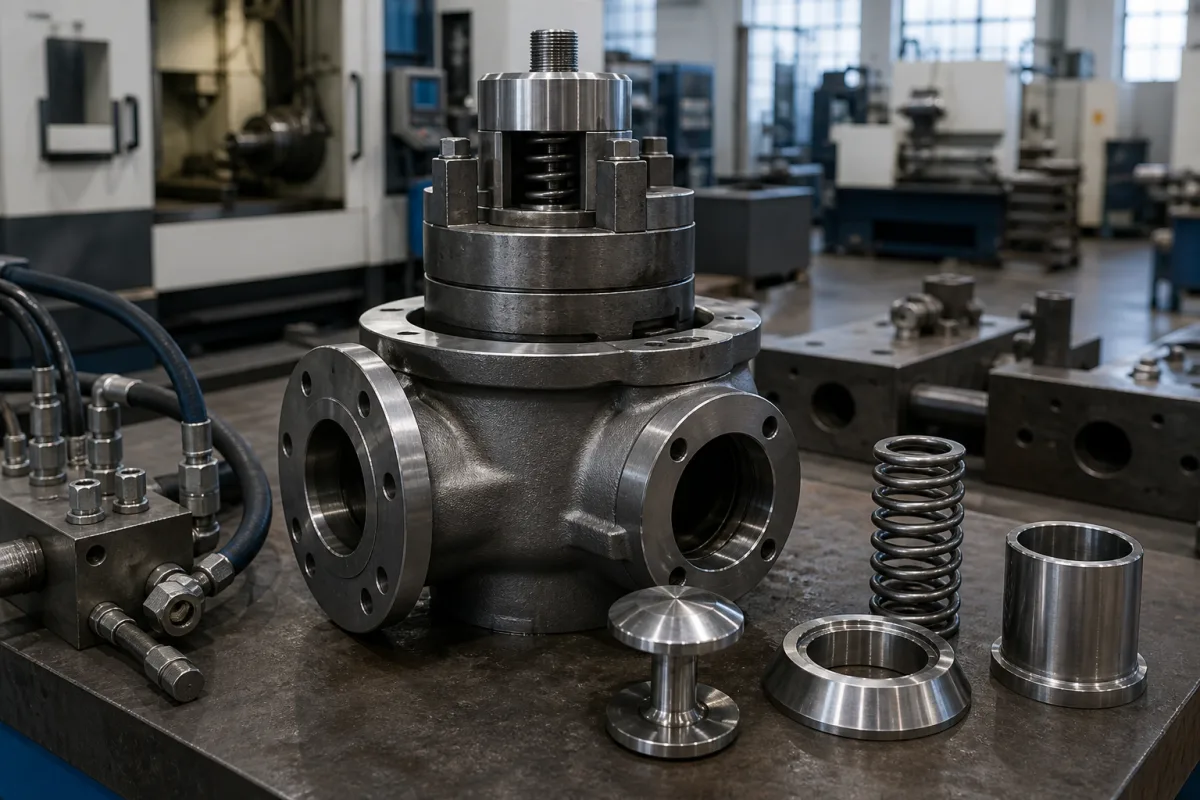
Poppet valve as a 2-way slip-in cartridge (logic element): seat-to-pilot area ratio, cracking pressure and size
Hydraulic slip-in poppet cartridges (logic elements) to ISO 7368 · area ratio between seat and spring chamber, cracking pressure in each flow direction, nominal size from 16 to 100 and a sealed poppet for accumulator and load-holding circuits
A 2-way slip-in cartridge, also called a logic element, is a hardened poppet that closes on a seat in a sleeve, pushed by a spring and by whatever pressure the control cover lets into the chamber behind it. Whether it acts as a check valve, an on-off directional valve or a relief valve depends on its area ratio and on the cover, so those two choices come first, then the spring, the size and the leak-tightness.
Hydraulically piloted 2-way poppet cartridges that slip into an ISO 7368 (DIN 24342) cavity in a manifold block, with their sleeve, poppet, closing spring and control cover, for directional, check and pressure functions. On-off solenoid valves, including solenoid-operated screw-in cartridges, are covered on the Solenoid valve page; fast-switching reject valves on the Control solenoid valve page; and dosing manifolds of two or more solenoid valves on the Solenoid valve manifold assembly for ingredient dosing page; screw-in relief and reducing cartridges on the Hydraulic cartridge pressure control valve page.
CNFX editorial research · Sources checked October 13, 2026 · 3 sources
Seat area A1 against pilot area A3: why a 1:1 poppet relieves pressure and a 1:1.66 poppet switches flow
Three areas decide what the poppet does. Bosch Rexroth defines the seat area A1 as 100 %, the annulus A2 as 0 %, 7 % or 50 % of A1 depending on the version, and A3 on the spring side as A1 + A2; A1 and A2 push the poppet open, while A3 and the spring hold it shut. [1]
Editorial calculation: Duplomatic's size-16 Q cartridge lists A1 = 1.54 cm², A2 = 1 cm² and A3 = 2.54 cm², so its annulus is about 65 % of the seat area, larger than Rexroth's 50 % "A" spool. [2][1] The same maker's P cartridge has A1 = A3 = 2.54 cm² in size 16: the whole pilot face sits over the seat, which is what lets a pilot relief valve in the cover set the opening pressure. [2]
Because the area ratios are written differently (A1 : A2 at Rexroth, A1/A3 at Duplomatic, A:Ap at Atos), convert a quoted ratio to the same pair of areas before comparing two cartridges.
State the function (check, directional, throttle or pressure), the area ratio written as A1 : A3, whether a damping nose is wanted, and the cover type and pilot ports.
02
Cracking pressure from A to B and from B to A on the same spring
The spring is chosen by its cracking pressure on the seat area, but flow from B to A sees only the annulus, so the same spring opens at a much higher pressure in that direction. Atos publishes both figures for its SC LIR cartridges. [3]
All values in the table are from the Atos SC LIR data table. [3] Editorial calculation: with spring 3 the poppet opens A→B at 3 bar over the seat area; B→A, only the annulus pushes, which is 0.5 of A1 on a 1:1.5 poppet (3 ÷ 0.5 = 6 bar, as published) and 0.1 of A1 on a 1:1.1 poppet (3 ÷ 0.1 = 30 bar against 32.5 bar published, the gap coming from the actual areas and spring preload of the part). [3]
Duplomatic's Q cartridges with a 1:1.66 ratio show a smaller spread: the 2 bar spring opens at 2 bar A→B and 3–3.2 bar B→A across sizes 16 to 63, and the 4 bar spring at 4 bar A→B and 5.4–6.15 bar B→A. [2] Rexroth offers springs of approximately 2 and 4 bar, with 4 bar marked as preferred. [1]
Spring
A→B, 1:1.1 poppet
B→A, 1:1.1 poppet
A→B, 1:1.5 poppet
B→A, 1:1.5 poppet
1
0.3 bar
3 bar
0.6 bar
1.2 bar
2
1.5 bar
12.8 bar
–
–
3
3 bar
32.5 bar
3 bar
6 bar
6
5.5 bar
54.5 bar
5.5 bar
11 bar
Give the pressure available to open the poppet in each flow direction and the back pressure on the spring chamber; a 1:1.1 poppet is a poor choice where B→A flow must open at a few bar.
03
Nominal size, cavity bore and flow from size 16 to size 100
The nominal size fixes the ISO 7368 cavity and the flow. Duplomatic's dimension table gives the sleeve bore ØD1 (H7) of the cavity as 32, 45, 60, 75, 90 and 120 mm for sizes 16, 25, 32, 40, 50 and 63, with cartridge masses from 0.25 kg to 7.8 kg. [2]
Sources for the table: Duplomatic LC data sheet [2]; Atos table TH030 [3]. The two columns are not measured the same way: Duplomatic gives a recommended maximum, Atos a flow at a stated 5 bar pressure drop with ISO VG 46 oil at 50 °C. A damping nose costs flow: Atos lists 240 against 270 l/min in size 16 and 6300 against 9000 l/min in size 100; Duplomatic 200 against 250 l/min in size 16. [3][2]
On pressure, Duplomatic rates its LC cartridges to 420 bar and its DP/DF/LCM covers to 350 bar, Atos rates SC LIR to 420 bar, while Rexroth's high-pressure LCT series goes to 1000 bar (700 bar for the DB pressure version) and up to 3500 l/min depending on size. [2][3][1]
Size
Duplomatic Q, no damping nose: max recommended flow
Atos SC LIR poppet 32/33: nominal flow at Δp 5 bar
16
250 l/min
270 l/min
25
500 l/min
550 l/min
32
900 l/min
1000 l/min
40
1300 l/min
1700 l/min
50
2000 l/min
2500 l/min
63
3000 l/min
4000 l/min
80
not offered
5500 l/min
100
not offered
9000 l/min
State the size or the flow with its allowed pressure drop, the maximum pressure in each port, and whether the cartridge must fit an existing ISO 7368 cavity.
04
Leakage past the poppet, seals and fluid cleanliness
Where a poppet holds an accumulator or a suspended load, leakage from B into the pilot chamber matters more than flow. Atos fits a dynamic poppet seal on its SC LIR series to stop leakage from port B to the pilot line, for circuits with accumulators or vertical loads; Duplomatic offers a low-leakage LL version with a seal between C and B; Rexroth fits shaft seals on all its LCT cartridges to prevent leakage between the spring chamber and port B. [3][2][1]
Rexroth warns that with water-containing HFC fluids the cavitation tendency can shorten component life by up to 30 % against mineral oil HLP, and suggests backing up return pressure to about 20 % of the pressure differential. [1] Its control covers carry leakage indicators and a leakage bore L that must not be closed, so a failed pilot seal, cartridge radial seal or high-pressure fitting shows outside the block. [1]
Say whether the poppet must be leak-free from B (accumulator, load holding), which fluid and seal material are used, and the cleanliness the system holds.
05
Details for a slip-in poppet cartridge quotation
Paste it into your enquiry below or into an email to a maker, then replace every bracket.
Function: [check; directional; throttle; pressure relief]
Poppet: [area ratio A1 : A3; damping nose yes/no; sealed poppet yes/no]
Spring: [cracking pressure A→B; required opening B→A]
Size: [ISO 7368 nominal size; or flow and allowed pressure drop]
Pressure: [maximum in A, B and pilot]
Cover: [type; pilot ports; pilot valve interface]
Fluid: [type; temperature; seals; cleanliness class]
Explore company information and manufacturing capabilities, then discuss the scope of your project with a relevant supplier.
Share this page
Compiled and source-reviewed by the CNFX editorial team.
Each manufacturer above links to the page on that company's own website where the product is listed, with the date we checked it. How we source and review
· Page last updated 13 October 2026
Buyer questions
What decides whether a slip-in poppet cartridge works as a check valve or a relief valve?
Its area ratio and cover. Duplomatic uses 1:1.66 poppets for flow, directional and check duty and 1:1 poppets for pressure control; Rexroth limits pressure control to its DB version with no annulus. [2][1]
Why does the cartridge open at a higher pressure from B to A?
Flow from B acts only on the annulus. Atos lists 3 bar A→B and 32.5 bar B→A for one spring on a 1:1.1 poppet, and 3 and 6 bar on a 1:1.5 poppet. [3]
How much flow does a size-63 logic element pass?
Duplomatic recommends up to 3000 l/min for its size-63 Q cartridge; Atos gives 4000 l/min at 5 bar pressure drop for size 63. [2][3]
Sources and what still needs a direct check
Sources checked 2026-10-13. Data sheets of three hydraulic valve makers: Bosch Rexroth RE 21045 (LCT/LFT, 2022), Duplomatic 48 900/122 ED (LC/LP, as hosted by the distributor Paro) and Atos table TH030 (SC LIR).