Industry-Verified Manufacturing Data (2026)

Rod Gland / End Cap

Based on aggregated insights from multiple verified factory profiles within the CNFX directory, the standard Rod Gland / End Cap used in the Machinery and Equipment Manufacturing sector typically supports operational capacities ranging from standard industrial configurations to heavy-duty production requirements.

Technical Definition & Core Assembly

A canonical Rod Gland / End Cap is characterized by the integration of Primary Rod Seal Groove and Wiper Seal Groove. In industrial production environments, manufacturers listed on CNFX commonly emphasize Carbon Steel construction to support stable, high-cycle operation across diverse manufacturing scenarios.

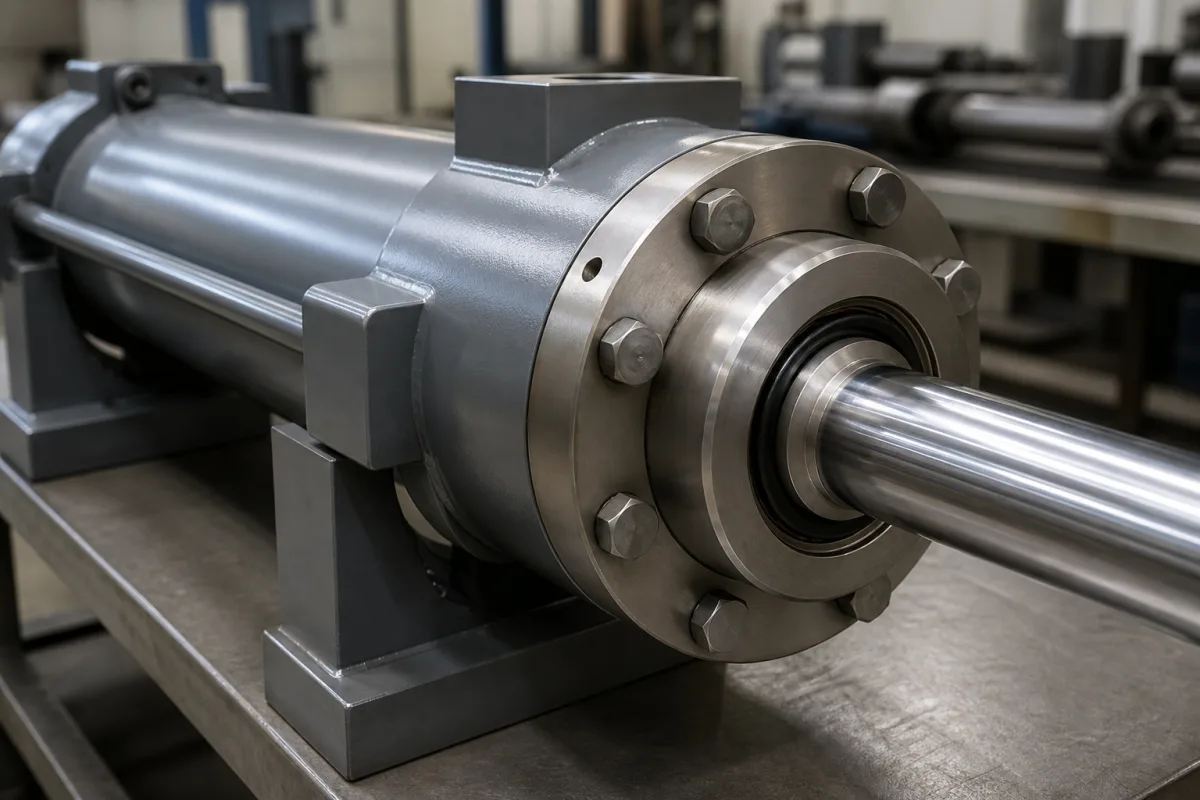
A critical sealing and structural component at the rod end of a hydraulic cylinder that contains the piston rod seal and bearing.
Product Specifications

Technical details and manufacturing context for Rod Gland / End Cap

Definition
The rod gland, also known as the end cap, is a precision-machined component that forms the sealed closure at the rod end of a hydraulic cylinder assembly. It serves multiple functions: housing the rod seal to prevent hydraulic fluid leakage, containing the rod wiper to exclude contaminants, supporting the piston rod through an integrated bearing surface, and providing structural integrity to withstand internal pressure and external loads. This component is essential for maintaining cylinder efficiency, preventing contamination, and ensuring reliable operation in hydraulic systems.
Working Principle
The rod gland creates a static seal with the cylinder barrel while allowing the piston rod to move dynamically through its bore. It contains multiple sealing elements: primary rod seals prevent hydraulic fluid leakage, wiper seals exclude external contaminants, and bearing surfaces support rod alignment. Internal pressure forces the seals against the rod surface, creating a tight barrier while the gland's mechanical structure transfers rod loads to the cylinder housing.
Common Materials
Carbon Steel, Stainless Steel, Aluminum Alloy
Technical Parameters
  • Bore diameter for rod sealing and bearing surfaces, critical for proper seal compression and rod alignment (mm) Per Request
Components / BOM
  • Primary Rod Seal Groove
    Houses the main hydraulic seal that prevents fluid leakage along the piston rod
    Material: Same as gland body
  • Wiper Seal Groove
    Contains the wiper seal that excludes dirt, dust, and contaminants from entering the cylinder
    Material: Same as gland body
  • Bearing Surface
    Provides wear-resistant support and alignment for the piston rod during extension/retraction
    Material: Bronze alloy or hardened steel
  • Mounting Flange
    Provides bolt holes or threaded features for secure attachment to the cylinder barrel
    Material: Same as gland body
  • Grease Fitting Port
    Optional feature for lubricating the rod bearing surface (if applicable)
    Material: Same as gland body
Engineering Reasoning
0-350 bar hydraulic pressure, -40°C to 120°C temperature, 0.5-2.0 m/s rod velocity
Seal extrusion at 1.5 mm radial clearance with 400 bar pressure, bearing seizure at 150°C PTFE temperature, seal lip tearing at 3.0 m/s rod velocity
Design Rationale: Seal extrusion failure occurs when pressure-induced radial deformation exceeds the 0.9 mm extrusion gap, governed by the Mooney-Rivlin hyperelastic material model with C₁=0.5 MPa, C₂=0.05 MPa constants for HNBR elastomers
Risk Mitigation (FMEA)
Trigger Hydraulic fluid contamination with 15 μm abrasive particles exceeding ISO 4406 18/16/13 cleanliness level
Mode: Seal lip abrasive wear causing 0.1 mm³/s leakage rate exceeding 10 mL/min allowable limit
Strategy: Install 10 μm absolute beta₃=75 filter with 0.5 bar differential pressure monitoring at cylinder inlet port
Trigger Misalignment-induced bending moment exceeding 150 N·m at 100 mm offset from gland centerline
Mode: Bearing surface spalling with 0.05 mm radial play causing 0.5° rod angular deflection
Strategy: Integrate spherical plain bearing with 20° angular misalignment capacity and 0.01 mm radial clearance

Industry Taxonomies & Aliases

Commonly used trade names and technical identifiers for Rod Gland / End Cap.

Applied To / Applications

This component is essential for the following industrial systems and equipment:

Industrial Ecosystem & Supply Chain DNA

Complementary Systems
Downstream Applications
Specialized Tooling

Application Fit & Sizing Matrix

Operational Limits
pressure: Up to 5000 psi (350 bar) standard, higher with special designs
rod speed: Up to 1.5 m/s continuous, 3.0 m/s intermittent
temperature: -40°C to +120°C (dependent on seal material)
environmental class: IP67/IP69K for ingress protection
Media Compatibility
✓ Hydraulic oil (mineral/synthetic) ✓ Water-glycol fluids ✓ Phosphate ester fluids
Unsuitable: Highly abrasive slurries with >10% solids concentration
Sizing Data Required
  • Rod diameter (mm/in)
  • Operating pressure (psi/bar)
  • Seal material compatibility with fluid

Reliability & Engineering Risk Analysis

Failure Mode & Root Cause
Seal leakage
Cause: Wear or degradation of sealing elements due to misalignment, improper installation, or material incompatibility with process fluids
Structural fatigue cracking
Cause: Cyclic stress from pressure fluctuations or vibration, often exacerbated by corrosion or material defects
Maintenance Indicators
  • Visible fluid leakage around the gland or end cap interface
  • Unusual vibration or audible knocking from the rod assembly during operation
Engineering Tips
  • Implement precision alignment procedures during installation and use laser alignment tools to ensure rod and gland concentricity
  • Establish a condition-based monitoring program with regular vibration analysis and thermography to detect early degradation

Compliance & Manufacturing Standards

Reference Standards
ISO 3601-1:2015 (Hydraulic fluid power - O-rings) ANSI/B93.5M:1995 (Hydraulic fluid power - Cylinders) DIN 3771-1:2011 (O-rings - Dimensions, tolerances and size identification)
Manufacturing Precision
  • Bore diameter: +/-0.025mm
  • Surface flatness: 0.05mm
Quality Inspection
  • Dimensional verification with CMM (Coordinate Measuring Machine)
  • Pressure testing for seal integrity

Factories Producing Rod Gland / End Cap

Verified manufacturers with capability to produce this product in China

✓ 96% Supplier Capability Match Found

T Technical Director from Australia Feb 03, 2026
★★★★★
"Standard OEM quality for Machinery and Equipment Manufacturing applications. The Rod Gland / End Cap arrived with full certification."
Technical Specifications Verified
P Project Engineer from Singapore Jan 31, 2026
★★★★☆
"Great transparency on the Rod Gland / End Cap components. Essential for our Machinery and Equipment Manufacturing supply chain. (Delivery took slightly longer than expected, but technical support was excellent.)"
Technical Specifications Verified
S Sourcing Manager from Germany Jan 28, 2026
★★★★★
"The Rod Gland / End Cap we sourced perfectly fits our Machinery and Equipment Manufacturing production line requirements."
Technical Specifications Verified
Verification Protocol

“Feedback is collected from verified sourcing managers during RFQ (Request for Quote) and factory evaluation processes on CNFX. These reports represent historical performance data and technical audit summaries from our B2B manufacturing network.”

19 sourcing managers are analyzing this specification now. Last inquiry for Rod Gland / End Cap from Vietnam (20m ago).

Supply Chain Compatible Machinery & Devices

Automated Assembly Line System

Integrated production system for sequential component assembly operations

Explore Specs →
Automated Powder Coating System

Integrated industrial system for applying dry powder coatings to metal substrates.

Explore Specs →
Centrifugal Pump Impeller

Rotating component that transfers energy to fluid in centrifugal pumps.

Explore Specs →
High-Precision CNC Laser Cutting Machine

Computer-controlled industrial machine using focused laser beams to cut sheet metal with micron-level accuracy.

Explore Specs →

Frequently Asked Questions

What is the primary function of a rod gland or end cap in hydraulic cylinders?

The rod gland, also known as an end cap, serves as a critical sealing and structural component at the rod end of a hydraulic cylinder. It contains and secures the piston rod seal and bearing, preventing fluid leakage and maintaining cylinder integrity under pressure.

Which material is best for corrosive environments: carbon steel, stainless steel, or aluminum alloy?

Stainless steel is the optimal choice for corrosive environments due to its superior corrosion resistance. Aluminum alloy offers good corrosion resistance with lighter weight, while carbon steel provides strength but requires protective coatings in corrosive conditions.

What maintenance features should I look for in a rod gland design?

Look for designs that include a grease fitting port for easy lubrication of the bearing surface, accessible seal grooves for straightforward seal replacement, and robust mounting flanges for secure installation and alignment within the cylinder assembly.

Can I contact factories directly on CNFX?

CNFX is an open directory, not a transaction platform. Each factory profile provides direct contact information and production details to help you initiate direct inquiries with Chinese suppliers.

Get Quote for Rod Gland / End Cap

Request technical pricing, lead times, or customized specifications for Rod Gland / End Cap directly from verified manufacturing units.

Your business information is encrypted and only shared with verified Rod Gland / End Cap suppliers.

Thank you! Your message has been sent. We'll respond within 1–3 business days.

Need to Manufacture Rod Gland / End Cap?

Connect with verified factories specializing in this product category

Add Your Factory Contact Us
Previous Product
Rod Assembly
Next Product
Rod Gland/End Cap