Editorial Technical Reference

Scraper Assembly

This page explains how Scraper Assembly is classified within Machinery and Equipment Manufacturing. Technical values and manufacturer relationships are research references; confirm the current specification and supplier evidence for each order.

Technical Definition & Core Assembly

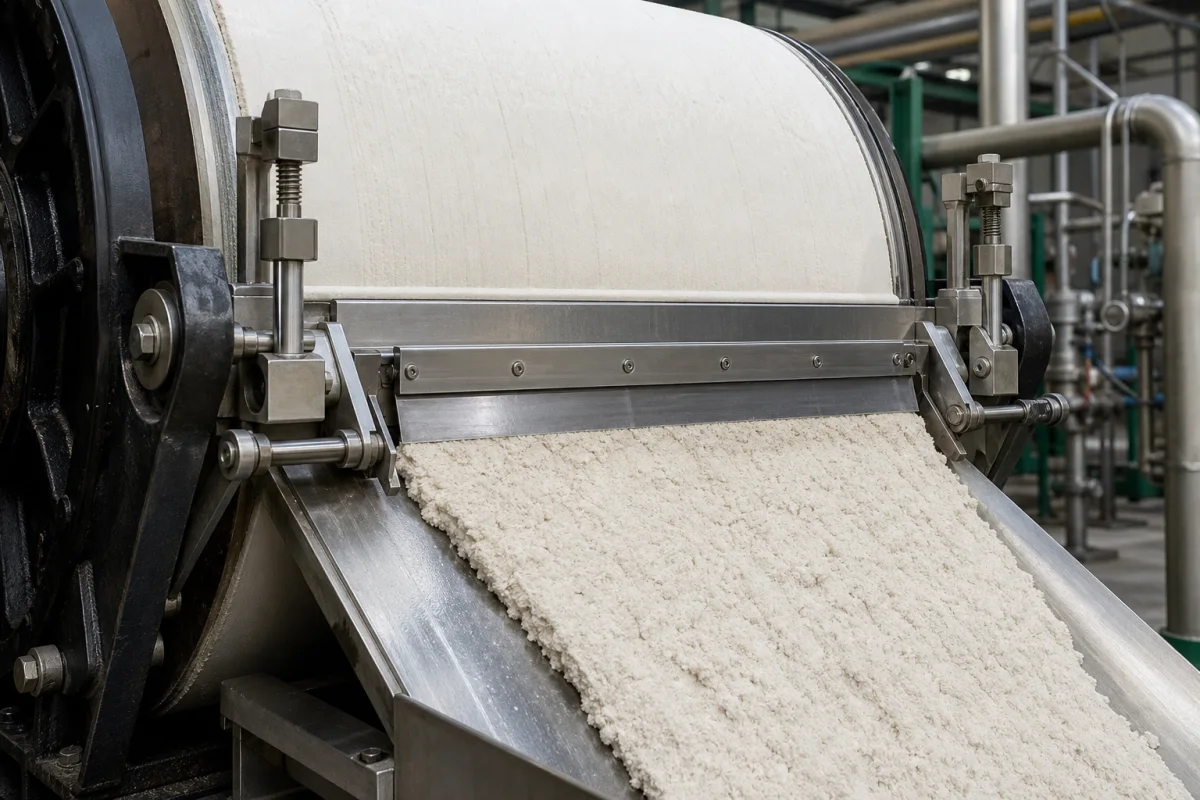
A mechanical assembly designed to continuously remove filtered solids from the surface of a rotary drum vacuum filter.

Representative product image. Confirm appearance and specifications with the manufacturer.

Product Specifications

Technical details and manufacturing context for Scraper Assembly

Definition
The scraper assembly is a critical component of an industrial rotary drum vacuum filter, responsible for the continuous and efficient removal of the filter cake (accumulated solids) from the rotating drum's filter media surface. It ensures the filtration process remains uninterrupted by preventing cake buildup that would otherwise reduce filtration efficiency and capacity. The assembly is typically mounted at a specific angle and position relative to the drum, using a rigid blade or knife-edge to shear the formed filter cake from the drum's surface as it rotates. The contact pressure and angle are precisely controlled to ensure complete cake removal without damaging the underlying filter cloth or media. Materials commonly used include stainless steel (e.g., 304, 316), abrasion-resistant alloy steel, and polyurethane or rubber for blade tips. Key parameters include blade width (500–3000 mm), thickness (3–10 mm), material (SS304/316L, PTFE, UHMWPE per ASTM A240), edge angle (15–45°), clearance (0.5–3.0 mm), operating pressure (0.2–0.6 MPa), temperature (-10–80°C), linear speed (0.1–0.5 m/s), positioning accuracy (±0.05 mm), weight (20–150 kg), mounting hole diameter (10–20 mm per ISO 273), and surface roughness (Ra 0.8–3.2 µm per ISO 4287). These values are reference ranges and must be verified for the specific model and application. The scraper assembly is selected based on drum dimensions, cake characteristics, and process conditions. It interfaces with the filter frame and drive system, and its performance is verified through cake removal efficiency and media wear. Maintenance signals include uneven cake removal, increased wear on the blade, or changes in clearance. Failure boundaries include blade breakage, excessive wear, or loss of contact pressure, which can lead to reduced filtration performance. Always confirm model-specific values and standards with the legal manufacturer or supplier.
Working Principle
The scraper assembly operates by positioning a rigid blade against the rotating drum surface. As the drum rotates, the blade shears the filter cake from the media. The blade angle and contact pressure are adjustable to match cake properties. The blade is typically mounted on a support frame with pneumatic loading to maintain consistent pressure. The clearance between blade and drum is set to avoid damage while ensuring complete removal. The blade's linear speed corresponds to drum rotation speed, and the assembly is designed to handle various cake thicknesses and materials.
Common Materials
Stainless Steel (e.g., 304, 316), Abrasion-Resistant Alloy Steel, Polyurethane or Rubber (for blade tips)
Technical Parameters
ParameterTypical rangeNotes & selection driver
Blade Width500–3000 mmMatch drum face width
Blade Thickness3–10 mmThicker for abrasive solids
Blade MaterialSS304/316L, PTFE, UHMWPECorrosion and wear resistanceASTM A240
Blade Edge Angle15–45 °Lower angle for softer cakes
Blade-to-Drum Clearance0.5–3.0 mmAdjustable; too small causes wear
Operating Pressure0.2–0.6 MPaPneumatic loading force
Operating Temperature-10–80 °CHigher for special materials
Blade Linear Speed0.1–0.5 m/sMatch drum rotation speed
Positioning Accuracy±0.05 mmEnsures uniform cake removal
Weight20–150 kgDepends on width and material
Mounting Hole Diameter10–20 mmFor bolting to support frameISO 273
Surface RoughnessRa 0.8–3.2 µmSmoother for sticky materialsISO 4287

Ranges are indicative industry figures for RFQ preparation, not a supplier commitment. Confirm every value and standard with the legal manufacturer before ordering.

Components / BOM
  • Scraper Blade / Knife Part
    Primary contact element that physically separates the filter cake from the drum surface.
    Material: Abrasion-resistant steel or polyurethane-coated steel
  • Blade Holder / Mounting Bracket Part
    Secures the scraper blade and allows for precise adjustment of its angle and position.
    Material: Carbon steel or stainless steel
  • Adjustment Mechanism
    Allows for fine-tuning of the blade's contact pressure, angle, and alignment during operation and maintenance.
    Material: Steel
  • Support Frame Part
    Provides rigid structural support for the entire assembly, attaching it to the main filter frame.
    Material: Carbon steel
  • Pneumatic Loading Unit
    Presses the blade against the drum with constant force as the blade and drum wear.

Industrial Ecosystem & Supply Chain Structure

Complementary Systems
Downstream Applications
Specialized Tooling

Application Fit & Sizing Matrix

Operational Limits
pressure: Atmospheric to 0.5 bar (7.25 psi) vacuum
flow rate: Dependent on drum speed and scraper geometry
temperature: Ambient to 100°C (212°F)
slurry concentration: 5-40% solids by weight
Media Compatibility
✓ Mineral slurries (e.g., gypsum, limestone) ✓ Chemical process solids (e.g., precipitated salts) ✓ Food-grade particulates (e.g., starch, sugar crystals)
Unsuitable: Highly abrasive slurries with >60% silica content or corrosive environments with pH <2 or >12
Sizing Data Required
  • Drum diameter and rotational speed (RPM)
  • Solids loading rate (kg/m²·hr)
  • Required cake thickness and moisture content

Reliability & Engineering Risk Analysis

Failure Mode & Root Cause
Wear and Tear on Scraper Blades
Cause: Abrasive erosion from particulate matter in the processed material, leading to blade dulling, thinning, or breakage, reducing scraping efficiency and potentially causing product contamination or equipment damage.
Bearing Failure in Drive Mechanism
Cause: Inadequate lubrication, ingress of contaminants (moisture, dust), or misalignment causing overheating, increased friction, and eventual seizure or catastrophic failure, halting the assembly's operation.
Maintenance Indicators
  • Unusual grinding, scraping, or knocking noises from the assembly, indicating blade contact with unintended surfaces, bearing issues, or mechanical obstructions.
  • Visible material buildup, leakage, or spillage around the scraper area, suggesting blade inefficiency, seal failure, or misalignment leading to improper material handling.
Engineering Tips
  • Implement a predictive maintenance schedule using vibration analysis and thermal imaging to monitor bearing health and blade condition, allowing for timely interventions before failures occur.
  • Use wear-resistant materials (e.g., hardened steel or ceramic coatings) for scraper blades and ensure proper alignment during installation to reduce abrasive wear and extend component life.

Indicative industry ranges for design and RFQ preparation. Confirm the exact figures and applicable standard with the manufacturer before specifying.

Compliance & Manufacturing Standards

Applicable Standards
ANSI B5.50-1985 Machine Tools - Tooling and Workholding DIN 8589-1:2003 Manufacturing Processes - Chip Removal - Part 1: General

Quoted from the published standard.

Manufacturing Precision
  • Bearing Bore Diameter: +/-0.01mm
  • Blade Edge Flatness: 0.05mm
Quality Inspection
  • Dimensional Verification with CMM
  • Material Hardness Testing (Rockwell C)

Manufacturers of Scraper Assembly

Manufacturer profiles associated with Scraper Assembly.

Sourcing Scraper Assembly from China?
Tell us your specification and target quantity — we will match it against manufacturer records and come back with the factories that fit.
Request manufacturers We manufacture this

Manufacturer listings support early research and capability understanding. They are not certification, ranking, or transaction guarantees.

Technical documentation
Request current drawings, revision history, and a signed specification sheet.
Manufacturing capability
Verify equipment lists, process limits, capacity, and representative production evidence.
Inspection readiness
Confirm test methods, calibrated equipment, sampling plans, and traceable reports.
Supplier transparency
Check the legal entity, factory address, ownership, certifications, and direct contacts.

CNFX does not score or rank suppliers. Buyers must verify all claims and documents with the legal manufacturer before ordering.

Supply Chain Compatible Machinery & Devices

Heavy-Duty CNC Plasma Cutting Machine

The Heavy-Duty CNC Plasma Cutting Machine is a standalone industrial device designed for cutting conductive metals such as steel, stainless steel, aluminum, and copper alloys.

Explore Specs →
Automated Powder Coating System

Integrated industrial system for applying dry powder coatings to metal substrates.

Explore Specs →
Centrifugal Pump Impeller

The centrifugal pump impeller is a critical rotating component that converts mechanical energy from the motor into kinetic energy in fluid systems.

Explore Specs →
High-Precision CNC Laser Cutting Machine

Computer-controlled industrial machine using focused laser beams to cut sheet metal with micron-level accuracy.

Explore Specs →

Frequently Asked Questions

What is the function of a scraper assembly in a rotary drum vacuum filter?

It continuously removes the filter cake from the drum's surface to maintain filtration efficiency and prevent clogging.

What materials are commonly used for scraper blades?

Stainless steel (304, 316), abrasion-resistant alloy steel, and polyurethane or rubber for blade tips, depending on the application.

How is the blade-to-drum clearance adjusted?

The clearance is adjustable, typically between 0.5 and 3.0 mm, and must be set to avoid wear while ensuring complete cake removal.

What standards apply to scraper assembly parameters?

Relevant standards include ASTM A240 for blade material, ISO 273 for mounting holes, and ISO 4287 for surface roughness. Verify compliance with the manufacturer.

Data Basis

Editorial classification, named public sources where available, and source-reviewed manufacturer records.

Preliminary Technical Classification
This page supports structured research, RFQ preparation, and supplier evaluation. It does not replace buyer-led supplier qualification, standards review, or technical approval.
Buyer enquiry

Request manufacturing insight for Scraper Assembly

Ask for use case, specification boundaries, supplier type, and RFQ preparation information for this product.

Where it goes
Straight to the CNFX editorial desk, and to the manufacturer if this product is linked to a claimed profile. Nothing is broadcast to a supplier list.
Your details stay here
We do not sell or rent enquiry data, and we do not add you to a mailing list. Used only to answer this request.
No commission, no middleman
CNFX is a directory. We take no cut of any order and never negotiate on a supplier's behalf.
What we don't claim
A listing is not an endorsement. Qualify every supplier and verify every figure yourself before ordering.

Your business information is used only to process this request.

Thank you! Your message has been sent. We'll respond within 1–3 business days.
Sorry, we couldn't send your message. Please try again, or email us at contact@cnfx.com.

Need to Manufacture Scraper Assembly?

Compare manufacturer profiles with relevant product and process capability.

Previous Product
Score Calculator
Next Product
Screen Panels
Get QuotesChat