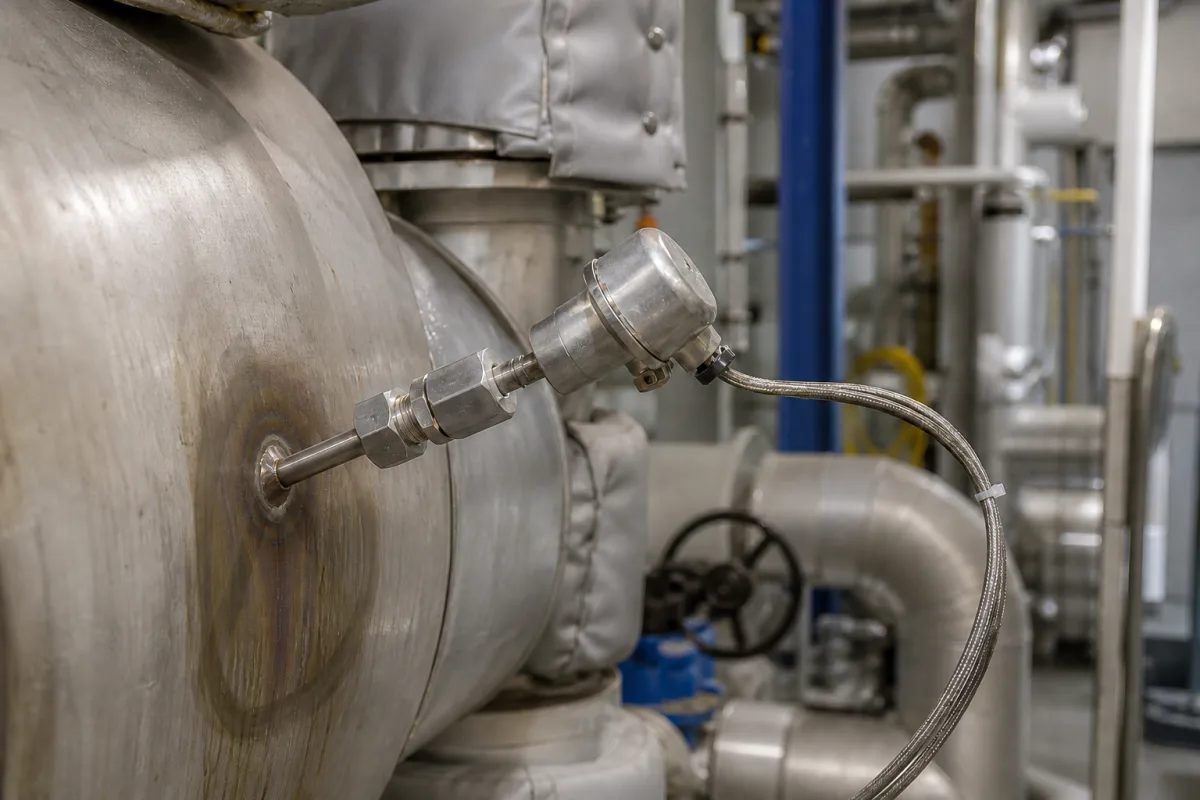
Mineral-insulated thermocouple sensor for direct insertion through a compression fitting
Mineral-insulated sheathed thermocouple fitted straight into a pipe, vessel or machine port · sheath diameter against response time, grounded or insulated junction, bend radius and fitting length, lead cable temperature
A mineral-insulated (MI) thermocouple sensor is a pair of thermocouple wires packed in compacted magnesium oxide inside a thin metal sheath, closed and welded at the tip, then fitted directly into the process through a compression or threaded fitting and finished with a flexible lead, plug or small transition housing. Unlike a thermowell assembly, the sheath itself touches the medium, so the sheath diameter and the way the junction is made decide how fast it reads. Settle three things first: the sheath diameter and junction for the response you need, the bend radius and fitting length for the route into the process, and a lead cable rated for the temperature beside the fitting.
Mineral-insulated sheathed thermocouples from 0.5 mm to about 10 mm diameter, inserted directly into pipes, vessels, moulds and machines with compression or threaded fittings, with plug, bare-wire or braided-lead terminations. High-temperature thermocouples with ceramic or metal thermowells for furnaces, kilns and ladles are covered on the High-temperature thermocouple assemblies page. Probe assemblies with a connection head, transmitter and thermowell for process lines are covered on the Industrial temperature probe page. Thermocouple wire and extension cable sold by the metre, and temperature controllers, are outside this page.
CNFX editorial research · Sources checked October 12, 2026 · 4 sources
0.15 s at 0.5 mm, 3 s at 6 mm: sheath diameter sets how fast an MI thermocouple reads
JUMO's data sheet 90.1221 for mineral-insulated thermocouples lists response times in water flowing at 0.4 m/s and in air at 2 m/s for each sheath diameter. In water the half-value time t0.5 rises from 0.15 s at 0.5 mm to 3.00 s at 6.0 mm; in air the same sheaths take 3.5 s and 55.0 s. [1]
Editorial calculation: in JUMO's figures the same 6.0 mm sheath takes 55.0 ÷ 3.00 ≈ 18 times longer to reach t0.5 in moving air than in moving water, so a response time quoted without its medium and velocity cannot be compared with another supplier's. [1]
The thinner sheath that reads faster also carries thinner wires. JUMO gives the loop resistance of a single type K element as 126 Ω/m at 0.5 mm and 0.88 Ω/m at 6.0 mm. [1] Editorial calculation: a 1 m run of 0.5 mm type K sheath adds 126 Ω to the loop, while 3 m of 3.0 mm sheath adds 3 × 3.5 = 10.5 Ω; check the input impedance and lead-resistance limits of the controller or transmitter before choosing a long, thin sheath.
JUMO sets a minimum fitting length of 50 mm for 0.5 to 2.0 mm sheaths and 100 mm for 3.0 to 6.0 mm sheaths, with lengths up to 50,000 mm in 50 mm steps. [1]
Give the supplier the medium (liquid, gas or solid), its velocity past the tip, the response time you need and how it is defined (t0.5, t0.9 or 63.2%), the insertion depth, and the instrument the sensor will be wired to.
02
Grounded, insulated or exposed tip: response time traded against electrical isolation
Aircom Instrumentation describes three junction styles in mineral-insulated sheathed thermocouples: a grounded junction is joined to the sheath and gives no electrical isolation with fast response; an ungrounded junction is isolated from the sheath with what Aircom calls "reasonable response time"; an exposed junction sits outside the sheath and gives the fastest response with no isolation. [2]
Aircom's times are for a single element, measured as the time to indicate 63.2% of the change from room temperature to boiling water. [2] Editorial calculation: at these diameters the ungrounded junction takes between 2.0 (0.187 in) and 2.8 (0.375 in) times as long as the grounded one; 0.125 in is about 3.2 mm and 0.250 in about 6.4 mm.
In JUMO's order code the basic version has the thermocouple insulated from the sheath, and an uninsulated assembly, with the thermocouple welded to the tip, is an extra code. JUMO specifies insulation resistance between thermocouple and sheath at ambient temperature of 200 MΩ for lengths up to 1 m and 200 MΩ × m for lengths of 1 m and above. [1] Labfacility's type K fast-response MI sensors are offered with the junction insulated or grounded from the sheath in diameters from 0.5 to 3 mm. [3]
Editorial note: a grounded tip can couple electrical noise or a ground loop from the plant into the measurement, which is why isolated inputs or insulated junctions are asked for where the sheath touches earthed equipment; ask the supplier to state the junction type on the label.
Bending the sheath to the port: radius, temperature by diameter and the lead beside the fitting
An MI sheath can be bent on site to reach the measuring point, but the two makers reviewed give different minimum radii: JMS says its sheath can be formed to a radius equal to 2 × the sheath diameter, while JUMO gives a minimum bending radius of 5 × the external diameter. [4][1] Use the supplier's own figure for the sheath you buy.
Editorial calculation: for a 3 mm sheath the JMS figure gives a 6 mm radius and the JUMO figure 15 mm; for a 6 mm sheath, 12 mm against 30 mm.
Maximum temperature depends on diameter as well as sheath material. Labfacility rates its 310 stainless steel type K sensors from −40 °C to +1100 °C above 1.0 mm diameter and to +750 °C at 1.0 mm and below. [3] JUMO lists type K in Inconel 600 (2.4816) sheath from −200 to +1200 °C and types J and L in stainless steel 1.4541 sheath from −200 to +800 °C. [1]
JMS says its sheath "withstands pressures upwards to 50,000 psi", and lists compression fittings and welded or spring-loaded 1/2 × 1/2 in NPT fittings as process connections in the transition area between the sheath and the cold end. [4] JUMO's sensors are leak-tested with helium at 40 bar at the measurement point. [1] Editorial note: the compression fitting, not the sheath, limits the pressure rating of the seal; ask for the fitting's pressure rating at process temperature and whether the ferrule is metal (permanent) or PTFE (repositionable).
The lead next to the fitting must survive the heat radiating from the pipe or vessel. JUMO lists connecting cables in silicone for −50 to +180 °C, PTFE for −190 to +260 °C and metal braiding for −20 to +350 °C. [1] JMS lists fiberglass, PVC, Teflon, Kapton, high-temperature fiberglass and fiberglass with stainless steel overbraid or flexible armour. [4]
State the process temperature at the tip and the ambient temperature at the fitting, the route and bend radius available, the fitting thread and pressure, the lead type and length, and the termination (bare wires, miniature plug or connector).
04
Send the sheath, junction, fitting and lead together
Paste it into your enquiry below or into an email to a maker, then replace every bracket.
Thermocouple: [type K, J, T, N; single or dual element; tolerance class]
Sheath: [diameter; material; length; bends]
Junction: [grounded, insulated or exposed]
Response: [t0.5, t0.9 or 63.2%; medium and velocity]
Fitting: [compression or threaded; thread size; pressure; ferrule material]
Lead: [silicone, PTFE, fiberglass or metal braid; length; ambient temperature at the fitting]
Termination: [bare wires, miniature plug, standard plug]
Tests: [insulation resistance; leak test; calibration certificate]
1 company lists this product among what they make. Company figures are quoted from each
company's own website; every card states where the relationship came from.
Xiamen Maxwell Automation Limited
Manufacturing site to be confirmed for the order
Thermocouple category lists TC-K1/J1/T1 screw-in nozzle thermocouples (types K, J, T, E) with grounded or ungrounded junctions, 304/316/310 stainless steel, and cable options including metal braiding with mica or glass fibre.
Explore company information and manufacturing capabilities, then discuss the scope of your project with a relevant supplier.
Share this page
Compiled and source-reviewed by the CNFX editorial team.
Each manufacturer above links to the page on that company's own website where the product is listed, with the date we checked it. How we source and review
· Page last updated 13 October 2026
Buyer questions
How fast does a mineral-insulated thermocouple respond?
It depends on diameter and medium: JUMO lists t0.5 in water at 0.4 m/s from 0.15 s at 0.5 mm to 3.00 s at 6.0 mm, and 3.5 s to 55.0 s in air at 2 m/s. [1]
Is a grounded or ungrounded junction faster?
Grounded. Aircom's table gives 0.6 s grounded against 1.5 s ungrounded at 0.125 in, and 2.0 s against 4.5 s at 0.250 in, to 63.2% of the step to boiling water. [2]
How tightly can the sheath be bent?
JMS gives a radius equal to 2 × the sheath diameter; JUMO gives a minimum of 5 × the external diameter. Use your supplier's figure. [4][1]
Does a thin sheath lower the maximum temperature?
In Labfacility's 310 stainless range, yes: +1100 °C above 1.0 mm diameter but +750 °C at 1.0 mm and below. [3]
Sources and what still needs a direct check
Sources checked 2026-10-12. JUMO, Labfacility and JMS describe their own mineral-insulated thermocouples; Aircom Instrumentation publishes a response-time table for its sheathed probes. Response times are measured under each maker's own conditions and are not directly interchangeable.