Industry-Verified Manufacturing Data (2026)

Tension Control Device

Based on aggregated insights from multiple verified factory profiles within the CNFX directory, the standard Tension Control Device used in the Machinery and Equipment Manufacturing sector typically supports operational capacities ranging from standard industrial configurations to heavy-duty production requirements.

Technical Definition & Core Assembly

A canonical Tension Control Device is characterized by the integration of Tension Sensor and Braking Mechanism. In industrial production environments, manufacturers listed on CNFX commonly emphasize Aluminum alloy construction to support stable, high-cycle operation across diverse manufacturing scenarios.

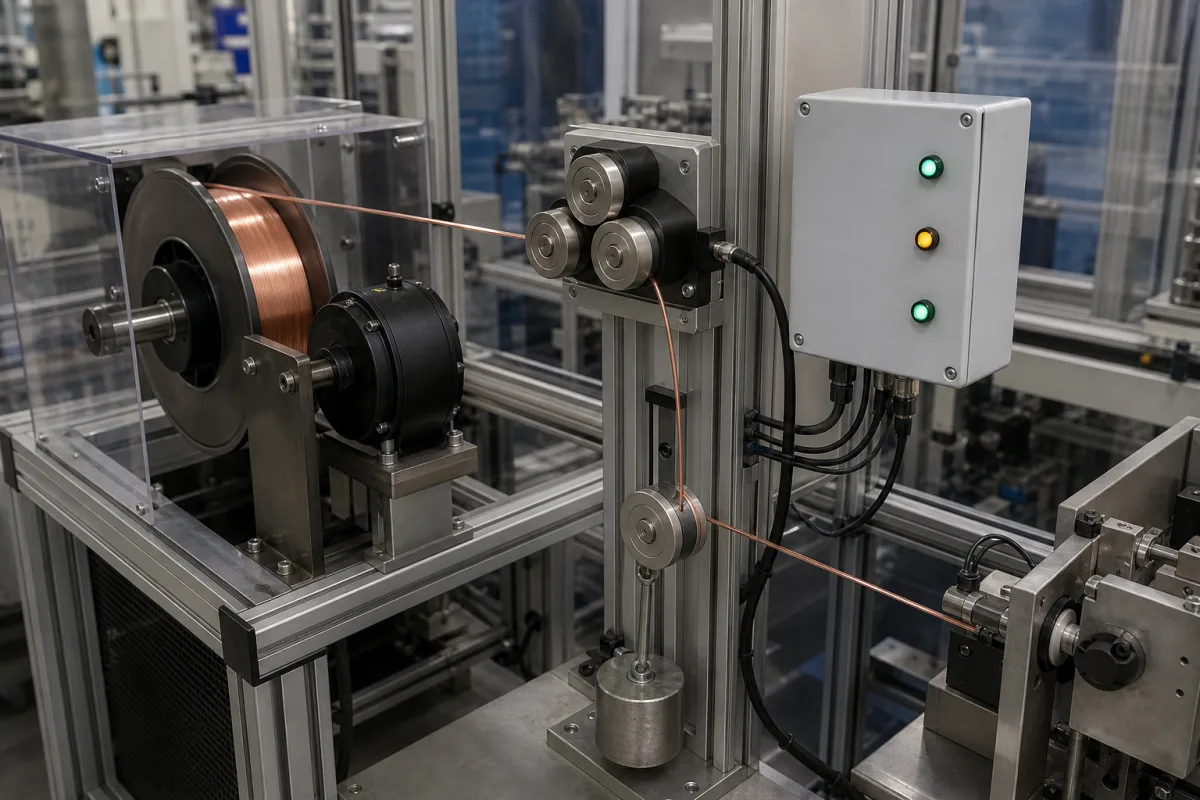
A device that regulates and maintains consistent tension in wire or filament during feeding processes.
Product Specifications

Technical details and manufacturing context for Tension Control Device

Definition
A critical component within wire feed mechanisms that precisely controls and maintains optimal tension levels in wire or filament as it's fed through manufacturing equipment, ensuring consistent material flow, preventing slack or over-tensioning, and improving product quality in various industrial applications.
Working Principle
Typically employs mechanical, pneumatic, or electronic systems to monitor wire tension and apply corrective forces through friction brakes, magnetic particle brakes, servo motors, or dancer arm mechanisms to maintain preset tension values.
Common Materials
Aluminum alloy, Stainless steel, Spring steel
Technical Parameters
  • Tension range capacity (N) Per Request
Components / BOM
  • Tension Sensor
    Detects actual wire tension through load cells or dancer position
    Material: Stainless steel
  • Braking Mechanism
    Applies controlled friction or resistance to regulate wire tension
    Material: Ceramic composite
  • Control Unit
    Processes sensor data and adjusts braking force to maintain set tension
    Material: Aluminum housing with electronic components
Engineering Reasoning
0.5-15 N tension force, 0.1-5 m/s wire speed
Tension exceeds 20 N causing permanent deformation of load cell strain gauges
Design Rationale: Plastic deformation of strain gauge foil at 0.3% strain limit (350 MPa yield strength for Constantan alloy)
Risk Mitigation (FMEA)
Trigger Capacitive coupling from adjacent high-voltage cables induces 50V AC noise on tension sensor signal lines
Mode: PID controller oscillates at 120 Hz, causing ±8 N tension fluctuations exceeding material yield limits
Strategy: Implement twisted-pair shielded cabling with 360-degree connector grounding and common-mode choke filtering
Trigger Polymer filament static charge accumulation reaches 15 kV, creating corona discharge to tension roller bearings
Mode: Arcing through bearing grease creates conductive carbon tracks, causing encoder signal corruption
Strategy: Install ionizing air blower at filament entry point and specify conductive POM rollers with 10^6 Ω surface resistivity

Industry Taxonomies & Aliases

Commonly used trade names and technical identifiers for Tension Control Device.

Applied To / Applications

This component is essential for the following industrial systems and equipment:

Industrial Ecosystem & Supply Chain DNA

Complementary Systems
Downstream Applications
Specialized Tooling

Application Fit & Sizing Matrix

Operational Limits
pressure: 0 to 10 bar
line speed: 0 to 300 m/min
temperature: -10°C to 60°C
tension range: 0.1 to 100 N
Media Compatibility
✓ Copper wire ✓ Polymer filament ✓ Steel cable
Unsuitable: Abrasive slurry environments
Sizing Data Required
  • Maximum tension requirement (N)
  • Wire/filament diameter (mm)
  • Required response time (ms)

Reliability & Engineering Risk Analysis

Failure Mode & Root Cause
Wear and Tear on Tensioning Components
Cause: Continuous friction and mechanical stress on rollers, belts, or pneumatic elements due to improper tension settings, material abrasion, or lack of lubrication.
Sensor or Control System Malfunction
Cause: Electrical failures, calibration drift, or environmental contamination (dust, moisture) leading to inaccurate tension readings and loss of control.
Maintenance Indicators
  • Irregular or fluctuating tension readings on monitoring displays
  • Unusual noises (grinding, squealing) or vibrations from the device during operation
Engineering Tips
  • Implement regular calibration and validation of tension sensors and control systems to ensure accuracy and prevent drift.
  • Establish a preventive maintenance schedule for cleaning, lubrication, and inspection of mechanical components to reduce wear and detect early degradation.

Compliance & Manufacturing Standards

Reference Standards
ISO 9001:2015 - Quality management systems ANSI/ASME B5.54-2005 - Methods for performance evaluation of computer numerically controlled machining centers CE Marking - Directive 2006/42/EC for machinery safety
Manufacturing Precision
  • Shaft alignment: +/-0.01mm
  • Torque output consistency: +/-2% of rated value
Quality Inspection
  • Calibration verification against traceable standards
  • Functional load testing under simulated operating conditions

Factories Producing Tension Control Device

Verified manufacturers with capability to produce this product in China

✓ 97% Supplier Capability Match Found

P Project Engineer from Canada Jan 25, 2026
★★★★★
"Standard OEM quality for Machinery and Equipment Manufacturing applications. The Tension Control Device arrived with full certification."
Technical Specifications Verified
S Sourcing Manager from United States Jan 22, 2026
★★★★★
"Great transparency on the Tension Control Device components. Essential for our Machinery and Equipment Manufacturing supply chain."
Technical Specifications Verified
P Procurement Specialist from United Arab Emirates Jan 19, 2026
★★★★★
"The Tension Control Device we sourced perfectly fits our Machinery and Equipment Manufacturing production line requirements."
Technical Specifications Verified
Verification Protocol

“Feedback is collected from verified sourcing managers during RFQ (Request for Quote) and factory evaluation processes on CNFX. These reports represent historical performance data and technical audit summaries from our B2B manufacturing network.”

14 sourcing managers are analyzing this specification now. Last inquiry for Tension Control Device from Brazil (1h ago).

Supply Chain Compatible Machinery & Devices

Automated Assembly Line System

Integrated production system for sequential component assembly operations

Explore Specs →
Automated Powder Coating System

Integrated industrial system for applying dry powder coatings to metal substrates.

Explore Specs →
Centrifugal Pump Impeller

Rotating component that transfers energy to fluid in centrifugal pumps.

Explore Specs →
High-Precision CNC Laser Cutting Machine

Computer-controlled industrial machine using focused laser beams to cut sheet metal with micron-level accuracy.

Explore Specs →

Frequently Asked Questions

What materials are used in this tension control device?

This device is constructed from durable aluminum alloy for the housing, stainless steel for critical components, and spring steel in the braking mechanism to ensure longevity and consistent performance in industrial environments.

How does the tension control device maintain consistent wire tension?

The device uses a tension sensor to monitor wire/filament tension in real-time, a control unit to process this data, and a braking mechanism to automatically adjust and maintain precise tension throughout the feeding process.

What industries typically use this type of tension control device?

This device is essential in machinery and equipment manufacturing, particularly in wire drawing, cable production, textile machinery, 3D printing filament processing, and any application requiring precise tension control during material feeding.

Can I contact factories directly on CNFX?

CNFX is an open directory, not a transaction platform. Each factory profile provides direct contact information and production details to help you initiate direct inquiries with Chinese suppliers.

Get Quote for Tension Control Device

Request technical pricing, lead times, or customized specifications for Tension Control Device directly from verified manufacturing units.

Your business information is encrypted and only shared with verified Tension Control Device suppliers.

Thank you! Your message has been sent. We'll respond within 1–3 business days.

Need to Manufacture Tension Control Device?

Connect with verified factories specializing in this product category

Add Your Factory Contact Us
Previous Product
Tension Control
Next Product
Tension Control Mechanism