Industry-Verified Manufacturing Data (2026)

Wire Feed Mechanism

Based on aggregated insights from multiple verified factory profiles within the CNFX directory, the standard Wire Feed Mechanism used in the Electrical Equipment Manufacturing sector typically supports operational capacities ranging from standard industrial configurations to heavy-duty production requirements.

Technical Definition & Core Assembly

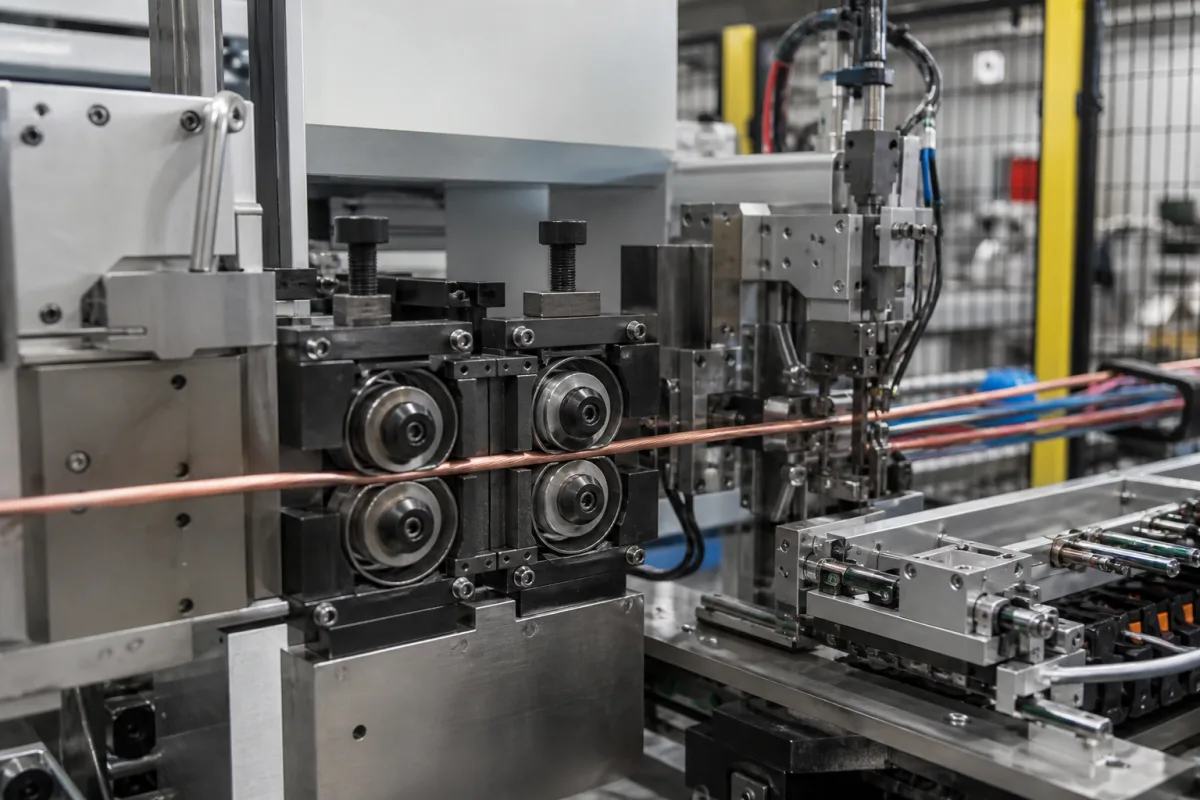
A canonical Wire Feed Mechanism is characterized by the integration of Feed Rollers and Wire Straightener. In industrial production environments, manufacturers listed on CNFX commonly emphasize Aluminum alloy construction to support stable, high-cycle operation across diverse manufacturing scenarios.

A precision mechanism that controls the feeding of wire to the crimping station in automated wire harness production.
Product Specifications

Technical details and manufacturing context for Wire Feed Mechanism

Definition
The Wire Feed Mechanism is a critical component of the Automated Wire Harness Crimping Machine responsible for accurately measuring, straightening, and advancing wire from the spool to the crimping head. It ensures precise wire length, maintains proper tension, and coordinates timing with the crimping cycle to enable continuous, high-speed production of wire harnesses with consistent quality.
Working Principle
The mechanism typically uses servo motors or stepper motors to drive feed rollers that grip and advance the wire. A length measurement system (encoder or sensor) monitors wire displacement, while tension control devices maintain proper wire tautness. The system interfaces with the machine's control unit to synchronize wire feeding with the crimping operation based on programmed wire lengths and production sequences.
Common Materials
Aluminum alloy, Stainless steel, Engineering plastics, Rubber
Technical Parameters
  • Wire diameter range that the mechanism can handle (mm) Customizable
Components / BOM
  • Feed Rollers
    Grip and advance the wire through friction
    Material: Hardened steel with rubber coating
  • Wire Straightener
    Removes curvature and twists from the wire before feeding
    Material: Tool steel
  • Tension Control Device
    Maintains consistent wire tension during feeding
    Material: Spring steel, aluminum
  • Length Measurement Sensor
    Measures exact wire length fed to the crimping station
    Material: Stainless steel, optical components
  • Wire Guide Tubes
    Directs wire path and prevents tangling
    Material: Nylon, stainless steel
Engineering Reasoning
0.5-3.0 m/s wire feed velocity, 0.1-5.0 N feed force, 0.01-0.05 mm positioning accuracy
Wire feed velocity exceeds 3.5 m/s causing slip, feed force drops below 0.05 N causing stall, positioning error exceeds 0.1 mm causing misalignment
Design Rationale: Coulomb friction coefficient degradation below 0.15 causes slip failure, stepper motor torque drops below 0.02 N·m at 85°C due to neodymium magnet Curie temperature effects, ball screw backlash exceeding 0.03 mm causes positioning hysteresis
Risk Mitigation (FMEA)
Trigger Permanent magnet stepper motor demagnetization at 150°C ambient temperature
Mode: Feed velocity drops to 0.2 m/s maximum, positioning accuracy degrades to 0.2 mm
Strategy: Install PTC thermistor thermal cutoff at 130°C, use samarium-cobalt magnets with 350°C Curie temperature
Trigger Drive roller polyurethane surface hardness increases from 80 Shore A to 95 Shore A due to ozone cracking
Mode: Wire slippage occurs at 1.5 m/s feed velocity, feed force transmission efficiency drops to 65%
Strategy: Implement nitrile rubber rollers with carbon black filler, install UV-resistant enclosure with 400 nm cutoff filter

Industry Taxonomies & Aliases

Commonly used trade names and technical identifiers for Wire Feed Mechanism.

Industrial Ecosystem & Supply Chain DNA

Complementary Systems
Downstream Applications
Specialized Tooling

Application Fit & Sizing Matrix

Operational Limits
pressure: Max 10 bar
other spec: Wire feed speed: 0.1-10 m/s, Wire diameter range: 0.1-10 mm
temperature: 0°C to 50°C
Media Compatibility
✓ Copper wire ✓ Aluminum wire ✓ Tinned copper wire
Unsuitable: Abrasive or corrosive wire coatings
Sizing Data Required
  • Wire diameter (mm)
  • Required feed speed (m/s)
  • Wire material type

Reliability & Engineering Risk Analysis

Failure Mode & Root Cause
Feed Roller Wear/Slippage
Cause: Abrasive erosion from wire surface contaminants (rust, scale) and excessive tension causing accelerated roller groove wear, leading to inconsistent wire feed and slippage.
Liner Blockage/Excessive Drag
Cause: Accumulation of wire shavings, debris, or internal corrosion within the conduit liner due to poor wire quality, lack of cleaning, or moisture ingress, increasing friction and feed resistance.
Maintenance Indicators
  • Erratic or stuttering wire feed accompanied by audible grinding or clicking noises from the mechanism.
  • Visible wire burn-back at the contact tip or irregular weld bead formation indicating inconsistent feed speed.
Engineering Tips
  • Implement routine inspection and cleaning of feed rollers and liners using appropriate tools (e.g., liner cleaning brushes), and replace consumables (rollers, liners) based on wire usage hours rather than failure.
  • Ensure proper wire tension calibration and use high-quality, clean wire with minimal surface contaminants; store wire in dry conditions to prevent moisture-induced corrosion and debris accumulation.

Compliance & Manufacturing Standards

Reference Standards
ISO 9001:2015 - Quality management systems ANSI/AWS D14.1/D14.1M:2018 - Specification for welding of industrial and mill cranes and other material handling equipment DIN EN ISO 17637:2017 - Non-destructive testing of welds - Visual testing of fusion-welded joints
Manufacturing Precision
  • Wire feed speed accuracy: +/- 2% of set value
  • Drive roller concentricity: 0.05mm maximum runout
Quality Inspection
  • Functional performance test under load conditions
  • Dimensional verification of critical components using CMM

Factories Producing Wire Feed Mechanism

Verified manufacturers with capability to produce this product in China

✓ 93% Supplier Capability Match Found

P Project Engineer from Germany Feb 14, 2026
★★★★★
"As a professional in the Electrical Equipment Manufacturing sector, I confirm this Wire Feed Mechanism meets all ISO standards."
Technical Specifications Verified
S Sourcing Manager from Brazil Feb 11, 2026
★★★★★
"Standard OEM quality for Electrical Equipment Manufacturing applications. The Wire Feed Mechanism arrived with full certification."
Technical Specifications Verified
P Procurement Specialist from Canada Feb 08, 2026
★★★★★
"Great transparency on the Wire Feed Mechanism components. Essential for our Electrical Equipment Manufacturing supply chain."
Technical Specifications Verified
Verification Protocol

“Feedback is collected from verified sourcing managers during RFQ (Request for Quote) and factory evaluation processes on CNFX. These reports represent historical performance data and technical audit summaries from our B2B manufacturing network.”

9 sourcing managers are analyzing this specification now. Last inquiry for Wire Feed Mechanism from Brazil (50m ago).

Supply Chain Compatible Machinery & Devices

Transformer Winding Machine

Industrial machine for winding copper wire onto transformer cores

Explore Specs →
Circuit Breaker Trip Unit

Protective control module for electrical circuit breakers

Explore Specs →
Circuit Breaker Arc Chute

Electrical component that extinguishes arcs in circuit breakers

Explore Specs →
Medium Voltage Switchgear Assembly Line

Automated production system for assembling medium voltage electrical switchgear.

Explore Specs →

Frequently Asked Questions

What materials are used in this wire feed mechanism?

The mechanism is constructed from durable aluminum alloy, stainless steel, engineering plastics, and rubber components for optimal performance and longevity in industrial environments.

How does this mechanism improve wire harness production?

It provides precise wire feeding control to crimping stations, ensuring consistent wire length, proper tension, and straight alignment, which reduces waste and improves crimping quality in automated production lines.

What components are included in the BOM?

The bill of materials includes feed rollers, length measurement sensor, tension control device, wire guide tubes, and wire straightener - all essential for accurate wire handling in electrical equipment manufacturing.

Can I contact factories directly on CNFX?

CNFX is an open directory, not a transaction platform. Each factory profile provides direct contact information and production details to help you initiate direct inquiries with Chinese suppliers.

Get Quote for Wire Feed Mechanism

Request technical pricing, lead times, or customized specifications for Wire Feed Mechanism directly from verified manufacturing units.

Your business information is encrypted and only shared with verified Wire Feed Mechanism suppliers.

Thank you! Your message has been sent. We'll respond within 1–3 business days.

Need to Manufacture Wire Feed Mechanism?

Connect with verified factories specializing in this product category

Add Your Factory Contact Us
Previous Product
Winding Spindle Assembly
Next Product
Wire Feeder Mechanism