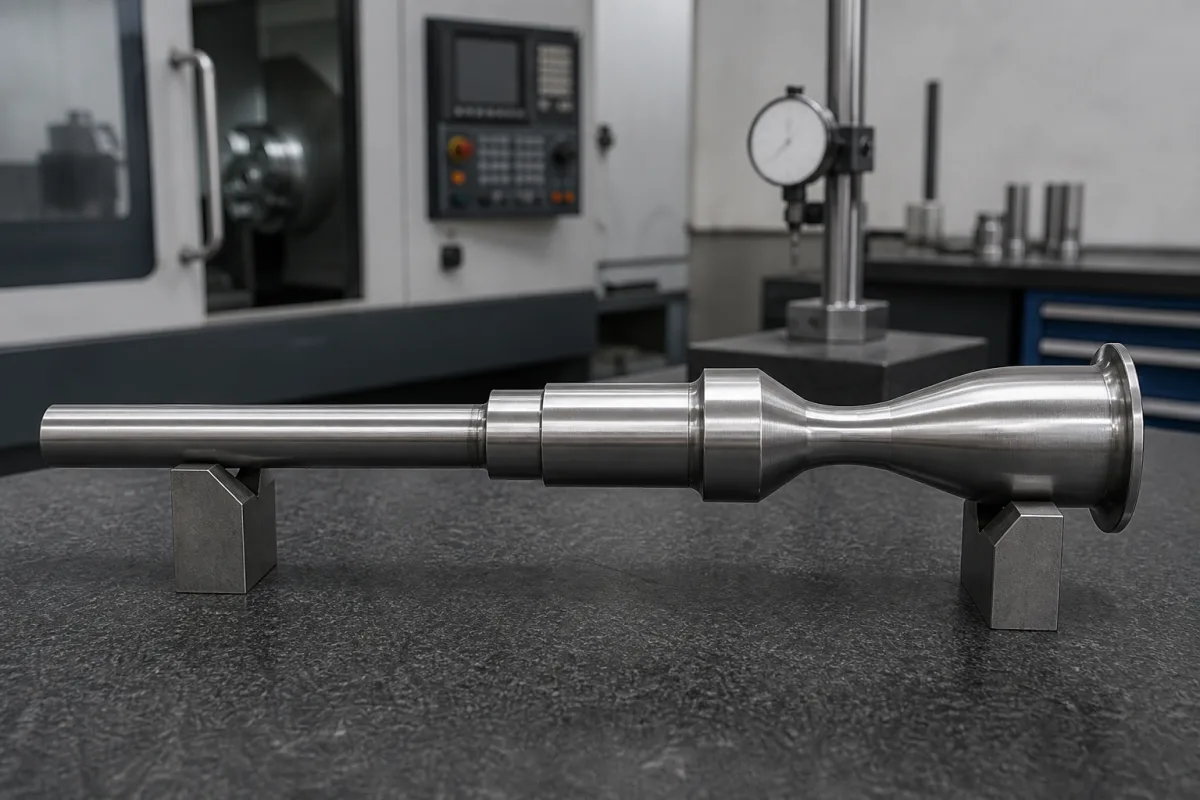
Control valve plug (contoured, perforated and hardfaced trim plugs)
Control valve plug as a trim part: contoured, perforated and close-clearance plugs, Stellite hardfacing or solid Stellite, plug-to-stem pinning, and the leakage class each seat-plug seal reaches
The valve plug is the part of a globe control valve's trim that moves with the stem: its position sets the flow area between plug and seat, its contour sets the flow characteristic, and its seating face makes the shut-off. Plugs are bought as spare or replacement trim as well as inside new valves. Ask three things first: which plug type and characteristic the valve and duty need (contoured, perforated, close-clearance, balanced or soft-seated), which material and hardfacing the seating and guiding surfaces carry, and how the plug is fixed to the stem.
Plugs for globe and angle control valves supplied as trim parts: contoured, perforated, close-clearance, pressure-balanced and soft-seated plugs, with their hardfacing, plug-to-stem connection and guiding surfaces. Complete pneumatic globe control valves, with actuator, positioner, sizing and fail position, are covered on the Pneumatic globe control valve page. Plug valves (quarter-turn valves with a rotating plug), solenoid valve connector plugs and pipe plugs are outside this page.
CNFX editorial research · Sources checked October 12, 2026 · 5 sources
Choose contoured, perforated or close-clearance plug for the duty
SAMSON's data sheet for its Type 3241 globe valve states that the valve plug position determines the cross-sectional area between seat and plug, and lists contoured trim with equal-percentage or linear characteristics, a rangeability of 50:1 for DN 15 to 50, 30:1 for DN 65 to 150 and 50:1 for DN 200 and larger, and options including a perforated plug and a pressure-balanced plug. [1]
SAMSON's perforated plug splits the jet stream into smaller jets for low-noise energy transfer. It is used mainly in steam service, particularly the wet steam region, and also for two-phase flow, liquids that flash at the outlet, and blow-off valves where gas velocities cannot be held at or below 0.3 Mach. It is offered from DN 25 to 500, PN 16 to 400 and –273 to +550 °C depending on valve type, with leakage class IV in metal-seated form and a rangeability of 50:1, and SAMSON advises avoiding media containing solids. [2]
Baker Hughes' Masoneilan 21000 top-guided globe valve offers contoured plugs with linear, equal-percentage or modified-percentage characteristics, single- and multi-stage Lo-dB and anti-cavitation plugs, and close-clearance low-flow trim. Its table for a 2 in (50 mm) valve with a 1.625 in (41.3 mm) orifice and 0.8 in (20.3 mm) travel gives a rated Cv of 46 for a linear contoured plug, with 20.9 at 50% travel; close-clearance trim with a 0.125 in orifice runs from Cv 0.01 to 0.1. [3] Editorial calculation: 20.9 ÷ 46 ≈ 45% of rated Cv at half travel for that linear plug. [3]
Give the supplier the valve make, model, size and seat (orifice) diameter, the plug type and characteristic, rated Cv and travel, the drawing or the plug being replaced, the seat-plug seal and leakage class, the medium, temperature and pressure drop, the material and hardfacing, the stem connection, and the inspection and test documents required.
02
Specify plug material, Stellite facing and the stem connection
The Masoneilan 21000 materials table lists the plug as 316 stainless steel with Stellite (or equivalent) No. 6 hardfacing on the seat, or on the seat and guide, or as solid Stellite No. 6, and notes that a solid Stellite plug is used for Cv smaller than 1.7 and is not available for Lo-dB or anti-cavitation plugs. The plug stem is hardened ASTM A638 Grade 660, with 17-4 PH H1075 substituted where differential pressure requires, and the plug pin is solution-annealed 316 stainless. [3]
SAMSON lists its Type 3241 plugs in stainless grades such as 1.4006, 1.4008 and 1.4404/1.4409 depending on body material, states that all seats and metal-seated plugs are also available with Stellite facing, and offers plugs of solid Stellite for nominal sizes up to DN 100, up to seat bore SB 38. [1]
Fisher Controls' European patent 2 132 450 describes the known way of fixing a plug to its stem: the stem is threaded tightly into the plug, a counter bore is drilled through plug and stem, and a pin is press-fitted to stop the plug rotating. It warns that the force of press-fitting can leave the stem at a non-perpendicular angle to the plug and affect the integrity of the coupling. [4] A related Fisher patent, EP 2 171 322, notes that stem and plug cannot be welded together if either is a non-weldable material or the filler is incompatible with the base material. [5]
03
Match the seat-plug seal to the leakage class
SAMSON lists leakage classes under DIN EN 60534-4 by seat-plug seal for Type 3241: metal seal class IV as standard and class V with the high-performance metal seal, and soft seal class VI; balanced plugs are class IV as standard. It gives the metal seal a temperature range of –196 to +450 °C and the soft seal –196 to +220 °C. [1]
Baker Hughes lists Masoneilan 21000 metal seats at class IV or V and soft seats at class VI under IEC 60534-4 and ANSI/FCI 70.2. [3] A replacement plug must therefore be ordered with the same seal type and lapped or fitted to the seat that sets the class, and tested as an assembly.
04
Plug dimensions, ratings and material values to fix in the order
Field
Published values from reviewed sources
Ask the supplier for
Nominal diameter (mm)
Type 3241 DN 15–300; perforated plugs DN 25–500 by valve type. [1][2]
Valve size and seat bore.
Flow coefficient (Cv)
Example: Cv 46 at 0.8 in travel, 1.625 in orifice. [3]
Rated Cv and characteristic.
Leakage class
Metal IV, high-performance metal V, soft VI. [1][3]
1 company lists this product among what they make. Company figures are quoted from each
company's own website; every card states where the relationship came from.
Shanxi Haoyi Valve Pipe Pieces Co.,Ltd.
Manufacturing site to be confirmed for the order
Lists closed-die forged valve components, including valve plugs, valve seats and brackets, among flanges and custom forgings.
Explore company information and manufacturing capabilities, then discuss the scope of your project with a relevant supplier.
Share this page
Compiled and source-reviewed by the CNFX editorial team.
Each manufacturer above links to the page on that company's own website where the product is listed, with the date we checked it. How we source and review
· Page last updated 13 October 2026
Buyer questions
When is a solid Stellite plug used?
Baker Hughes calls for a solid Stellite plug on Masoneilan 21000 valves for Cv smaller than 1.7; SAMSON offers solid Stellite plugs up to DN 100. [3][1]
What leakage class does a metal-seated plug reach?
SAMSON lists class IV for metal seals, V for its high-performance metal seal and VI for soft seals under DIN EN 60534-4. [1]
What is a perforated plug for?
SAMSON uses it mainly for steam, especially wet steam, and for two-phase, flashing and blow-off service, splitting the jet stream into smaller jets. [2]
Sources and what still needs a direct check
Sources checked 2026-10-12. SAMSON and Baker Hughes (Masoneilan) are control valve makers describing their own trims; the Fisher Controls patents describe plug-to-stem connections. Plug data apply to the named valve series.