Industry-Verified Manufacturing Data (2026)

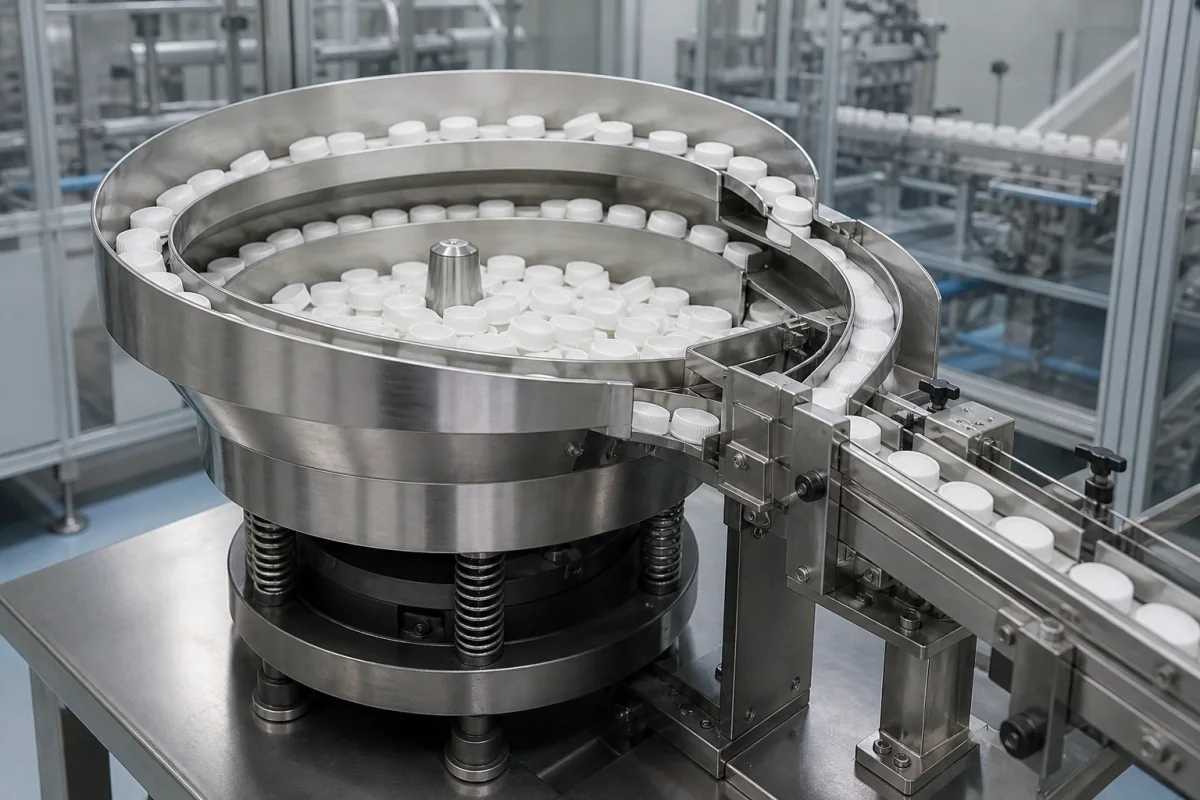
Vibratory Feed Bowl

Based on aggregated insights from multiple verified factory profiles within the CNFX directory, the standard Vibratory Feed Bowl used in the Machinery and Equipment Manufacturing sector typically supports operational capacities ranging from standard industrial configurations to heavy-duty production requirements.

Technical Definition & Core Assembly

A canonical Vibratory Feed Bowl is characterized by the integration of Bowl and Base with Drive Unit. In industrial production environments, manufacturers listed on CNFX commonly emphasize Stainless Steel (AISI 304/316) construction to support stable, high-cycle operation across diverse manufacturing scenarios.

A vibratory bowl feeder component that orients and feeds pharmaceutical tablets into counting and bottling systems.

Product Specifications

Technical details and manufacturing context for Vibratory Feed Bowl

Definition
A vibratory feed bowl is a critical component within pharmaceutical tablet counting and bottling machines. It uses controlled vibrations to move tablets from a bulk hopper, orient them correctly (e.g., with the logo facing up), and singulate them into a single-file stream for accurate counting and subsequent transfer into bottles or blister packs. Its design is crucial for preventing tablet damage, ensuring consistent feed rates, and maintaining high counting accuracy in pharmaceutical packaging lines.
Working Principle
The bowl is mounted on a base containing an electromagnetic drive unit. When energized, this unit creates controlled, rapid vibrations. These vibrations, combined with the bowl's helical track or specially designed tooling (like grooves or pockets), cause tablets to climb the track. The motion separates and aligns the tablets, moving them in a single direction toward the discharge chute for counting.
Common Materials
Stainless Steel (AISI 304/316)
Technical Parameters
  • Bowl diameter, critical for determining capacity and footprint. (mm) Per Request
Components / BOM
  • Bowl
    The main container with an internal helical track that holds and guides tablets.
    Material: Stainless Steel
  • Base with Drive Unit
    Houses the electromagnetic drive that generates controlled vibrations to move the bowl.
    Material: Cast Aluminum or Steel
  • Spring System
    Leaf or coil springs that connect the bowl to the base, allowing and directing the vibratory motion.
    Material: Spring Steel
Engineering Reasoning
0.5-2.0 mm amplitude at 50-100 Hz vibration frequency, 24 VDC power supply with 1.5-3.0 A current draw
Amplitude exceeding 2.5 mm causes tablet fracture, vibration frequency below 40 Hz causes jamming, current draw above 4.0 A causes coil overheating
Design Rationale: Resonant frequency mismatch between bowl (50-100 Hz) and base spring system causes destructive interference, leading to amplitude decay below 0.3 mm and feeding failure
Risk Mitigation (FMEA)
Trigger Electromagnetic coil insulation breakdown due to thermal cycling between 20-80°C
Mode: Coil short circuit causing 60% reduction in magnetic flux density from nominal 0.8 T
Strategy: Epoxy-encapsulated coil design with thermal conductivity of 0.8 W/m·K and glass transition temperature of 130°C
Trigger Polyurethane bowl lining wear exceeding 0.5 mm thickness loss
Mode: Tablet-to-bowl friction coefficient increase from 0.15 to 0.35 causing orientation failure
Strategy: Hard-anodized aluminum bowl surface with 60 μm coating and hardness of 400 HV

Industry Taxonomies & Aliases

Commonly used trade names and technical identifiers for Vibratory Feed Bowl.

Industrial Ecosystem & Supply Chain DNA

Complementary Systems
Downstream Applications
Specialized Tooling

Application Fit & Sizing Matrix

Operational Limits
pressure: Atmospheric (no pressure rating required)
feed rate: Up to 5000 tablets/minute depending on configuration
temperature: 15-35°C (ambient pharmaceutical environment)
tablet size range: 3-25 mm diameter
vibration frequency: 50-100 Hz typical
Media Compatibility
✓ Pharmaceutical tablets (coated/uncoated) ✓ Capsules (gelatin/HPMC) ✓ Small medical devices (e.g., syringe components)
Unsuitable: Abrasive slurries or wet materials (requires dry, free-flowing particulates)
Sizing Data Required
  • Tablet dimensions (diameter, thickness, shape)
  • Required feed rate (tablets/minute)
  • Orientation complexity (simple vs. multi-stage orientation requirements)

Reliability & Engineering Risk Analysis

Failure Mode & Root Cause
Coil burnout
Cause: Overheating due to excessive duty cycles, voltage fluctuations, or inadequate cooling, leading to insulation breakdown and short circuits.
Spring fatigue or fracture
Cause: Cyclic stress from constant vibration exceeding material endurance limits, often accelerated by corrosion, misalignment, or improper spring selection.
Maintenance Indicators
  • Irregular or erratic feeding patterns (e.g., parts jamming, inconsistent orientation)
  • Unusual audible noises such as grinding, scraping, or excessive buzzing beyond normal operational hum
Engineering Tips
  • Implement a preventive maintenance schedule to clean and inspect the bowl track, springs, and coil connections, removing debris and checking for wear or corrosion.
  • Use vibration monitoring tools to baseline normal amplitudes and frequencies, enabling early detection of deviations indicative of imbalance or component wear.

Compliance & Manufacturing Standards

Reference Standards
ISO 9001:2015 - Quality Management Systems ANSI B74.8 - Abrasive Grain Size Specifications CE Marking - Machinery Directive 2006/42/EC
Manufacturing Precision
  • Bowl Alignment: +/-0.05mm
  • Surface Finish: Ra 3.2μm max
Quality Inspection
  • Dimensional Accuracy Verification
  • Vibration Amplitude and Frequency Test

Factories Producing Vibratory Feed Bowl

Verified manufacturers with capability to produce this product in China

✓ 92% Supplier Capability Match Found

S Sourcing Manager from United States Feb 09, 2026
★★★★★
"Testing the Vibratory Feed Bowl now; the technical reliability results are within 1% of the laboratory datasheet."
Technical Specifications Verified
P Procurement Specialist from United Arab Emirates Feb 06, 2026
★★★★☆
"Impressive build quality. Especially the technical reliability is very stable during long-term operation. (Delivery took slightly longer than expected, but technical support was excellent.)"
Technical Specifications Verified
T Technical Director from Australia Feb 03, 2026
★★★★★
"As a professional in the Machinery and Equipment Manufacturing sector, I confirm this Vibratory Feed Bowl meets all ISO standards."
Technical Specifications Verified
Verification Protocol

“Feedback is collected from verified sourcing managers during RFQ (Request for Quote) and factory evaluation processes on CNFX. These reports represent historical performance data and technical audit summaries from our B2B manufacturing network.”

16 sourcing managers are analyzing this specification now. Last inquiry for Vibratory Feed Bowl from Poland (43m ago).

Supply Chain Compatible Machinery & Devices

Automated Assembly Line System

Integrated production system for sequential component assembly operations

Explore Specs →
Automated Powder Coating System

Integrated industrial system for applying dry powder coatings to metal substrates.

Explore Specs →
Centrifugal Pump Impeller

Rotating component that transfers energy to fluid in centrifugal pumps.

Explore Specs →
High-Precision CNC Laser Cutting Machine

Computer-controlled industrial machine using focused laser beams to cut sheet metal with micron-level accuracy.

Explore Specs →

Frequently Asked Questions

What materials are used in this vibratory feed bowl?

This vibratory feed bowl is constructed from food-grade stainless steel, specifically AISI 304 or 316 grades, ensuring corrosion resistance and compliance with pharmaceutical industry hygiene standards.

How does this bowl feeder orient pharmaceutical tablets?

The vibratory motion combined with custom-designed bowl tracks and tooling gently moves tablets into precise orientation for accurate counting and transfer into bottling systems, minimizing product damage.

What components are included in the BOM for this feeder?

The bill of materials includes a base with integrated drive unit for vibration control, a stainless steel bowl with custom tooling, and a spring system that isolates vibration from surrounding equipment.

Can I contact factories directly on CNFX?

CNFX is an open directory, not a transaction platform. Each factory profile provides direct contact information and production details to help you initiate direct inquiries with Chinese suppliers.

Get Quote for Vibratory Feed Bowl

Request technical pricing, lead times, or customized specifications for Vibratory Feed Bowl directly from verified manufacturing units.

Your business information is encrypted and only shared with verified Vibratory Feed Bowl suppliers.

Thank you! Your message has been sent. We'll respond within 1–3 business days.

Need to Manufacture Vibratory Feed Bowl?

Connect with verified factories specializing in this product category

Add Your Factory Contact Us
Previous Product
Vibratory Drum
Next Product
Vibratory Roller