Editorial Technical Reference

Industrial Dough Conditioner Base Powder

This page explains how Industrial Dough Conditioner Base Powder is classified within Manufacture of Bakery and Farinaceous Products. Technical values and manufacturer relationships are research references; confirm the current specification and supplier evidence for each order.

Technical Definition & Core Assembly

Industrial-grade powder blend for optimizing dough rheology and baking performance.

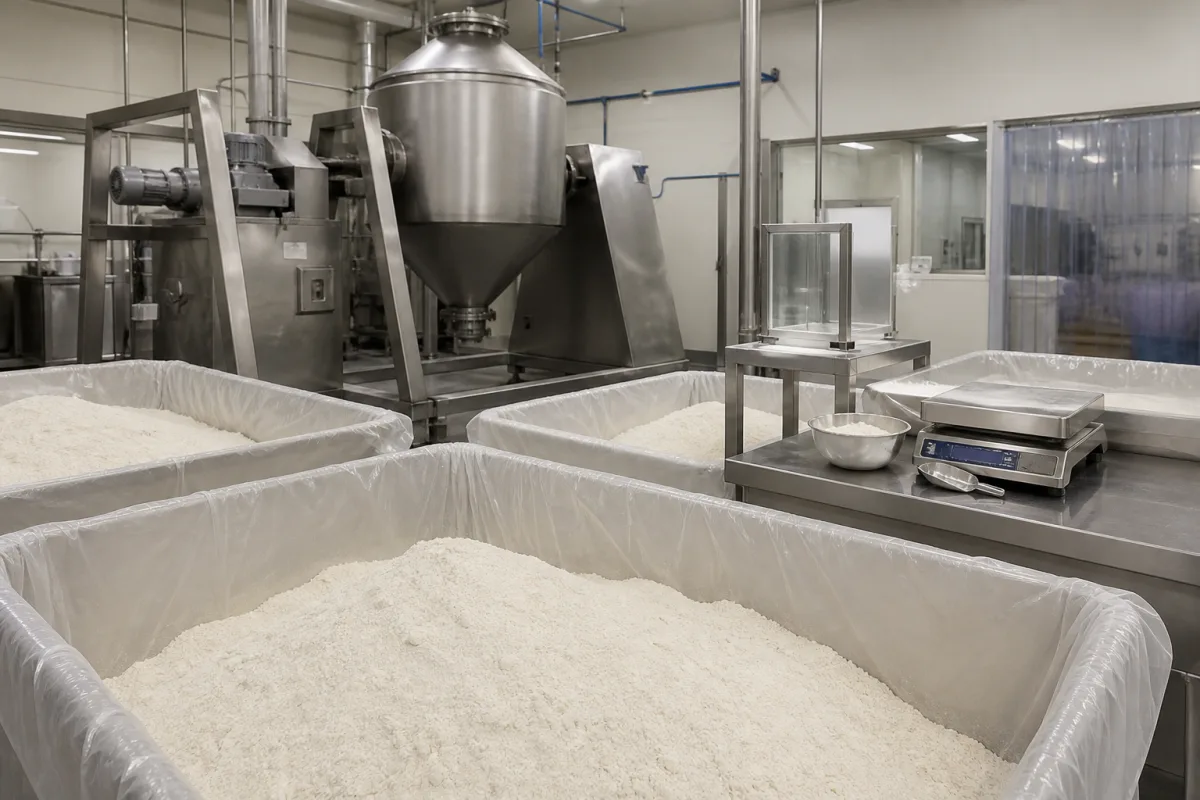
Industrial Dough Conditioner Base Powder in a manufacturing environment
Representative product image. Confirm appearance and specifications with the manufacturer.

Product Specifications

Technical details and manufacturing context for Industrial Dough Conditioner Base Powder

Definition
Industrial Dough Conditioner Base Powder is a standardized, pre-mixed dry powder formulation used in high-volume bakery and farinaceous product manufacturing. It serves as a foundational additive that modifies dough properties such as elasticity, extensibility, water absorption, and fermentation tolerance. This material is supplied in bulk to industrial bakeries and food processing plants, where it is precisely metered into large-scale mixers to ensure consistent product quality and processing efficiency across production batches. Its use is critical for achieving uniform texture, volume, and shelf-life in products like bread, rolls, pastries, and pasta. The powder is typically composed of a wheat flour carrier, enzyme blends (e.g., amylases, xylanases), oxidizing agents (e.g., ascorbic acid), and emulsifiers (e.g., DATEM, SSL). Key parameters include particle size (D90: 75–150 microns), bulk density (0.50–0.70 g/cm³), enzyme activity (Falling Number: 250–350 seconds per ISO 3093), ash content (≤5.0% dry basis per ISO 2171), pH (5.5–6.5 in 10% solution), water absorption index (1.5–2.5%), moisture content (≤8.0% per ISO 712), protein content (10–15% per ISO 20483), fat content (≤3.0% per ISO 11085), total plate count (≤10,000 CFU/g per ISO 4833), shelf life (12–18 months under cool, dry storage), and packaging (20–25 kg multi-layer kraft paper bags). These values are reference ranges for directory purposes and must be confirmed with the legal manufacturer for specific applications. The product is not certified or compliant solely by listing standards; verification is required.
Working Principle
The powder's functional ingredients (e.g., enzymes, oxidants, emulsifiers) interact with flour proteins and starch during mixing and fermentation, modifying gluten network formation, gas retention, and starch gelatinization to optimize dough handling and final baked characteristics. Enzymes like amylases break down damaged starch into fermentable sugars, while xylanases modify arabinoxylans for improved extensibility. Oxidizing agents such as ascorbic acid strengthen the gluten network, and emulsifiers like DATEM and SSL improve dough stability and crumb softness. The carrier flour ensures even distribution of active components. During mixing, the powder hydrates and disperses, influencing water absorption and dough development. Fermentation tolerance is enhanced, allowing consistent proofing. The result is uniform texture, volume, and shelf-life across batches.
Common Materials
Wheat flour carrier, Enzyme blends (e.g., amylases, xylanases), Oxidizing agents (e.g., ascorbic acid), Emulsifiers (e.g., DATEM, SSL)
Technical Parameters
ParameterTypical rangeNotes & selection driver
Particle Size (D90)Required75–150 microns90th percentile particle diameter for dispersion and mixing
Bulk DensityRequired0.50–0.70 g/cm³Loose poured density for volumetric feeding system calibration
Enzyme Activity (Falling Number)Required250–350 secondsAmylase activity measured by Hagberg Falling Number testISO 3093
Ash ContentRequired≤5.0 % dry basisMineral residue indicating carrier flour purityISO 2171
pH (10% Solution)5.5–6.5 pHAcidity/alkalinity of aqueous extract affecting dough pH
Water Absorption Index1.5–2.5 %Maximum water binding capacity of the powder blend
Moisture Content≤8.0 %Prevents caking and microbial growth.ISO 712
Protein Content10–15 %Strengthens gluten network.ISO 20483
Fat Content≤3.0 %Affects crumb softness.ISO 11085
Total Plate Count≤10000 CFU/gEnsures food safety.ISO 4833
Shelf Life12–18 monthsUnder cool, dry storage.
Packaging20–25 kg/bagMulti-layer kraft paper bags.

Ranges are indicative industry figures for RFQ preparation, not a supplier commitment. Confirm every value and standard with the legal manufacturer before ordering.

Components / BOM
  • Flour Carrier Base Part
    Provides bulk, ensures even distribution of active ingredients, and standardizes dosage
    Material: Wheat flour (type 550 or similar)
  • Functional Enzyme Blend
    Modifies starch and non-starch polysaccharides to control dough rheology and crumb structure
    Material: Microbial amylases, hemicellulases, proteases
  • Oxidation System
    Strengthens gluten network through controlled protein cross-linking during mixing and proofing
    Material: Ascorbic acid, potassium bromate (where permitted), azodicarbonamide
  • Emulsifier Dispersion Optional Part
    Improves dough tolerance, gas retention, and final product softness and volume
    Material: Diacetyl tartaric acid esters of monoglycerides (DATEM), sodium stearoyl lactylate (SSL)

Industry Taxonomies & Aliases

Commonly used trade names and technical identifiers for Industrial Dough Conditioner Base Powder.

Industrial Ecosystem & Supply Chain Structure

Complementary Systems
Downstream Applications
Specialized Tooling

Application Fit & Sizing Matrix

Operational Limits
pressure: Atmospheric (powder handling), up to 2 bar for pneumatic conveying
flow rate: Variable based on dosing system, typical 0.5-5 kg/min
temperature: Ambient to 40°C (storage), 15-30°C (mixing)
slurry concentration: 5-15% w/w in water
Media Compatibility
✓ Wheat flour dough systems ✓ High-speed industrial mixers ✓ Stainless steel processing equipment
Unsuitable: High-moisture (>25% water) environments without immediate mixing
Sizing Data Required
  • Daily dough production volume (kg/day)
  • Target dough rheology improvement (e.g., mixing time reduction %)
  • Existing flour specifications and water absorption requirements

Reliability & Engineering Risk Analysis

Failure Mode & Root Cause
Agglomeration and bridging
Cause: Moisture absorption leading to powder clumping, improper storage conditions, or electrostatic buildup causing particles to stick together and obstruct flow
Segregation and demixing
Cause: Particle size variation during handling or vibration, improper blending techniques, or excessive mechanical agitation leading to separation of components
Maintenance Indicators
  • Visible powder caking or hard deposits on equipment surfaces
  • Audible changes in pneumatic conveying systems (increased pressure sounds or flow interruptions)
Engineering Tips
  • Implement controlled humidity storage (maintain below 40% RH) with desiccant systems and use anti-static additives in powder formulation
  • Install vibration monitoring on storage silos and use mass flow meters with feedback control for consistent powder discharge rates

Indicative industry ranges for design and RFQ preparation. Confirm the exact figures and applicable standard with the manufacturer before specifying.

Compliance & Manufacturing Standards

Applicable Standards
ASTM E1958-17 - Standard Practice for Microbial Examination of Water CE Regulation (EC) No 852/2004 - Hygiene of foodstuffs

Quoted from the published standard.

Manufacturing Precision
  • Particle size distribution: +/- 5% of specified mesh range
  • Moisture content: +/- 0.5% of target value
Quality Inspection
  • Microbiological analysis for total plate count and pathogens
  • Spectroscopic analysis for chemical composition verification

Manufacturers of Industrial Dough Conditioner Base Powder

Manufacturer profiles associated with Industrial Dough Conditioner Base Powder.

Sourcing Industrial Dough Conditioner Base Powder from China?
Tell us your specification and target quantity — we will match it against manufacturer records and come back with the factories that fit.
Request manufacturers We manufacture this

Manufacturer listings support early research and capability understanding. They are not certification, ranking, or transaction guarantees.

Share this page
Technical documentation
Request current drawings, revision history, and a signed specification sheet.
Manufacturing capability
Verify equipment lists, process limits, capacity, and representative production evidence.
Inspection readiness
Confirm test methods, calibrated equipment, sampling plans, and traceable reports.
Supplier transparency
Check the legal entity, factory address, ownership, certifications, and direct contacts.

CNFX does not score or rank suppliers. Buyers must verify all claims and documents with the legal manufacturer before ordering.

Frequently Asked Questions

What is the typical particle size of this dough conditioner?

The D90 particle size is typically in the range of 75–150 microns, which facilitates dispersion and mixing in industrial dough systems. Confirm the exact value for your specific batch with the manufacturer.

How is enzyme activity measured?

Enzyme activity is indicated by the Hagberg Falling Number, typically 250–350 seconds, measured according to ISO 3093. This test reflects amylase activity and is a reference for quality control.

What is the recommended storage condition?

Store under cool, dry conditions to maintain quality. The typical shelf life is 12–18 months under such conditions. Always check the manufacturer's recommendations for your specific product.

Is this product certified to any standards?

The listed standards (e.g., ISO 3093, ISO 2171) are reference methods for testing parameters. They do not imply certification of the product. Verify compliance with applicable regulations and supplier certifications.

Data Basis

Editorial classification, named public sources where available, and source-reviewed manufacturer records.

Preliminary Technical Classification
This page supports structured research, RFQ preparation, and supplier evaluation. It does not replace buyer-led supplier qualification, standards review, or technical approval.
Buyer enquiry

Request manufacturing insight for Industrial Dough Conditioner Base Powder

Ask for use case, specification boundaries, supplier type, and RFQ preparation information for this product.

Where it goes
Straight to the CNFX editorial desk, and to the manufacturer if this product is linked to a claimed profile. Nothing is broadcast to a supplier list.
Your details stay here
We do not sell or rent enquiry data, and we do not add you to a mailing list. Used only to answer this request.
No commission, no middleman
CNFX is a directory. We take no cut of any order and never negotiate on a supplier's behalf.
What we don't claim
A listing is not an endorsement. Qualify every supplier and verify every figure yourself before ordering.

Your business information is used only to process this request.

Thank you! Your message has been sent. We'll respond within 1–3 business days.
Sorry, we couldn't send your message. Please try again, or email us at [email protected].

Need to Manufacture Industrial Dough Conditioner Base Powder?

Compare manufacturer profiles with relevant product and process capability.

First Product
Next Product
Industrial Dough Laminator
Get QuotesChat