Industry-Verified Manufacturing Data (2026)

Industrial Dough Divider Blade Assembly

Based on aggregated insights from multiple verified factory profiles within the CNFX directory, the standard Industrial Dough Divider Blade Assembly used in the Manufacture of Bakery and Farinaceous Products sector typically supports operational capacities ranging from standard industrial configurations to heavy-duty production requirements.

Technical Definition & Core Assembly

A canonical Industrial Dough Divider Blade Assembly is characterized by the integration of Primary Cutting Blade/Wire and Blade Holder / Frame. In industrial production environments, manufacturers listed on CNFX commonly emphasize Food-grade stainless steel (e.g., AISI 304, 316) construction to support stable, high-cycle operation across diverse manufacturing scenarios.

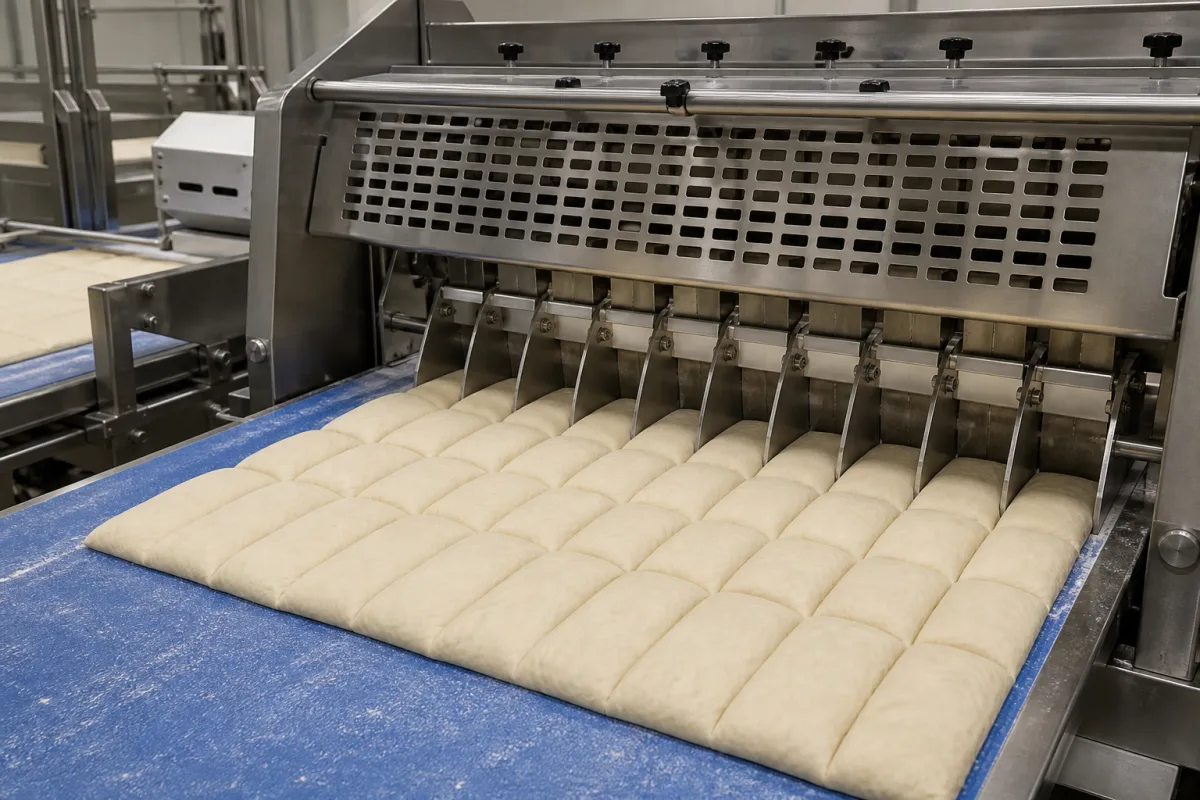
Precision cutting assembly for portioning dough in industrial bakery production lines.
Product Specifications

Technical details and manufacturing context for Industrial Dough Divider Blade Assembly

Definition
A critical wear component in automated bakery production systems, specifically designed for high-volume dough dividing operations. This assembly ensures consistent portion weights and shapes for products like bread loaves, rolls, and pastries. It integrates directly into industrial dough dividers and rounders, forming part of the B2B supply chain for bakery equipment manufacturers and maintenance providers. Its precision directly impacts product uniformity, waste reduction, and overall line efficiency in large-scale food manufacturing.
Working Principle
Mechanically driven blades or wires within a rigid frame cut through bulk dough as it passes through a divider hopper, creating individual portions of predetermined weight and volume.
Common Materials
Food-grade stainless steel (e.g., AISI 304, 316), Hardened tool steel, Food-safe polymer (e.g., PTFE, POM) for guides/bushings
Technical Parameters
  • Cutting blade thickness / wire diameter (mm) Standard Spec
  • Maximum rated operational cycle speed (portions/minute) Standard Spec
Components / BOM
  • Primary Cutting Blade/Wire
    Executes the primary shearing action to separate dough portions
    Material: Hardened tool steel or food-grade stainless steel
  • Blade Holder / Frame
    Provides structural rigidity and precise alignment for all cutting elements
    Material: Food-grade stainless steel (AISI 304/316)
  • Tensioning Mechanism Optional
    Maintains optimal tension on cutting wires (for wire-type assemblies)
    Material: Stainless steel with food-safe polymer bushings
  • Wear Plate / Liner
    Protects non-cutting surfaces from dough adhesion and abrasion
    Material: Food-safe polymer (e.g., PTFE, UHMW-PE) or coated steel
Engineering Reasoning
0.5-3.0 N·m torque at 120-300 RPM rotational speed
Blade edge wear exceeding 0.15 mm radius deviation from original profile
Design Rationale: Abrasive wear from dough particulate (primarily flour silica content of 0.5-2.0%) causing progressive material removal at cutting interface
Risk Mitigation (FMEA)
Trigger Misalignment exceeding 0.05 mm between blade shaft and bearing housing
Mode: Eccentric blade rotation inducing 2.5× nominal vibration amplitude
Strategy: Precision ground bearing seats with H7 tolerance class and laser alignment verification during assembly
Trigger Dough hydration variation below 35% causing dough hardness exceeding 85 Shore A
Mode: Blade edge chipping at stress concentrations exceeding 450 MPa yield strength
Strategy: In-line dough consistency monitoring with real-time blade speed adjustment maintaining 0.8-1.2 m/s cutting velocity

Industry Taxonomies & Aliases

Commonly used trade names and technical identifiers for Industrial Dough Divider Blade Assembly.

Industrial Ecosystem & Supply Chain DNA

Complementary Systems
Downstream Applications
Specialized Tooling

Application Fit & Sizing Matrix

Operational Limits
pressure: Max 5 bar (72.5 psi) hydraulic pressure
other spec: Dough viscosity range: 500-5000 cP, Slurry concentration: Not applicable (solid dough processing)
temperature: 0°C to 50°C (32°F to 122°F)
Media Compatibility
✓ Wheat-based dough ✓ Rye-based dough ✓ Multigrain dough
Unsuitable: High-acidity dough (pH <4.0) with corrosive ingredients
Sizing Data Required
  • Dough batch volume (L/hr)
  • Desired portion weight (g)
  • Production line speed (cycles/min)

Reliability & Engineering Risk Analysis

Failure Mode & Root Cause
Blade edge dulling and deformation
Cause: Repeated impact with dough containing hard contaminants (e.g., bone fragments, metal shavings) or abrasive particles (e.g., sand, mineral residues), combined with cyclic stress from high-speed cutting operations leading to plastic deformation and edge rolling.
Corrosion and pitting at blade-root interface
Cause: Exposure to corrosive cleaning agents (chlorine-based sanitizers, acidic detergents) and moisture ingress in the assembly joint, exacerbated by improper drying after wash-down cycles, leading to galvanic corrosion between dissimilar metals (e.g., stainless steel blade and aluminum housing).
Maintenance Indicators
  • Audible change in cutting sound: high-pitched screeching or irregular thumping indicating blade misalignment, edge damage, or bearing wear in the drive mechanism.
  • Visual dough inconsistency: ragged cuts, uneven portion weights, or dough smearing on blade surfaces, signaling blade dullness, contamination buildup, or excessive clearance in the assembly.
Engineering Tips
  • Implement inline contaminant detection (e.g., metal detectors, X-ray systems) upstream of the divider and establish strict raw material inspection protocols to prevent abrasive or hard foreign objects from reaching the blades.
  • Adopt a precision cleaning and drying regimen: use pH-neutral, corrosion-inhibiting cleaners, ensure complete drying with compressed air directed at blade-root interfaces, and apply food-grade anti-corrosion coatings on non-cutting surfaces during scheduled maintenance.

Compliance & Manufacturing Standards

Reference Standards
ISO 9001:2015 - Quality Management Systems ANSI/NSF 2 - Food Equipment CE Marking - Machinery Directive 2006/42/EC
Manufacturing Precision
  • Blade Edge Sharpness: +/- 0.005mm
  • Assembly Alignment: +/- 0.1mm
Quality Inspection
  • Material Composition Verification via XRF Analysis
  • Surface Roughness Measurement per ISO 4287

Factories Producing Industrial Dough Divider Blade Assembly

Verified manufacturers with capability to produce this product in China

✓ 97% Supplier Capability Match Found

S Sourcing Manager from Canada Feb 13, 2026
★★★★★
"Great transparency on the Industrial Dough Divider Blade Assembly components. Essential for our Manufacture of Bakery and Farinaceous Products supply chain."
Technical Specifications Verified
P Procurement Specialist from United States Feb 10, 2026
★★★★☆
"The Industrial Dough Divider Blade Assembly we sourced perfectly fits our Manufacture of Bakery and Farinaceous Products production line requirements. (Delivery took slightly longer than expected, but technical support was excellent.)"
Technical Specifications Verified
T Technical Director from United Arab Emirates Feb 07, 2026
★★★★★
"Found 36+ suppliers for Industrial Dough Divider Blade Assembly on CNFX, but this spec remains the most cost-effective."
Technical Specifications Verified
Verification Protocol

“Feedback is collected from verified sourcing managers during RFQ (Request for Quote) and factory evaluation processes on CNFX. These reports represent historical performance data and technical audit summaries from our B2B manufacturing network.”

9 sourcing managers are analyzing this specification now. Last inquiry for Industrial Dough Divider Blade Assembly from Vietnam (1h ago).

Frequently Asked Questions

What materials are used in this dough divider blade assembly?

The assembly uses food-grade stainless steel (AISI 304/316) for corrosion resistance, hardened tool steel for cutting blades, and food-safe polymers like PTFE or POM for guides and bushings to ensure hygiene and durability.

How does this blade assembly improve bakery production efficiency?

It provides precise, consistent dough portioning with minimal waste, reduces downtime through durable construction, and maintains hygiene standards with food-safe materials, enhancing overall production line throughput.

What maintenance is required for this industrial dough divider blade?

Regular cleaning with food-safe sanitizers, periodic inspection for blade wear or tension, and lubrication of polymer components as per manufacturer guidelines ensure optimal performance and longevity.

Can I contact factories directly on CNFX?

CNFX is an open directory, not a transaction platform. Each factory profile provides direct contact information and production details to help you initiate direct inquiries with Chinese suppliers.

Get Quote for Industrial Dough Divider Blade Assembly

Request technical pricing, lead times, or customized specifications for Industrial Dough Divider Blade Assembly directly from verified manufacturing units.

Your business information is encrypted and only shared with verified Industrial Dough Divider Blade Assembly suppliers.

Thank you! Your message has been sent. We'll respond within 1–3 business days.

Need to Manufacture Industrial Dough Divider Blade Assembly?

Connect with verified factories specializing in this product category

Add Your Factory Contact Us
Previous Product
Industrial Dough Conditioner Base Powder
Next Product
Industrial Dough Laminator