Industry-Verified Manufacturing Data (2026)

Functional Enzyme Blend

Based on aggregated insights from multiple verified factory profiles within the CNFX directory, the standard Functional Enzyme Blend used in the Food Manufacturing sector typically supports operational capacities ranging from standard industrial configurations to heavy-duty production requirements.

Technical Definition & Core Assembly

A canonical Functional Enzyme Blend is characterized by the integration of Alpha-Amylase and Protease. In industrial production environments, manufacturers listed on CNFX commonly emphasize Enzyme proteins (amylase, protease, hemicellulase, lipase, oxidase) construction to support stable, high-cycle operation across diverse manufacturing scenarios.

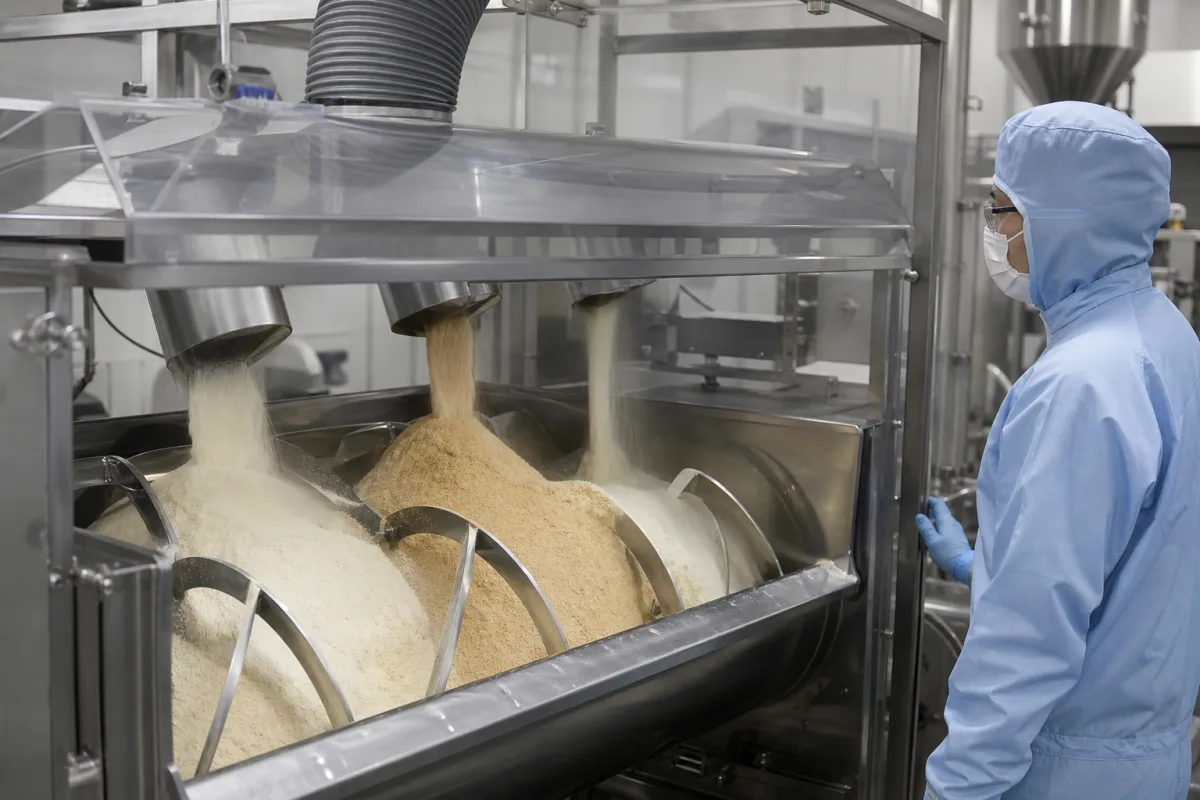
A specialized blend of enzymes designed to modify dough properties in industrial baking applications.
Product Specifications

Technical details and manufacturing context for Functional Enzyme Blend

Definition
A precisely formulated mixture of enzymes that functions as a key component within Industrial Dough Conditioner Base Powder. It works synergistically to improve dough handling characteristics, enhance fermentation, optimize crumb structure, and extend shelf life in mass-produced baked goods.
Working Principle
The blend contains specific enzymes (e.g., amylases, proteases, hemicellulases, lipases, oxidases) that catalyze biochemical reactions in the dough. Amylases break down starch to provide fermentable sugars for yeast, improving gas production and crust color. Proteases modify gluten proteins to increase dough extensibility and reduce mixing time. Hemicellulases and oxidases strengthen the gluten network and improve dough stability. The combined action results in more consistent, machinable dough with improved volume, texture, and freshness retention.
Common Materials
Enzyme proteins (amylase, protease, hemicellulase, lipase, oxidase), Carrier/stabilizer (maltodextrin, starch, calcium carbonate)
Technical Parameters
  • Recommended dosage range per kilogram of flour, typically between 50-500 mg/kg depending on flour type and desired effect. (mg/kg) Standard Spec
Components / BOM
  • Alpha-Amylase
    Breaks down starch into fermentable sugars (maltose, dextrins) to support yeast fermentation and improve crust color
    Material: Enzyme protein (typically from fungal or bacterial sources)
  • Protease
    Modifies gluten proteins to increase dough extensibility, reduce mixing time, and improve machinability
    Material: Enzyme protein (typically fungal protease)
  • Hemicellulase (Xylanase)
    Breaks down hemicellulose in flour to improve dough handling, increase water absorption, and enhance loaf volume
    Material: Enzyme protein
  • Carrier/Stabilizer Base
    Provides physical support for enzyme particles, prevents degradation, ensures uniform distribution in powder blends
    Material: Maltodextrin, starch, or calcium carbonate
Engineering Reasoning
0.5-2.0% by flour weight at 25-35°C
Enzyme denaturation at 60°C for 300 seconds or pH <3.5 for 120 minutes
Design Rationale: Protein tertiary structure disruption via thermal kinetic energy exceeding hydrogen bond strength (4-13 kJ/mol) or acid hydrolysis of peptide bonds
Risk Mitigation (FMEA)
Trigger Thermal exposure exceeding 60°C during dough mixing
Mode: Enzyme denaturation causing 85% reduction in catalytic activity
Strategy: Integrated temperature feedback loop with PID control maintaining 25-35°C mixing zone
Trigger pH drop below 3.5 due to acidic ingredient addition sequence error
Mode: Irreversible enzyme protonation and precipitation
Strategy: Automated pH monitoring with peristaltic acid/base dosing system maintaining 4.5-5.5 pH range

Industry Taxonomies & Aliases

Commonly used trade names and technical identifiers for Functional Enzyme Blend.

Industrial Ecosystem & Supply Chain DNA

Complementary Systems
Downstream Applications
Specialized Tooling

Application Fit & Sizing Matrix

Operational Limits
pH range: 4.5-7.0 (optimal 5.5-6.5)
pressure: Atmospheric (non-pressurized system)
temperature: 15-40°C (optimal 25-35°C)
mixing shear: Low to moderate (avoid high shear)
slurry concentration: 0.1-2.0% w/w in water
Media Compatibility
✓ Stainless steel 316L mixing vessels ✓ Food-grade polyethylene piping ✓ PTFE-lined storage tanks
Unsuitable: Copper or brass contact surfaces (catalytic deactivation)
Sizing Data Required
  • Daily flour throughput (kg/day)
  • Dough hydration percentage (%)
  • Target dough modification time (minutes)

Reliability & Engineering Risk Analysis

Failure Mode & Root Cause
Enzyme denaturation/deactivation
Cause: Exposure to extreme temperatures (outside 15-40°C range), pH shifts beyond optimal 6.5-8.0, or incompatible chemical contamination
Biological contamination/microbial growth
Cause: Inadequate storage conditions (moisture ingress, poor ventilation), improper handling introducing contaminants, or extended storage beyond shelf life
Maintenance Indicators
  • Visible microbial growth or discoloration in the blend
  • Significant reduction in process efficiency or product quality despite proper application
Engineering Tips
  • Implement strict environmental controls: maintain storage at 20-25°C with 40-60% RH, use sealed containers, and monitor pH regularly
  • Establish first-in-first-out (FIFO) inventory management and regular potency testing to ensure enzymatic activity remains within specified ranges

Compliance & Manufacturing Standards

Reference Standards
ISO 9001:2015 - Quality Management Systems ISO 22000:2018 - Food Safety Management Systems CE Marking - EU Regulation (EC) No 178/2002 for Food Enzymes
Manufacturing Precision
  • Enzyme Activity: +/- 5% of declared value
  • Moisture Content: <= 5.0% by weight
Quality Inspection
  • HPLC Analysis for Enzyme Purity and Identity
  • Microbiological Testing for Total Aerobic Count and Pathogens

Factories Producing Functional Enzyme Blend

Verified manufacturers with capability to produce this product in China

✓ 96% Supplier Capability Match Found

S Sourcing Manager from Australia Jan 09, 2026
★★★★★
"Great transparency on the Functional Enzyme Blend components. Essential for our Food Manufacturing supply chain."
Technical Specifications Verified
P Procurement Specialist from Singapore Jan 06, 2026
★★★★☆
"The Functional Enzyme Blend we sourced perfectly fits our Food Manufacturing production line requirements. (Delivery took slightly longer than expected, but technical support was excellent.)"
Technical Specifications Verified
T Technical Director from Germany Jan 03, 2026
★★★★★
"Found 22+ suppliers for Functional Enzyme Blend on CNFX, but this spec remains the most cost-effective."
Technical Specifications Verified
Verification Protocol

“Feedback is collected from verified sourcing managers during RFQ (Request for Quote) and factory evaluation processes on CNFX. These reports represent historical performance data and technical audit summaries from our B2B manufacturing network.”

16 sourcing managers are analyzing this specification now. Last inquiry for Functional Enzyme Blend from UAE (1h ago).

Supply Chain Compatible Machinery & Devices

Automated Food Packaging Integrity Tester

Automated system for non-destructive testing of food package seals and integrity.

Explore Specs →
Automated Food Moisture Analyzer

Automated system for precise moisture content measurement in food products

Explore Specs →
Automated Food Color Consistency Analyzer

Automated inline system for real-time color measurement and consistency control in food processing.

Explore Specs →
Control Panel

A centralized interface for monitoring and controlling industrial equipment and processes

Explore Specs →

Frequently Asked Questions

How does this enzyme blend improve dough properties in industrial baking?

This specialized blend modifies dough by breaking down starches (amylase), proteins (protease), and fibers (hemicellulase) to enhance texture, increase volume, improve machinability, and extend shelf life in baked goods.

What are the key applications for this functional enzyme blend in food manufacturing?

Primarily used in industrial bread, rolls, and pastry production for dough conditioning, crumb softening, anti-staling, and consistency improvement across high-volume baking operations.

How should this enzyme blend be stored and handled in a manufacturing facility?

Store in a cool, dry place below 25°C (77°F) in sealed containers. Use standard industrial enzyme handling procedures with appropriate PPE. The maltodextrin/starch carrier ensures stability during storage and processing.

Can I contact factories directly on CNFX?

CNFX is an open directory, not a transaction platform. Each factory profile provides direct contact information and production details to help you initiate direct inquiries with Chinese suppliers.

Get Quote for Functional Enzyme Blend

Request technical pricing, lead times, or customized specifications for Functional Enzyme Blend directly from verified manufacturing units.

Your business information is encrypted and only shared with verified Functional Enzyme Blend suppliers.

Thank you! Your message has been sent. We'll respond within 1–3 business days.

Need to Manufacture Functional Enzyme Blend?

Connect with verified factories specializing in this product category

Add Your Factory Contact Us
Previous Product
Food-Grade Sanitary Gasket
Next Product
Gap Adjustment Mechanism