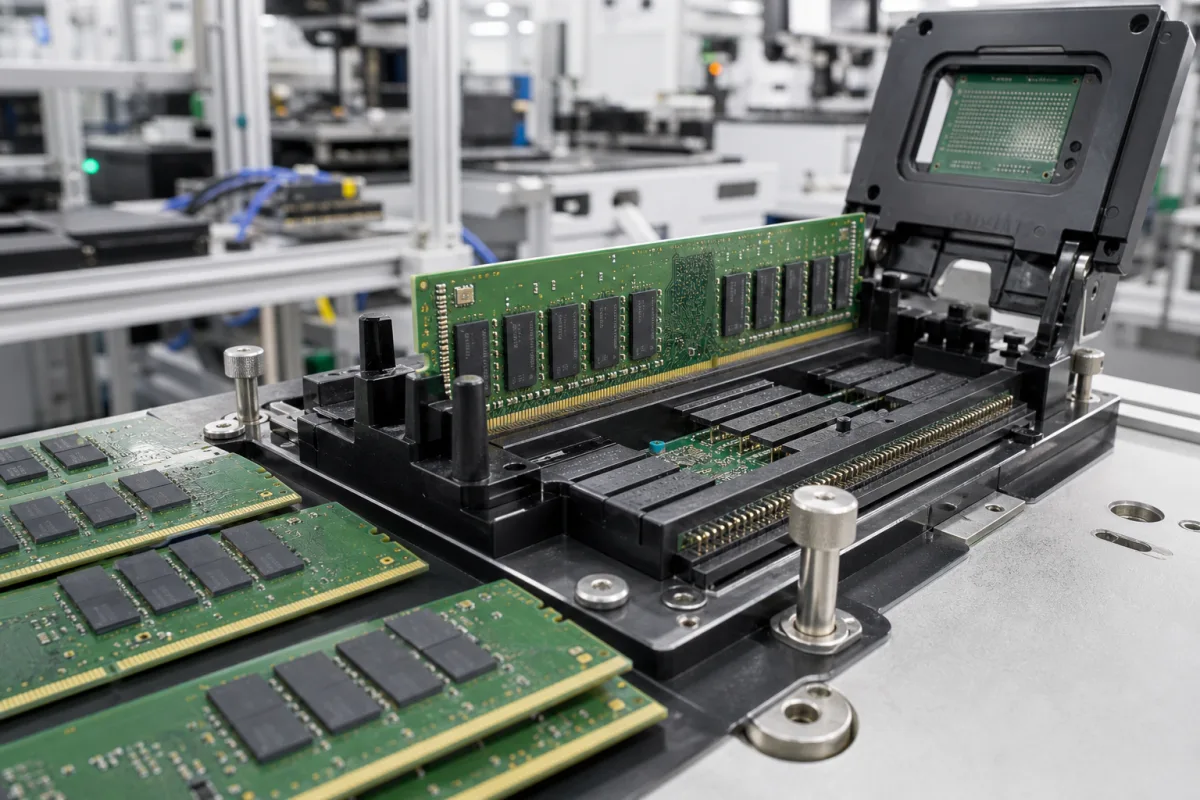
DDR5 DRAM modules · Data rate and bandwidth, two 32-bit subchannels and burst length, PMIC and SPD hub, ECC types and form factors
A high-speed memory module is a small circuit board carrying DRAM chips, an SPD device and, for DDR5, a power management IC, plugged into a computer's memory slot to provide working memory. Ask three things first: what data rate, capacity and module type (UDIMM, SODIMM, RDIMM) the system supports, whether you need module-level ECC rather than only on-die ECC, and what temperature grade and validation the application requires.
DDR5 (and, for comparison, DDR4) unbuffered, registered and small-outline DRAM modules for PCs, servers, industrial and embedded computers. Flash storage, USB drives, graphics memory soldered on boards and memory controllers are outside this page.
CNFX editorial research · Sources checked October 11, 2026 · 4 sources
Kingston's summary of the JEDEC DDR5 standard lists data rates of 4,000–6,400 MT/s, monolithic DRAM densities of 8–64 Gb, VDD/VDDQ of 1.1 V with VPP of 1.8 V, burst length 16 (BC8, optional BL32), 32 banks in 8 bank groups for x4/x8 devices, and form factors of 288-pin DIMMs and 262-pin SODIMMs in registered, load-reduced, ECC and non-ECC unbuffered versions, with the centre key moved so DDR5 cannot be fitted into DDR4 sockets and keyed differently for UDIMMs and RDIMMs. It notes DDR5 debuts at 4,800 MT/s against DDR4's top of 3,200 MT/s. [1]
Micron's white paper explains that a DDR5 module has two independent subchannels, each with up to two package ranks; the default burst length rose from 8 to 16 so that each 32-bit subchannel delivers a 64-byte payload, and a read from both subchannels returns 128 bytes. The subchannels increase concurrency and let the memory controller schedule better. [2]
Editorial calculation: following Kingston's DDR4-3200 example (3,200 MT/s × 8 bytes = 25.6 GB/s), a 64-bit DDR5-4800 module moves 4,800 × 8 = 38.4 GB/s and DDR5-6400 about 51.2 GB/s per module before efficiency losses. [1]
Give the supplier the host platform and supported speeds, module type (UDIMM, SODIMM, RDIMM, ECC UDIMM), capacity and rank, data rate and CAS latency, ECC requirement, temperature grade (commercial, industrial), conformal coating or anti-sulphur needs, compatibility and validation lists, lifecycle and BOM-lock requirements, and quantities.
02
Choose ECC type and check power and sensing
Kingston explains that on-die ECC corrects bit errors inside the DRAM chip but cannot correct errors outside the chip or on the bus between module and memory controller; system-level ECC needs extra DRAM bits on ECC module types (ECC unbuffered, registered, load-reduced), which add 8 bits per subchannel for 40 bits per subchannel or 80 bits per rank. Kingston lists on-die ECC as 128b+8b single-error correction with error check and scrub. [1]
DDR5 modules carry an on-board power management IC that regulates power for the DRAM, register and SPD hub, fed at 12 V on server modules and 5 V on PC modules, which Kingston says improves power distribution, signal integrity and noise. An SPD hub integrates the SPD EEPROM with hub functions, server RDIMMs and LRDIMMs add temperature sensors at the module ends, and at 1.1 V DDR5 uses about 20% less power than DDR4 at 1.2 V. [1] Micron notes that the SPD hub communicates over a sideband I3C bus, scaling sideband bandwidth. [2]
Editorial note: 'DDR5' alone does not mean ECC-protected memory; for servers and critical industrial systems, specify ECC module types and confirm the host supports them.
03
Check the module's interface chips on server RDIMMs
Rambus, a maker of DDR5 memory interface chips, describes the server RDIMM chipset as four device types: the registering clock driver (RCD), which distributes command/address signals, chip select and clock to the DRAM devices; the power management IC (PMIC); the SPD hub, which communicates configuration and thermal data over the I3C bus and has an integrated temperature sensor; and two separate temperature sensors per DIMM, which with the SPD hub give three points of thermal telemetry on the module. [3]
Its product table lists RCD generations rated for server RDIMMs at 4,800, 5,600, 6,400, 7,200, 8,000 and 9,600 MT/s, a multiplexed RCD and data buffer for 12,800 MT/s MRDIMMs, PMIC5000 and PMIC5020 for RDIMMs of 4,800–7,200 MT/s, and PMIC5030 for RDIMMs of 8,000–9,600 MT/s and MRDIMMs of 12,800 MT/s; the SPD hub with internal temperature sensor is listed for server RDIMMs and MRDIMMs and for client UDIMM, SODIMM, CSODIMM and CUDIMM modules. [3]
Rambus states that DDR4 DIMMs top out at 3,200 MT/s and the first DDR5 DIMMs launched at 4,800 MT/s, a 50% increase, and that DDR5 DIMMs support up to 4 times the capacity of DDR4 DIMMs — 256 GB against 64 GB for DIMMs built from single-die package DRAM devices. [3] Editorial note: the chip ratings above are the interface chips' limits; the module's rated speed is set by the DRAM, the RCD generation fitted and the host platform, so ask the supplier for the part numbers of the RCD, PMIC and SPD hub on the module and the host validation list.
04
DDR4 and DDR5 modules in consumer, industrial and automotive grades
The listing reviewed offers DDR4 and DDR5 memory modules in consumer, industrial and automotive grades; ask for the DRAM chip source, validation and temperature grade of each part.
Industrial module lines are specified by temperature grade as well as speed. ATP Electronics lists its Momentum Line DDR5 modules as JEDEC-compliant ECC and non-ECC UDIMMs and SO-DIMMs, all low-profile and rated up to 5,600 MT/s, with densities of 16 to 32 GB for the ECC types and 8 to 32 GB for the non-ECC types, each offered for 0 °C to 85 °C or −40 °C to 85 °C operation. ATP adds that densities may vary by product and project support. [4]
Editorial calculation: 5,600 MT/s on a 64-bit (two 32-bit subchannel) data path is 5,600 × 8 bytes ≈ 44.8 GB/s per module, about 88% of the 51.2 GB/s at the 6,400 MT/s top of Kingston's JEDEC range; the −40 °C grade widens the temperature span from 85 K to 125 K. [4][1][2]
05
DRAM chips, PMIC, SPD hub, register, temperature sensors and edge connector
On a DDR5 module the power regulation sits on the board: the PMIC is fed at 12 V on server modules and 5 V on PC modules, so its input voltage belongs in the order even though the DRAM runs at 1.1 V. [1]
ECC or non-ECC, UDIMM or SO-DIMM; sets density range, e.g. 16–32 GB ECC, 8–32 GB non-ECC. [4]
Type; temperature grade.
06
Capacity, data rate, CAS latency, voltage, height and temperature grade for a module order
Temperature grade separates an industrial module from a PC part: ATP sells the same DDR5 line in 0 to 85 °C and −40 to 85 °C grades, so state which one the enclosure needs. [4]
1 company lists this product among what they make. Company figures are quoted from each
company's own website; every card states where the relationship came from.
Powev Electronic Technology Co., Ltd.
Manufacturing site to be confirmed for the order
Lists DDR4 and DDR5 memory modules in consumer, industrial and automotive grades.
Explore company information and manufacturing capabilities, then discuss the scope of your project with a relevant supplier.
Share this page
Compiled and source-reviewed by the CNFX editorial team.
Each manufacturer above links to the page on that company's own website where the product is listed, with the date we checked it. How we source and review
· Page last updated 13 October 2026
Buyer questions
What voltage does DDR5 use?
VDD/VDDQ 1.1 V and VPP 1.8 V, per Kingston's JEDEC summary. [1]
Is DDR5 on-die ECC the same as ECC memory?
No; on-die ECC corrects errors only inside the DRAM chip; system ECC needs ECC module types with extra bits. [1]
What are DDR5 subchannels?
Micron describes two independent 32-bit subchannels per module, each delivering 64 bytes with burst length 16. [2]
Which chips sit on a DDR5 server RDIMM besides the DRAM?
Rambus lists a registering clock driver, a power management IC, an SPD hub with an internal temperature sensor and two temperature sensors per DIMM. [3]
Are industrial-temperature DDR5 modules available?
ATP lists DDR5 UDIMMs and SO-DIMMs up to 5,600 MT/s in 0 to 85 °C and −40 to 85 °C grades. [4]
Sources and what still needs a direct check
Sources checked 2026-10-11. Kingston and Micron are memory makers summarising the JEDEC DDR5 standard and their module designs, ATP Electronics makes industrial DDR5 modules, and Rambus is a maker of the RCD, PMIC and SPD hub chips fitted to DDR5 modules; Powev is a linked supplier. The JEDEC standard governs requirements.