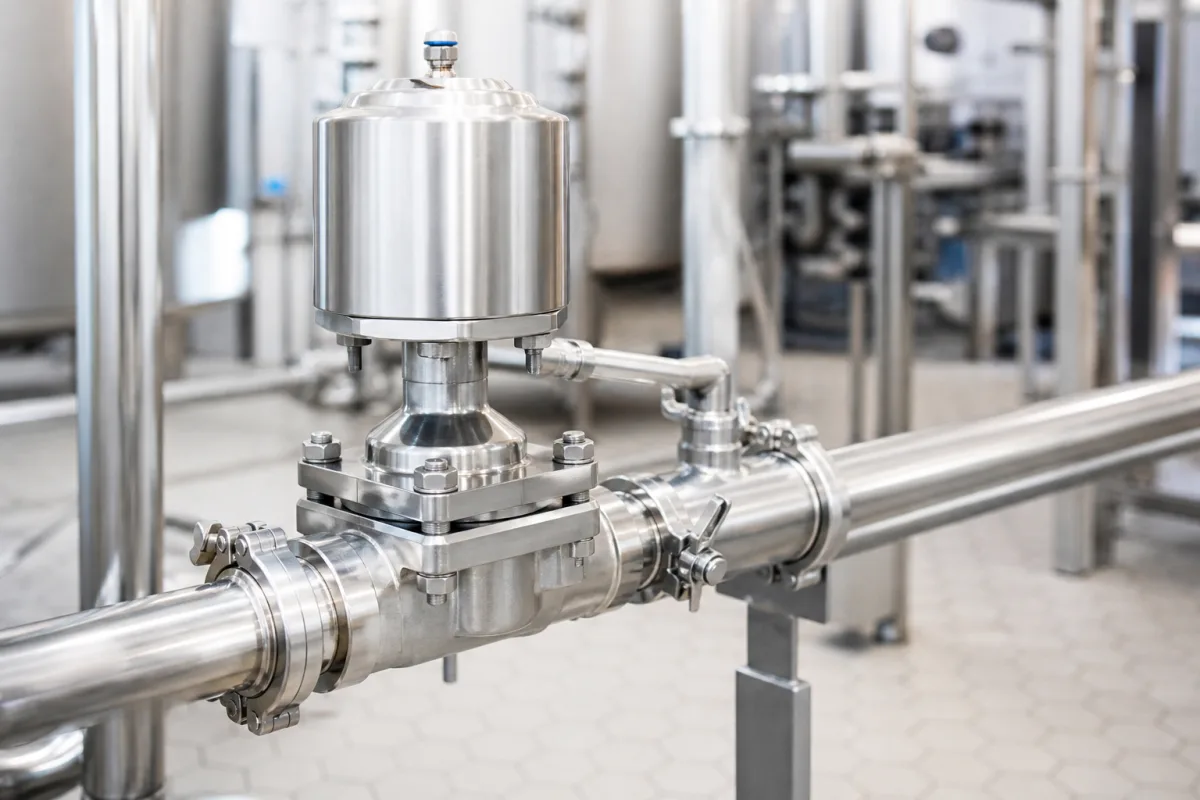
Hygienic process valves · Diaphragm material for CIP and steam, weir or radial body, drainability and line slope, food-contact rubber
A sanitary diaphragm valve isolates or regulates product, water or steam lines by pressing a flexible diaphragm onto the valve body, so the actuator never touches the product. Ask three things first: which diaphragm material will survive your cleaning and sterilising temperatures, whether a weir or radial body suits your drainability and flow needs, and what food-contact and traceability documents come with the wetted parts.
Hygienic (sanitary) diaphragm valves with stainless-steel bodies, manual or pneumatic, for dairy, food and beverage and similar clean processes, including lined variants for aggressive media. Butterfly, seat and ball valves, diaphragm pumps and industrial rubber-lined diaphragm valves for slurries are outside this page.
CNFX editorial research · Sources checked October 12, 2026 · 4 sources
Pick a diaphragm that survives your cleaning and steam temperatures
Crane's Saunders EX datasheet says EPDM rubbers suffer damage with prolonged exposure to heat-sterilisation temperatures, losing resiliency and compression-set resistance, which weakens an EPDM backing's ability to press a PTFE diaphragm face onto its seat. Its EX diaphragm uses a modified PTFE wetted face with a fabric-reinforced silicone backing, tested on continuous steam at 175 °C, rated 175 °C constant and intermittent and −20 °C minimum. [1]
The same datasheet lists conformance to FDA 21 CFR part 177, USP Class VI, ASME BPE part SG, animal-derived-component-free certification and EN 10204 3.1 lot traceability, with diaphragms marked with production date, cure date, grade and size. [1]
US 21 CFR 177.2600 lists ethylene-propylene copolymer elastomers and silicone elastomers among rubbers permitted for repeated food contact. For aqueous food the finished food-contact surface may yield no more than 20 mg/in² of water extractives in the first 7 hours and 1 mg/in² in the next 2 hours; for fatty food, 175 mg/in² then 4 mg/in² with n-hexane. Articles must be cleansed before first use with food. [3]
Editorial calculation: those limits are about 3.1 and 0.16 mg/cm² for aqueous food and 27.1 and 0.62 mg/cm² for fatty food (1 in² = 6.45 cm²). [3]
Give the supplier the media (milk, cream, whey, CIP chemicals, water, steam), CIP and SIP temperatures and durations, pressure, size and end connections, body form, actuator type and fail position, surface finish, and the certificates you need for wetted metal and the diaphragm.
02
Choose a body and line slope that drain
A Swagelok article in Pharmaceutical Processing notes that weir-style diaphragm valves are the established standard in validated systems, but in the open position the diaphragm lifts and exposes the body around the bowl, so small amounts of fluid can be trapped as it closes. Radial diaphragm designs seal along the bowl edge and are configured for full drainability, while an equivalent-size weir valve gives a higher flow rate. [2]
The article says ASME BPE section SD 3.12 gives drainability directives without a specific slope, and that “most companies abide by the commonly accepted guideline of a minimum 1/8 inch or 1/4 inch per foot”, which it equates to 0.6° and 1.2°. It also warns that clamp gaskets in ISO 2852 fittings can extrude into the flow path when tightened, more so with thermal cycling, causing turbulence and hold-up on draining. [2]
Editorial calculation: 1/8 in per foot is about 10 mm per metre and 1/4 in per foot about 21 mm per metre of line. [2] Editorial note: a weir body drains fully only when installed at the maker's drain angle, so ask the supplier for that angle for your size and body type.
03
Read a weir-type aseptic valve datasheet: pressure, steam and documentation
Alfa Laval's product page for the "Unique DV-ST UltraPure" describes a weir-type aseptic diaphragm valve, operated manually or pneumatically. It offers EPDM, PTFE/EPDM and M-PTFE diaphragms. The page rates the EPDM diaphragm for continuous steam operation at temperatures up to 150°C, and its actuators work at product pressures of up to 10 bar, depending on valve size, diaphragm material and actuator. [4]
The page states that all diaphragms have cure dates and compound tracking available, "meet FDA/USP classifications" and are TSE/ADI-compliant, and that the valves ship with the Q-doc documentation package covering product contact parts. Two-way bodies, including the ferrules for clamp-end bodies, are forged from a single block with low delta-ferrite and defined sulphur content. Use these as items to request in writing: cure date, compound batch, and the body material certificate. [4]
Compare the steam ratings across makers before choosing a diaphragm. Alfa Laval quotes 150°C continuous steam for its EPDM diaphragm [4], while Crane's Saunders EX datasheet rates its PTFE-faced diaphragm with silicone backing at 175 °C constant and intermittent [1]. The Swagelok article says a weir-style valve allows small quantities of fluid to become trapped as the diaphragm closes, and cites a line slope guideline of a minimum 1/8 inch or 1/4 inch per foot [2]; Alfa Laval says its slim actuator facilitates easy installation of the correct drain angle where space is tight [4].
Editorial calculation: 175 °C minus 150°C is a 25 °C gap between the two published diaphragm steam ratings, so a line sterilised above 150°C falls outside the EPDM figure Alfa Laval publishes. [4][1]
Item
Unique DV-ST UltraPure Slim (SS/SL)
Unique DV-ST UltraPure High Pressure (SS/HP)
Product pressure
Up to 10 bar (∆=100%), depending on valve size and diaphragm material
Up to 10 bar (∆=0%), depending on diaphragm material
Actuator functions
NC, NO, A/A; ATEX versions
NC, NO, A/A; ATEX versions
Option named
Stroke limiter for flow control
—
Diaphragm materials (range)
EPDM, PTFE/EPDM, M-PTFE
EPDM, PTFE/EPDM, M-PTFE
EPDM steam rating
Continuous steam up to 150°C
Continuous steam up to 150°C
Actuator warranty
Five years
Five years
Values are from Alfa Laval's product page; size-by-size pressure tables were not reviewed.
04
Manual, pneumatic, three-way, aseptic and PFA-lined sanitary diaphragm valves
Listings include manual and pneumatic sanitary diaphragm valves with clamp or weld ends, three-way and aseptic types, and PFA-lined sanitary diaphragm valves for aggressive media.
05
Diaphragm, weir or radial body, end connections, bonnet and compressor, actuator and elastomers
The diaphragm isolates the actuator from the product and carries both the steam-temperature limit and the food-contact paperwork, while the body form decides whether the valve drains. [1][2]
Part
Role
Fix in the order
Diaphragm
Seals on the body; isolates actuator from product. [1]
Temperature range, pressure, body form, diaphragm material and documentation for a valve order
Read the temperature row against the diaphragm, not the body: Alfa Laval rates its EPDM diaphragm to 150°C continuous steam and Crane's PTFE-faced Saunders EX diaphragm to 175 °C. [4][1]
12 companies list this product among what they make. Company figures are quoted from each
company's own website; every card states where the relationship came from.
China Sanitary Valve
Manufacturing site to be confirmed for the order
Lists food-grade and hygienic-grade sanitary diaphragm valves.
Explore company information and manufacturing capabilities, then discuss the scope of your project with a relevant supplier.
Share this page
Compiled and source-reviewed by the CNFX editorial team.
Each manufacturer above links to the page on that company's own website where the product is listed, with the date we checked it. How we source and review
· Page last updated 13 October 2026
Buyer questions
Is EPDM suitable for steam-sterilised diaphragm valves?
Crane's Saunders datasheet says EPDM is damaged by prolonged heat-sterilisation exposure, and offers a PTFE face with silicone backing tested on continuous steam at 175 °C. [1]
What line slope helps sanitary valves drain?
A Swagelok article cites “the commonly accepted guideline of a minimum 1/8 inch or 1/4 inch per foot”, about 0.6° to 1.2°. [2]
What food-contact rules apply to the diaphragm?
In the US, 21 CFR 177.2600 lists permitted rubbers, including ethylene-propylene and silicone elastomers, and sets extraction limits for the finished food-contact surface. [3]
What steam temperature can an EPDM diaphragm in a sanitary diaphragm valve take?
Alfa Laval rates the EPDM diaphragm in its Unique DV-ST UltraPure valve for continuous steam operation at temperatures up to 150°C; Crane's Saunders EX PTFE-faced diaphragm is rated 175 °C. Check the maker's figure for the diaphragm you are buying. [4][1]
Sources and what still needs a direct check
Sources checked 2026-10-12. Crane (Saunders) and Alfa Laval are diaphragm valve makers describing their own valves and diaphragms; the Swagelok article is a supplier's view published in a trade journal (2005); 21 CFR 177.2600 is the US regulation, and other markets have their own rules.