Beverage & dairy process equipment · Buyer's guide
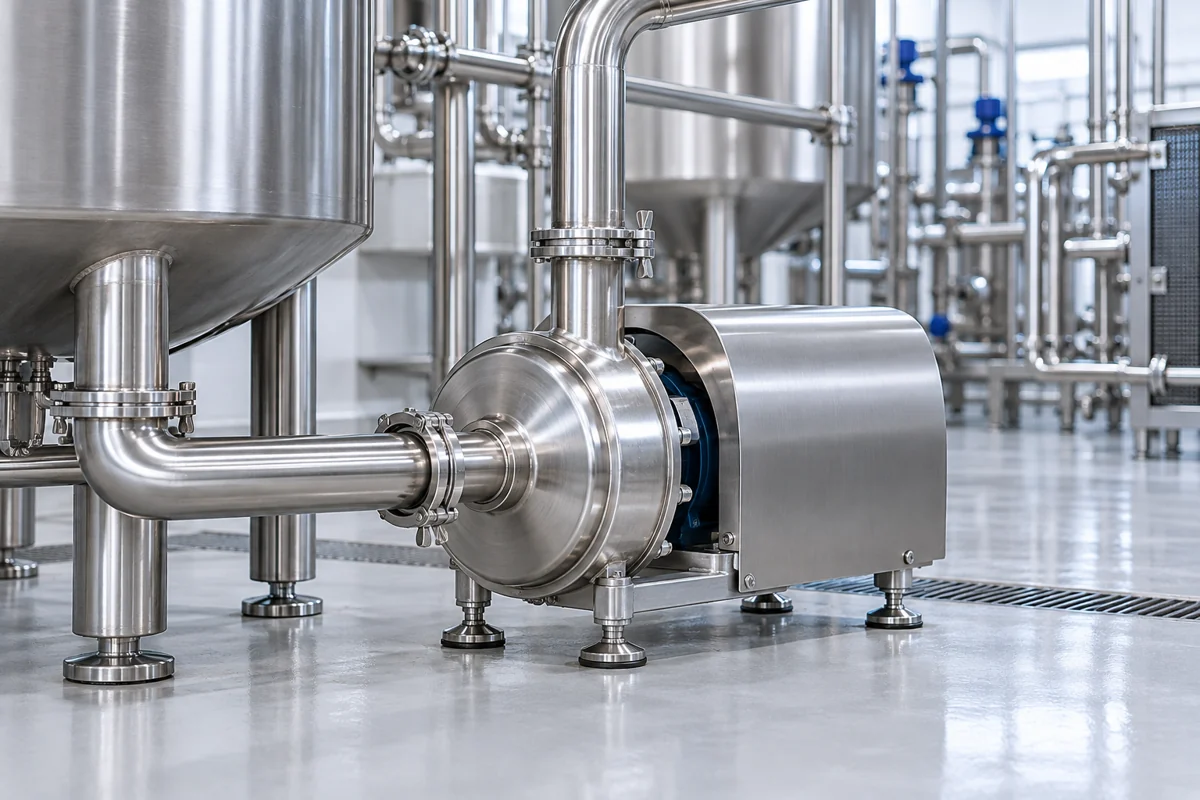
A sanitary centrifugal pump moves low-viscosity food, beverage and cleaning liquids through closed process lines and is built to be cleaned in place. "Sanitary" is not one specification: hygienic-design certification, surface finish, wetted materials, seal arrangement and food-contact documents are separate items, and each has to be named in the order.
CNFX editorial research · Sources checked October 12, 2026 · 11 sources
The same catalogue name covers pumps built for different jobs. Sort the duty first; it decides which designs and documents are relevant.
Duty
Design offered by makers
What to confirm with the maker
Transfer of milk, juice, beer, water-like liquids
Hygienic centrifugal pump with a semi-open impeller, sized from a family of models (one published range runs to 500 m³/h and 11 bar differential at 50 Hz across 13 sizes) [8]
Duty point on the actual curve, NPSH margin, elastomer for the product temperature
CIP return and suction lines that carry air
Self-priming hygienic centrifugal pump; one published model is offered as a CIP return pump and for liquids up to 500 cP, with a maximum of 70 m³/h and 70 m head [9]
Air handling at your suction conditions, and whether the same unit is also rated for product duty
Viscous or shear-sensitive products
Positive rotary pumps, which the same 3-A standard and EHEDG guideline also cover [1][2]
Compare against a positive rotary quote before forcing a centrifugal pump onto the duty
Aseptic, steam-sterilised lines
Equipment certified to EHEDG EL Aseptic Class I: closed, cleaned in place without dismantling, steam-sterilisable and bacteria-tight [3]
Certificate class and model range; a standard CIP pump is not an aseptic pump
A sorting aid for buyers, not a sizing method. Final selection comes from the maker's performance curve at your duty point.
02
Follow the drive into the wetted assembly
The shaft transmits the motor’s rotation to the impeller; the casing encloses the pumping chamber and the shaft seal separates that chamber from the drive. On the LKH example, a compression coupling joins the motor shaft to a stub shaft. Balance holes in the impeller circulate liquid around the seal and reduce axial forces [10].
Component / BOM reference
Role in this assembly
Material: LKH standard example
Semi-open impeller
Rotates with the shaft and transfers energy to the liquid.
The leaflet does not identify a separate stub-shaft grade [8].
Mechanical shaft seal
Seals the rotating shaft boundary.
Carbon rotating face; silicon carbide stationary face [8]
Wetted elastomer seals
Seal the product-contact joints.
EPDM as standard; alternative compounds are configuration choices [8]
Functional assembly reference, not an orderable spare-parts BOM. The material example is Alfa Laval LKH, January 2026; it does not establish the materials in DONJOY ZLX or another pump. No part numbers or quantities are inferred.
03
"Sanitary" is four separate claims
Ask for each claim on its own. One document rarely proves the others.
A hygienic-design reference is not a certificate
3-A Sanitary Standard 02-12 "Centrifugal and Positive Rotary Pumps" covers the manufacture, fabrication and use of pumps for dairy processing; 3-A lists editions 02-09 to 02-11 as historical [1]. EHEDG Guideline 17 (fourth edition, May 2020) sets hygienic design for pumps and is being updated by its working group [2]. EHEDG certification is a separate scheme with classes: EL Class I for equipment cleaned in place without dismantling, EL Class II for equipment dismantled for wet cleaning, and EL Aseptic Class I [3]. "Designed according to" either document is not the same as a certificate for your model.
316L does not tell you the surface finish
A leading European hygienic pump lists its standard inside finish as "standard blasted", with mechanical polishing to Ra ≤ 0.8 µm as an option [8]. A Chinese maker publishes Ra ≤ 0.8, ≤ 0.6 and ≤ 0.4 µm options for one model [9]. Name the Ra value and the wetted surfaces it applies to, and ask for a roughness report.
"Stainless steel" is not one material
Published wetted-part materials range from 304 to 316L, 1.4404, ASME BPE 316L and 1.4435 within a single product page [9], while another range uses W. 1.4404 (AISI 316L) for casing, impeller, impeller nut and backplate as standard [8]. State the grade for each wetted part, not only for the casing.
A compliant elastomer is not a compliant pump
In the US, 21 CFR 177.2600 covers rubber articles intended for repeated food contact. Its extractive limits are 20 mg/in² in the first 7 hours and 1 mg/in² in the next 2 hours with water, and 175 mg/in² and 4 mg/in² with n-hexane for fatty foods [4]. In the EU and UK, Regulation (EC) No 1935/2004 requires that contact materials do not transfer constituents that endanger health, change the food's composition unacceptably or deteriorate its taste and smell (Article 3), and that they are traceable (Article 17) [5][6]. These cover materials; they do not certify the pump's hygienic design.
04
Numbers a maker will ask for before quoting
Published values below show the kind of range makers state; they are not limits for every pump.
Give the maker
Why it matters
Published example
Flow (m³/h) and differential head (m) or differential pressure (bar) at the duty point
Sets model size and impeller diameter; reduced-diameter impellers are a standard option on some ranges
13 sizes up to 500 m³/h and 11 bar at 50 Hz [8]; up to 70 m³/h and 70 m [9]
NPSH available at the pump inlet
NPSHA belongs to the system; NPSHR is supplied by the pump maker. Selection also needs an application-specific margin over NPSHR throughout the operating range, not merely a positive difference at one duty point [7]
Ask for the NPSHR curve at your duty point
Product, temperature range, viscosity, air or solids
Decides elastomer, seal arrangement and whether a self-priming design is needed
EPDM rated −10 to +140 °C [8]; −20 to 150 °C and up to 500 cP [9]
Maximum inlet pressure
Inlet pressure limits differ across sizes in the same family
LKH-5: 6 bar; LKH-10 to -70: 10 bar, except LKH-70 at 60 Hz: 5 bar; LKH-85/-90: 5 bar [8]
Cleaning and sterilisation regime
CIP chemistry and temperature, and any steam sterilisation, affect elastomers and seal flushing
Flush-housing sterilisation up to 125 °C with the pump stopped, on one range [8]
Connection standard and size, both ports
Clamp, union and flange systems are not interchangeable
ISO 2037 clamp, DIN, SMS, RJT, DS and ASME BPE clamp variants [8]; thread, clamp, flange or aseptic flange [9]
Motor and supply
Frame, protection, voltage and frequency, and speed control
Include minimum and maximum flow, density, viscosity and cleaning chemistry. A new liquid or duty point can require reselection.
Recheck application suitability when capacity, pressure or liquid changes; do not substitute a generic pH or service-life range [11].
05
Choose the shaft seal with the product and the cleaning
Seal options are a configuration choice with utility needs, not a detail to leave to the quote.
Single mechanical seal
Standard on one leading range, with a carbon rotating face and silicon carbide stationary face; front-loading designs allow quick replacement [8].
Flushed (quench) seal
Needs a water supply: one range specifies a maximum 1 bar inlet and 0.25–0.5 l/min, with flush media up to 70 °C [8].
Double mechanical seal
Needs pressurised barrier water: up to 5 bar for LKH-5 to -60 and 3 bar for LKH-70 to -90 [8]. Chinese ranges also list single or double seals [9].
Ask the maker which arrangement it recommends for your product, temperature and cleaning cycle, and what water connection and consumption that arrangement needs.
06
Keep seal service tied to the liquid and cleaning cycle
Alfa Laval’s LKH service guidance calls for regular visual checks and operation within the specified duty. Prevent the shaft seal from running dry, and provide the water supply required by the selected seal arrangement. After cleaning agents, rinse thoroughly with clean water. These are LKH care instructions, not a substitute for another model’s operating manual [11].
Keep the matching service kit available. A change of liquid, capacity or pressure calls for a suitability check, even when the piping and motor have not changed. The same guidance recommends preventive maintenance after 12 months for LKH; a contract for another pump needs its own service schedule rather than an assumed lifetime in hours [11].
07
Documents to request before the order
Ask for documents that name the supplied model and the legal holder, not a brochure page.
3-A authorization for the specific model and the current edition of the standard. One Chinese maker's page cites 3-A 02-10, while 3-A lists 02-12 as current; ask whether the authorization covers the current edition [1][9].
EHEDG certificate stating the class (EL Class I, EL Class II or EL Aseptic Class I) and the models covered, checked against EHEDG's certified-equipment list [3].
Material certificates for each wetted part, matching the grade on the quote [8][9].
Surface roughness report for wetted surfaces, stating the Ra value you specified [8].
Food-contact statements for elastomers: 21 CFR 177.2600 for the US [4]; for the EU and UK, a compliance statement and traceability under Regulation (EC) No 1935/2004 [5][6].
Performance curve with NPSHR at the duty point [7].
08
Copy this RFQ and fill in the brackets
Paste it into your enquiry below or into an email to a maker, then replace every bracket.
Product: sanitary centrifugal pump for [product], [temperature] °C, viscosity [cP], air/solids: [yes/no]
Duty point: [flow] m³/h at [head] m differential; NPSH available: [value] m; max inlet pressure: [bar]
Service: [product transfer / CIP return / aseptic]; cleaning: CIP [chemicals, °C]; SIP: [yes/no, °C]
Wetted parts: [grade, e.g. 1.4404 / 316L] for casing, impeller and backplate; surface finish Ra ≤ [µm] on wetted surfaces
Elastomers: [EPDM / FKM / other], food-contact statement for [US 21 CFR 177.2600 / EU 1935/2004]
Shaft seal: [single / flushed / double]; flush or barrier water available: [bar, l/min]
Connections: [standard and size] inlet, [standard and size] outlet
Motor: [kW], [V/Hz], IP [rating], speed control: [VFD yes/no]
Documents: 3-A or EHEDG certificate for this model (state class/edition), material certificates, Ra report, performance curve with NPSHR
Quantity: [units]; delivery to [country]; target date: [date]
10 companies list this product among what they make. Company figures are quoted from each
company's own website; every card states where the relationship came from.
Wassermann Pump
Zhejiang, CN
The source now identifies its operator as Zhejiang Chenjie Pump Industry Co., Ltd. and publishes a wassermann.cn contact address. Its catalogue includes sanitary centrifugal pumps alongside circulation and other water pumps; those other pump families do not establish hygienic suitability for a food process.
Product scope checked 2026-10-09
Listed on the company's own website · profile compiled by CNFX from public sources
Listed there as: “Sanitary Centrifugal Pumps” View source page ↗waterpumpsupplier.com · recorded 2026-08-26
Explore company information and manufacturing capabilities, then discuss the scope of your project with a relevant supplier.
Share this page
Compiled and source-reviewed by the CNFX editorial team.
Each manufacturer above links to the page on that company's own website where the product is listed, with the date we checked it. How we source and review
· Page last updated 13 October 2026
Buyer questions
Is a 3-A 02-10 claim still current?
3-A lists 02-12 as the standard for centrifugal and positive rotary pumps and 02-09 to 02-11 as historical editions. Ask the maker for the authorization covering the model you buy and the edition it was assessed against. [1]
What does EHEDG EL Class I mean for a pump?
It is the certification class for equipment cleaned in place with liquids without being dismantled. Equipment that must be taken apart for wet cleaning falls under EL Class II, and EL Aseptic Class I adds steam-sterilisability and bacteria-tightness. [3]
Does FDA 21 CFR 177.2600 approve the whole pump?
No. It covers rubber articles intended for repeated food contact, such as elastomer seals and gaskets, including permitted ingredients and extractive limits. It says nothing about the pump's hygienic design. [4]
Can a standard sanitary centrifugal pump handle CIP return?
For return lines that carry air, makers offer self-priming hygienic pumps; one published model is described as a self-priming CIP return pump that tolerates air or gas in the feed. Confirm the suction conditions with the maker. [9]
Is a polished finish standard on sanitary pumps?
Not necessarily. One leading range lists a blasted inside finish as standard and Ra ≤ 0.8 µm mechanical polishing as an option. Specify the Ra value you need. [8]
Sources and what still needs a direct check
Sources checked 2026-10-12. Standards bodies and regulations define the requirements; manufacturer pages show published ranges for those models only. CNFX does not certify products or suppliers.