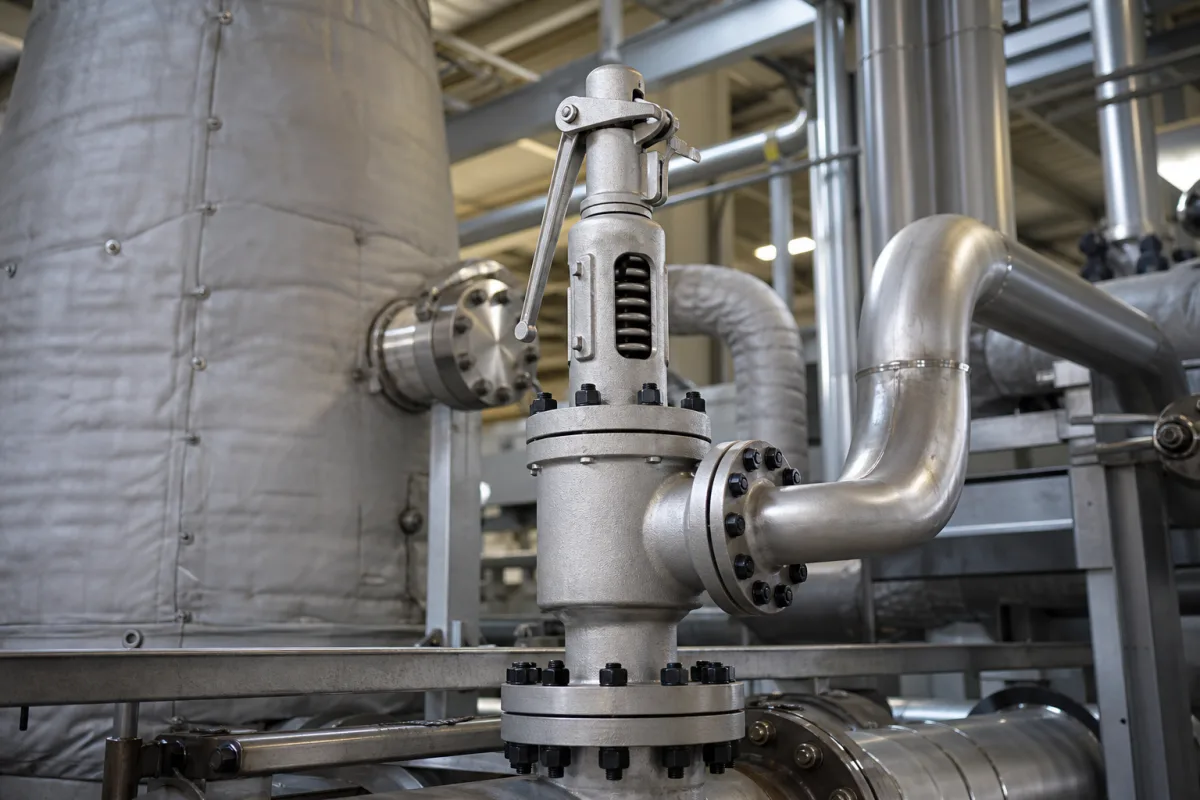
Overpressure protection · Set pressure, overpressure and piping
A relief valve is the last protection between a process upset and a burst vessel, and its inlet and outlet piping must be designed with it. Specify set pressure and capacity under the right code, choose conventional or balanced construction for the back pressure it will see, and design short inlet and well-drained discharge piping so it opens, flows and recloses as intended.
Spring-loaded and pilot-operated pressure relief and safety valves for vessels, boilers, steam, gas and liquid lines, including sanitary, fire-protection and waterworks relief valves. Hydraulic circuit relief valves are covered on the hydraulic valves page.
CNFX editorial research · Sources checked October 12, 2026 · 7 sources
Define set pressure, overpressure and blowdown under the code
Spirax Sarco defines set pressure as the gauge pressure at which a direct-loaded safety valve starts to lift, overpressure as the rise above set pressure needed for the lift that gives rated capacity, and blowdown as the difference between set pressure and reseating pressure. It summarises that an ASME Section VIII pressure-vessel valve (UV stamp) opens within 10% overpressure and closes within 7%, and an ASME Section I boiler valve (V stamp) opens within 3% and closes within 4%. [1][2]
As an editorial calculation example only: a Section VIII valve set at 10 barg should reach rated lift by about 11 barg and reclose by about 9.3 barg. If normal operating pressure sits close to that, the valve may leak or reseat late; ask the supplier for the recommended margin between operating and set pressure for the valve type.
Spirax Sarco classifies valves by how they lift after opening, for example a full-lift valve that reaches the lift for rated flow within a pressure rise of not more than 10%, and describes pilot-operated valves whose main valve is controlled by a pilot. Choose the type for the fluid and service with the supplier. [2]
Give the supplier the protected equipment's maximum allowable working pressure, the code it is built to, the relieving scenario and required capacity, the fluid and its state at relief, and the relieving temperature.
02
Allow for superimposed and built-up back pressure
Spirax Sarco explains that total back pressure is superimposed back pressure, present at the outlet before the valve opens, plus built-up back pressure generated while it discharges. In a conventional valve, superimposed back pressure changes the opening point, while total back pressure affects blowdown and reseating; balanced valves, for example with bellows, minimise these effects. [2]
Where valves discharge into a shared (“common”) discharge header, state the superimposed back pressure and its variation, and ask whether a conventional, balanced-bellows or pilot-operated valve is needed. [2]
03
Keep inlet losses low and the discharge drained
Spirax Sarco notes that EN ISO 4126 recommends keeping the inlet pipe pressure drop below 3% of set pressure when discharging, with rounded inlet corners, the valve at least 8 to 10 pipe diameters downstream of bends or Y fittings, the bonnet vertical, and no take-off branches in the inlet. It notes EN ISO 4126-1 limits pressure drop in the discharge system to 10% of set pressure. [3]
For steam and gas, discharge pipework should rise, for liquids it should fall, and horizontal runs should slope at least 1 in 100 away from the valve so it drains; fluid collecting downstream impairs performance and corrodes the spring. On steam, mount the valve above the pipe so condensate cannot wet the seat. [3]
As an editorial calculation example only: at 10 barg set pressure, a 3% inlet limit is 0.3 bar and a 10% discharge limit is 1 bar; check both against the line sizes before ordering.
04
Check seat tightness and keep the valve undamaged
Spirax Sarco states that “The vast majority of safety valve seat leakage problems occur after initial manufacture and test”, from transit damage, misuse, contamination or poor installation, and that test procedures are “usually based on the API 527 standard”, for air holding the valve at 90% of set pressure. Systems should be flushed before installation, valves never lifted by the easing lever, and never gagged or loaded to stop leakage. [3]
Repairs should be made only by personnel approved by the manufacturer; for ASME valves the repairer must hold a National Board ‘VR’ stamp. Ask for the set-pressure test certificate and the seat tightness standard applied. [3]
05
Compare what suppliers offer
Suppliers linked to this page list safety and relief valves for pressure vessels and steam, sanitary relief valves, fire-protection and waterworks relief valves, high-pressure oilfield relief valves and instrumentation relief valves. [4][6][7]
J&O and China Sanitary Valve list tri-clamp sanitary relief and safety valves; Convista lists a 1319 ductile-iron pressure relief valve and spring full-bore safety valves; FITOK lists proportional, medium- and high-pressure relief valves for instrumentation. [4][5][6][7]
06
Trace the relief valve components
This is a functional reference built from the sources cited; it is not one maker's parts list.
Part
Role
Fix in the order
Body and nozzle
Carry inlet pressure; nozzle area sets capacity. [2]
Fill the specification fields with values for your duty
A relief valve quotation needs duty-specific values. The table explains each field, gives published values where a reviewed source states them, and says what to obtain from the supplier.
Field
What it means and published values
Ask the supplier for
Nominal diameter (mm)
Inlet size; inlet loss below 3% of set pressure. [3]
Explore company information and manufacturing capabilities, then discuss the scope of your project with a relevant supplier.
Share this page
Compiled and source-reviewed by the CNFX editorial team.
Published product pages show what a company offers, not tested performance. Confirm the legal seller, factory, code certification and scope for your order. How we source and review
· Page last updated 13 October 2026
Buyer questions
How far above set pressure does a relief valve open?
Spirax Sarco summarises that an ASME Section VIII valve opens within 10% overpressure and closes within 7%, and an ASME Section I boiler valve opens within 3% and closes within 4%. [2]
How long can the inlet pipe to a safety valve be?
Spirax Sarco notes EN ISO 4126 recommends keeping the inlet pressure drop below 3% of set pressure when discharging, with the valve 8–10 diameters from bends. [3]
Can I gag a leaking relief valve?
No. Spirax Sarco warns never to gag or add load to stop leakage, as the valve may then fail to lift; refurbish it through approved repairers. [3]
Sources and what still needs a direct check
Sources checked 2026-10-12. Spirax Sarco is a steam equipment and safety valve manufacturer; its learning pages summarise ASME, EN ISO 4126 and API practice. Supplier pages describe their own offers. ASME Sections I and VIII, EN ISO 4126 and API 520/527 were not read for this page.