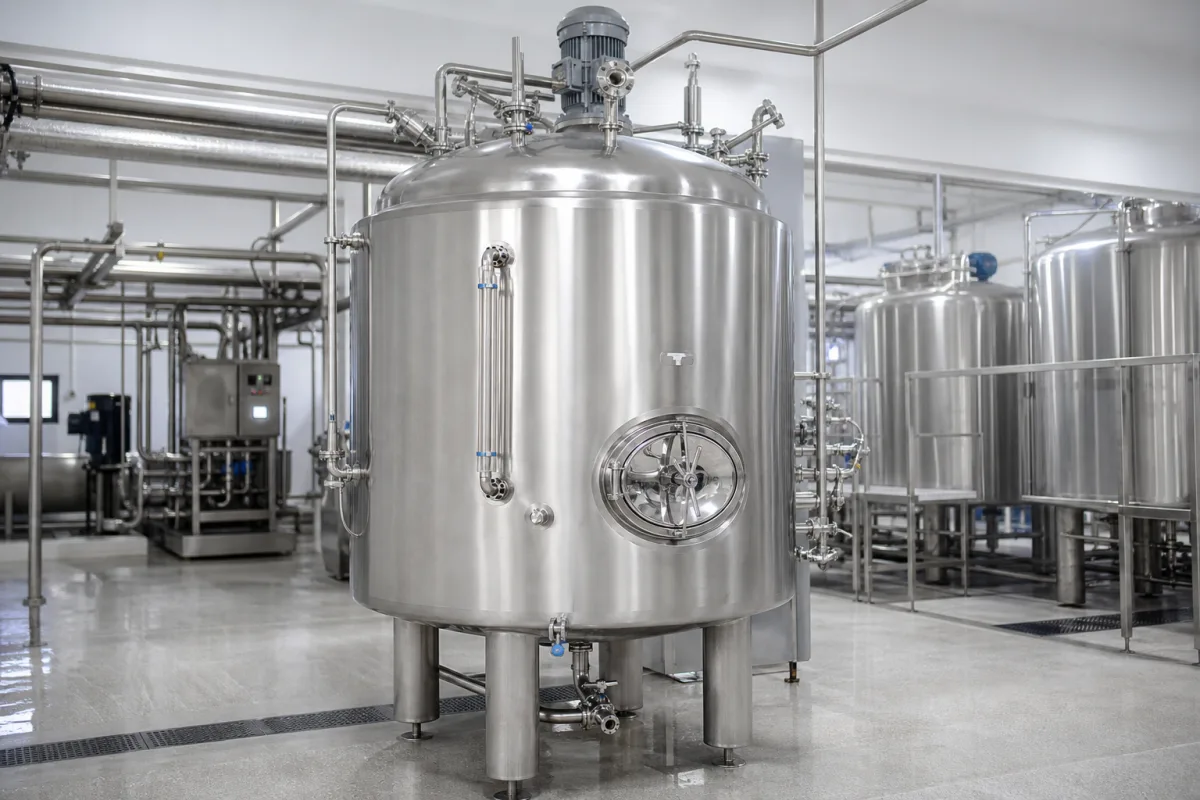
Yogurt fermentation tanks · What the product standard requires of the process (pasteurise before culturing, characterising cultures, pH 4.6 or lower), incubation temperature and its effect on quality, jacketed heating and cooling, agitation and pH monitoring
An industrial-scale yogurt fermentation tank is a jacketed, insulated stainless steel vessel with a gentle agitator in which pasteurised, inoculated milk is held at incubation temperature until it reaches the target acidity, then cooled to stop fermentation before stirring, flavouring and filling. Ask three things first: what batch size, incubation temperature and endpoint the recipe needs, how the tank heats, holds and cools the product evenly, and how temperature, pH and cleaning are controlled and recorded.
Jacketed fermentation (incubation) tanks for stirred and drinking yogurt and other cultured milks, with agitation, temperature and pH control and CIP. Milk pasteurisers (see continuous flow pasteurization system), cup-set incubation rooms, cheese vats and storage silos are outside this page.
CNFX editorial research · Sources checked October 12, 2026 · 4 sources
21 CFR 131.200 describes yogurt as made by culturing basic dairy ingredients (cream, milk, partially skimmed or skim milk, or reconstituted versions) with a culture of Lactobacillus delbrueckii subsp. bulgaricus and Streptococcus thermophilus; the dairy ingredients may be homogenised and must be pasteurised or ultra-pasteurised before the culture is added. Yogurt must contain at least 3.25% milkfat (with reduced-fat and other variants as allowed) and 8.25% milk solids not fat and have a pH of 4.6 or lower measured within 24 hours after filling; it may be heat-treated after culturing to extend shelf life. [1]
The rule names AOAC methods for milkfat and solids-not-fat, a potentiometric pH method, and ISO 7889/IDF 117 colony counts at 37 °C for live and active cultures. [1]
Editorial note: the tank must therefore receive pasteurised mix, keep it uncontaminated during inoculation and incubation, and let operators confirm the pH endpoint; ask how culture is added aseptically, where pH is measured and how batch records are kept.
An Elopak patent on fermented milk, US 5,453,286, summarises the conventional yogurt process: heat treatment of pasteurised milk to a negative peroxidase test, either batch at 80–85 °C for 20–30 minutes or continuous at 90–95 °C for 3 minutes, cooling to an incubation temperature of 43 °C, inoculation and 4–5 hours of incubation; 30 °C for 12–14 hours can also be used. It says starter can enter the fermentation tank through an openable cover or from a starter tank where it is premixed with milk, and that incubation time is critical for texture and aroma. [3]
Give the supplier the batch volume, product types (stirred, drinking, Greek-style), incubation temperature and time, pH endpoint, heating and cooling media and rates, agitator type and speed range, jacket and insulation, pressure and vacuum rating, CIP and SIP needs, instruments (temperature, pH, level, load cells), surface finish, sanitary standards required, and quantities.
02
Size heating, holding and cooling for quality
Akın and Güler-Akın (Harran University, 2005, indexed by FAO AGRIS) incubated yogurt and bio-yogurt made with starter and probiotic cultures at 37 °C and 42 °C until pH 4.6, then stored them at 4 ± 1 °C for 14 days. Bio-yogurts incubated at 37 °C had lower whey separation, titratable acidity and lactic acid and higher acetaldehyde and viable counts than those at 42 °C, all above 10⁷ cfu/g at the end of storage, and the authors conclude lower-temperature incubation can be used satisfactorily for bio-yogurt. [2]
Editorial calculation: heating 5,000 L of milk from 4 °C to 42 °C, assuming a density of about 1.03 kg/L and specific heat of about 3.9 kJ/kg·K, needs about 5,150 × 3.9 × 38 ≈ 763 MJ; doing it in 30 minutes requires about 424 kW of jacket duty, so decide whether the mix will be heated upstream in a heat exchanger rather than in the jacket, and confirm the duty split with the supplier. [1]
In one of the patent's plant examples, milk heated to 95 °C for 6 minutes and cooled to 42 °C in a plate heat exchanger ran through a 2.5-inch pipeline at 7,500 L/h into stainless steel fermentation tanks of 4,000 L each. [3]
Editorial calculation: at 7,500 L/h a 4,000 L tank fills in about 32 minutes (4,000 ÷ 7,500 × 60), so the first milk in the tank starts incubating about half an hour before the last; ask how inoculation and agitation keep the batch uniform during filling. [3]
Editorial note: ask for the temperature uniformity the jacket and agitator achieve during incubation, the cooling time from incubation temperature to the stirring or filling temperature, and how the agitator avoids breaking the gel when stirring.
03
Find yogurt fermentation tank manufacturers
Kosun's listing is a stainless steel fermentation tank for yogurt, vinegar and milk; Camels lists a dedicated yogurt fermentation tank.
04
Size filling, pH sampling and tank emptying for stirred yoghurt
Tetra Pak's Dairy Processing Handbook (chapter 13) describes milk held at 90–95 °C for 5 minutes, cooled to an inoculation temperature of 40–45 °C (typ.) and pumped to the fermentation tanks in succession while culture is dosed into the stream. After filling, brief agitation distributes the culture; the insulated tank holds the temperature, and samples are taken for pH. For stirred yoghurt, Tetra Pak gives a fermentation period of 4–5 hours at 42–43 °C (typ.). [4]
When the required pH, which Tetra Pak gives as about 4.2–4.5, is reached, the yoghurt is cooled to 15–22 °C in a gentle plate heat exchanger; the handbook relates pump and cooler capacity to emptying a tank in about 30 minutes, to keep product quality uniform. A sterile air filter traps particles larger than 0.3 microns; one filter and fan can serve four tanks. [4]
Editorial calculation: emptying one of the 4,000 L tanks in the Elopak example in 30 minutes needs a pump and cooler rated for about 4,000 ÷ 0.5 = 8,000 L/h, above that plant's 7,500 L/h fill rate; ask for pump, cooler and pH sample-point details. [4][3]
05
Vessel, jacket, agitator and inoculation port on a cultured-milk tank
Batch size, incubation set-point and pH endpoint per recipe
The pH row carries the legal limit: 21 CFR 131.200 sets pH 4.6 or lower for yogurt, so the tank's sample point and measurement method matter as much as its volume.
2 companies list this product among what they make. Company figures are quoted from each
company's own website; every card states where the relationship came from.
Wenzhou Kosun Fluid Equipment Co.,Ltd
Manufacturing site to be confirmed for the order
Its website lists “Stainless steel fermentation tank for yogurt, vinegar, milk”.
Explore company information and manufacturing capabilities, then discuss the scope of your project with a relevant supplier.
Share this page
Compiled and source-reviewed by the CNFX editorial team.
Each manufacturer above links to the page on that company's own website where the product is listed, with the date we checked it. How we source and review
· Page last updated 13 October 2026
Buyer questions
What pH must yogurt reach?
21 CFR 131.200 requires pH 4.6 or lower measured on the finished product within 24 hours after filling. [1]
Does incubation temperature affect yogurt quality?
One study found bio-yogurt incubated at 37 °C had less whey separation and higher viable counts than at 42 °C. [2]
Must milk be pasteurised before fermentation?
Yes; the dairy ingredients must be pasteurised or ultra-pasteurised before the culture is added. [1]
How long does yogurt incubate in the tank?
An Elopak patent describes the conventional process as 4–5 hours at 43 °C after heat treatment, or 12–14 hours at 30 °C. [3]
How quickly should a yoghurt fermentation tank be emptied?
Tetra Pak's Dairy Processing Handbook relates pump and cooler capacity to emptying a tank in about 30 minutes, cooling stirred yoghurt to 15–22 °C once the required pH is reached. [4]
Sources and what still needs a direct check
Sources checked 2026-10-12. 21 CFR 131.200 is the US standard of identity for yogurt; the AGRIS record summarises one study. Process design for your products must come from your recipe trials and the supplier's equipment data.