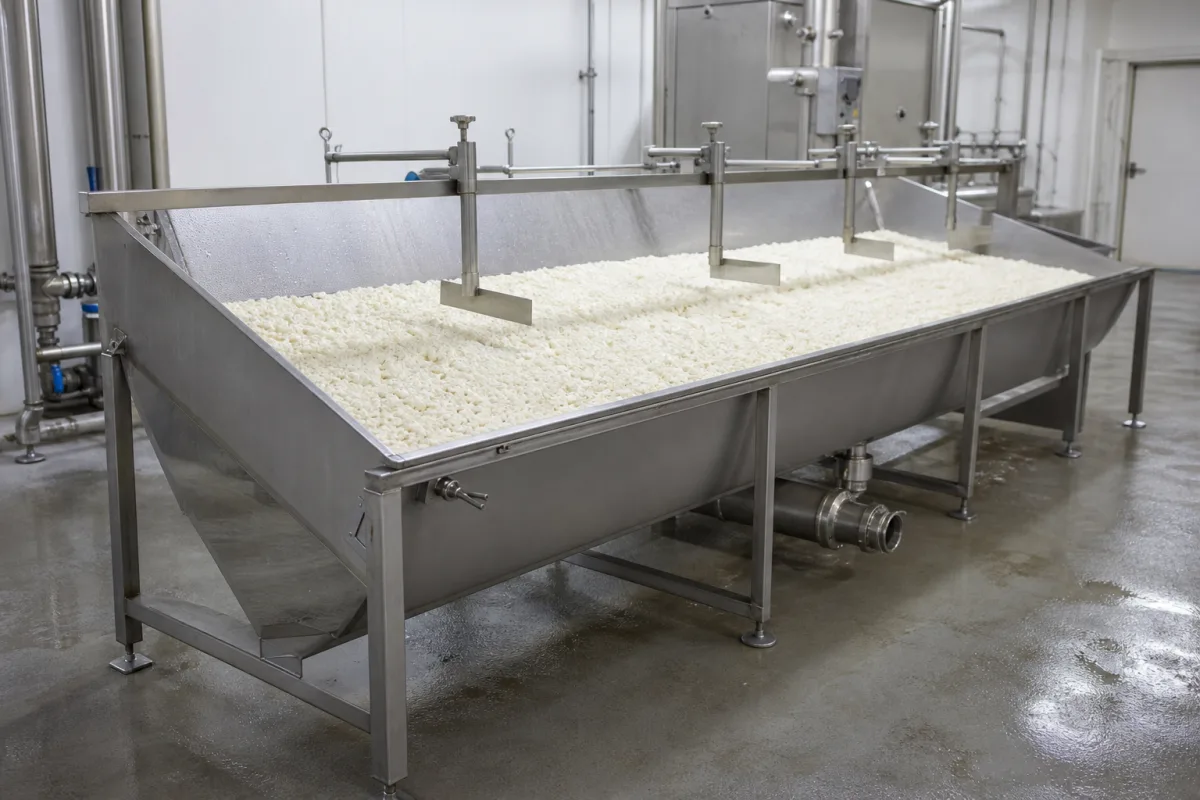
Drain tables for separating whey from cheese curd · Where the table sits in the make, USDA dairy plant construction rules (16-gauge stainless liner, pitched for drainage, jacket heating, sanitary outlet valve), stirring and cheddaring, and cleanable design
A cheese curd drain table is the stainless trough or table where curd from the vat is spread so the whey can run off, and where curd may be stirred, matted, cheddared, milled or salted before it goes to the hoops. It must drain completely, keep the curd at the right temperature and be easy to clean. Ask three things first: which cheese and batch size the table serves, how it is pitched, heated and emptied, and what stirring, cutting or salting equipment runs on it.
Drain tables, drainage troughs and finishing tables for cheese curd in batch cheese plants, including liners, jackets, outlet valves, curd agitators and covers. Cheese vats, automatic curd makers and cheddaring towers, presses, brine tanks and whey processing are outside this page except where compared.
CNFX editorial research · Sources checked October 12, 2026 · 4 sources
FDA's standard of identity for cheddar cheese (21 CFR 133.113) describes the procedure: the coagulated mass is cut, stirred and heated to separate whey and curd; the whey is drained off and the curd is matted into a cohesive mass; the mass is cut into slabs that are piled and handled to promote whey drainage and acidity development; the slabs are cut into pieces, which may be rinsed with free and continuous drainage; and the curd is salted, stirred, further drained and pressed into forms. Finished cheddar has at most 39% moisture and at least 50% milkfat in the solids. [2]
USDA's dairy plant rules call for a uniform schedule for setting, cutting, cooking, draining the whey and milling the curd to promote uniform quality, and for starter and make records kept at least three months. [1]
Editorial note: tell the supplier which steps happen on the table (drainage only, matting and cheddaring, milling, salting) and the curd mass per batch, so it can size the area, depth and agitator travel.
Give the supplier the cheese types, curd mass and whey volume per batch, steps done on the table, required curd temperature and heating or cooling medium, table length, width and depth, pitch and outlet position, outlet valve type and size, agitator or curd knife equipment, covers, cleaning method (manual or CIP), floor drainage, and materials and finish for product contact surfaces.
02
Plan drainage time, bed depth and curd moisture
An Australian Dairy Corporation patent, US 4,510,856 (priority 9 December 1981, granted 16 April 1985), explains why drainage has to come before fusion: if curd fuses before the whey has drained and must then be freed by vigorous mechanical action, the macerated lumps lose fat and other components, costing yield and quality. It describes the batch practice of draining free whey with occasional stirring and turning sections of curd by hand, and continuous drainage over an inclined screen followed by a perforated conveyor with stirrers. [3]
In the patent's worked example the curd–whey mixture reached the perforated belt at 42–43 °C and 50–54% moisture, forming a loose bed 30–35 cm deep. Stirrers, whose blades sweep within 5 mm of the belt, began within one minute and worked it intermittently for 10–20 minutes with no more than 1 °C temperature fall, bringing moisture to 41–43%; the curd then settled and fused for 3–8 minutes to a 23–30 cm bed. A floating weighted belt running about 12% faster than the conveyor then applied 0.28–0.4 psi for 22–27 minutes, leaving a 16–24 cm bed at 41–42 °C and 39.5–41.4% moisture before milling. [3]
Editorial calculation: 0.28–0.4 psi is about 1.9–2.8 kPa (1 psi = 6.895 kPa), and the example takes curd moisture from 50–54% down to 39.5–41.4% before salting and pressing, against the 39% maximum moisture that 21 CFR 133.113 sets for finished cheddar. On a batch table, ask the supplier what bed depth, stirring or turning method and holding time its design assumes, and how temperature is held during cheddaring. [3][2]
03
Size table holding time to the milling pH the cheese needs
A 2019 study from the University of Veterinary and Animal Sciences, Lahore, shows how long curd can occupy the table and why the end point is a pH rather than a clock time. Pasteurised, partly skimmed buffalo milk was set with thermophilic starter and rennet at 37 °C, reaching pH 6.4 after 1 h 50 min; the curd was cut into 3–4 mm pieces, and the curd–whey mixture was heated to 37–42 °C for 30 min until pH 6.2 for whey removal. The curd was then cheddared for 1 h 10 min to milling pH values of 5.2, 5.1, 5.0, 4.9 and 4.8, milled and heat-stretched at 94 °C. The authors cite earlier work finding that cheddar curd disintegrates at a milling pH of 5.75 and forms its proper texture at 5.3. [4]
Milling pH changed the cheese the table delivers: on day 1, moisture was 53.79% at milling pH 5.2, 52.3% at 5.1, 47.11% at 5.0, 46.23% at 4.9 and 45.13% at 4.8, and the authors report that lowering milling pH from 5.2 to 4.9 decreased moisture content. Editorial calculation: moving from pH 5.2 to 4.9 cut day-1 moisture by 53.79 − 46.23 = 7.56 percentage points. For cheddar, compare that range with the 39% maximum moisture in 21 CFR 133.113. [4][2]
For the table, this means the cheddaring step is ended by a pH reading, so the design needs room and time for the curd to reach it at temperature. Tell the supplier the cheddaring hold you plan per batch (1 h 10 min in this example), the batch interval, and whether the jacket must hold the curd at a set temperature during that hold, and plan sampling access for pH checks along the table. [4][1]
USDA's 7 CFR 58.416 states that vats, tanks and drain tables used for making cheese should be of metal construction with adequate jacket capacity for uniform heating. The inner liner shall be minimum 16-gauge stainless steel or other equally corrosion-resistant metal, pitched from side to centre and from rear to front for adequate drainage, smooth and free from excessive dents or creases, and extend over the edge of the outer jacket; the outer jacket shall be stainless or other cleanable metal, and the liner-to-jacket junction must stop milk or cheese entering the jacket. The table shall have a suitable sanitary outlet valve, with valves maintained to control heating, and any removable cloth covers must be clean. [1]
The same rules require mechanical agitators of sanitary construction with enclosed carriages and stainless product-contact parts, and knives, rakes, shovels, scoops, paddles and strainers of stainless steel or materials approved in the 3-A Sanitary Standards for plastic and rubber-like materials, free from rough or sharp edges; curd knife wires must be stainless, kept tight and replaced when necessary. [1]
Editorial note: ask the supplier to show the liner gauge and grade, the pitch in both directions, and how the jacket-to-liner junction is sealed.
05
Liner gauge, two-way pitch, jacket, outlet valve and curd tools under 7 CFR 58.416
Every row here traces to USDA's 7 CFR 58.416, which sets the 16-gauge minimum for the stainless liner and requires it to be pitched side to centre and rear to front so the whey drains. [1]
Surface area, jacket temperature, curd load, slope and liner finish for a drain table
Only two rows carry published figures, both from the patent's continuous-drainage example: curd held at 41–43 °C and a 30–35 cm loose bed. Area, hole size, whey volume, surface finish and IP rating have to come from the supplier. [3]
Field
What it means and published values
Ask the supplier for
Working Surface Area (m²)
Curd spread area per batch.
Area for your batch.
Temperature Control Range (°C)
Jacket heating; one example held curd at 41–43 °C. [1][3]
Range; medium.
Maximum Load Capacity (kg/m²)
Curd load; one continuous example ran a 30–35 cm curd bed. [3]
Explore company information and manufacturing capabilities, then discuss the scope of your project with a relevant supplier.
Share this page
Compiled and source-reviewed by the CNFX editorial team.
Each manufacturer above links to the page on that company's own website where the product is listed, with the date we checked it. How we source and review
· Page last updated 13 October 2026
Buyer questions
What does USDA require of a cheese drain table?
7 CFR 58.416: metal with adequate jacket heating, a minimum 16-gauge stainless liner pitched for drainage, and a sanitary outlet valve. [1]
What happens to curd on the table in cheddar making?
21 CFR 133.113 describes draining whey, matting the curd, cutting and piling slabs to drain and develop acidity, then milling, salting and further draining. [2]
What tools can be used on curd?
USDA requires stainless steel or 3-A approved plastic or rubber-like materials, free from rough or sharp edges. [1]
How deep is the curd bed during drainage and cheddaring?
In the example of US patent 4,510,856 the loose curd formed a 30–35 cm bed, settled to 23–30 cm and was pressed to 16–24 cm at the end of cheddaring. [3]
How long does curd stay on the table during cheddaring?
In a 2019 buffalo Mozzarella study, cheddaring lasted 1 h 10 min to reach milling pH 4.8–5.2; day-1 moisture fell from 53.79% at pH 5.2 to 46.23% at pH 4.9. [4]
Sources and what still needs a direct check
Sources checked 2026-10-12. 7 CFR Part 58 is the USDA's requirements for approved dairy plants; 21 CFR 133.113 is the FDA standard of identity for cheddar cheese; the Australian Dairy Corporation patent reports its own drainage and cheddaring trial, and a 2019 University of Veterinary and Animal Sciences, Lahore study reports cheddaring times and milling pH effects. Local rules may differ.