Industry-Verified Manufacturing Data (2026)

Agitation Mechanism

Based on aggregated insights from multiple verified factory profiles within the CNFX directory, the standard Agitation Mechanism used in the Food Manufacturing sector typically supports operational capacities ranging from standard industrial configurations to heavy-duty production requirements.

Technical Definition & Core Assembly

A canonical Agitation Mechanism is characterized by the integration of Drive Motor and Agitation Shaft. In industrial production environments, manufacturers listed on CNFX commonly emphasize Stainless Steel 316L construction to support stable, high-cycle operation across diverse manufacturing scenarios.

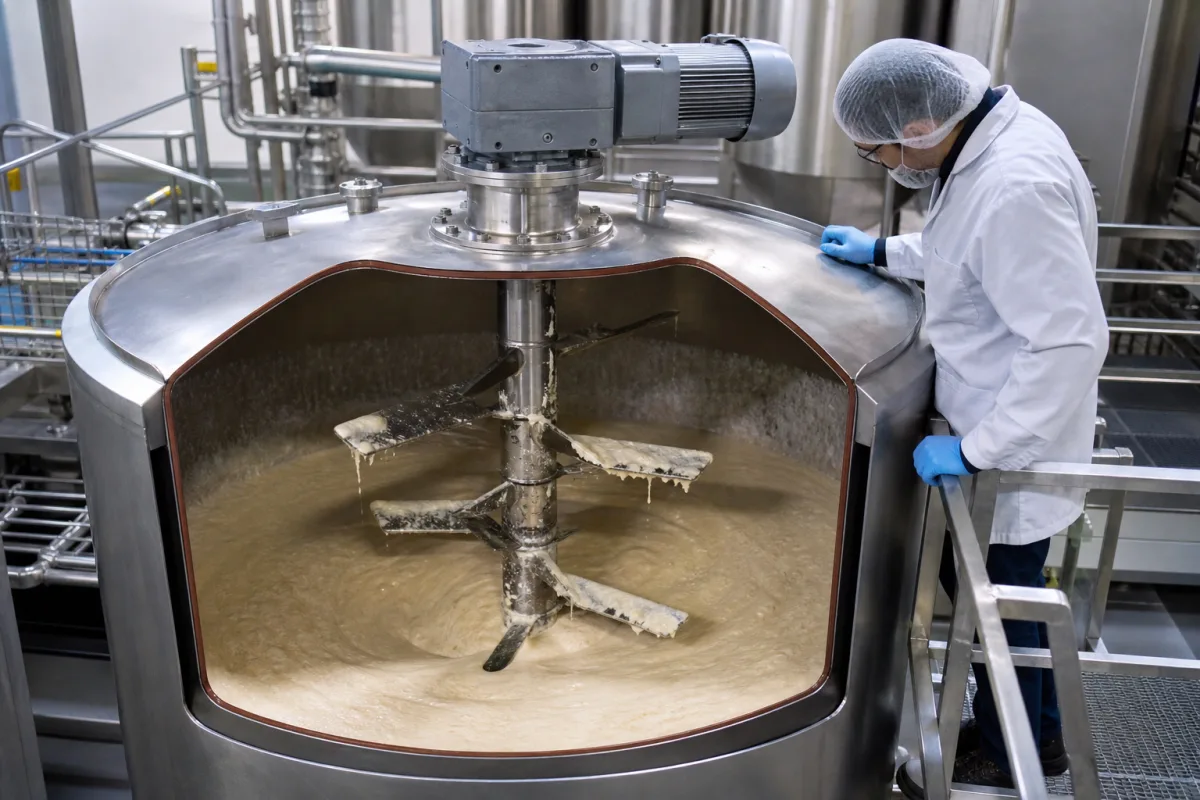
A mechanical system designed to mix and homogenize yogurt culture and milk within a fermentation tank.
Product Specifications

Technical details and manufacturing context for Agitation Mechanism

Definition
The agitation mechanism is a critical component of industrial-scale yogurt fermentation tanks, responsible for ensuring uniform distribution of starter cultures, maintaining consistent temperature and texture throughout the fermentation process, and preventing sedimentation or separation of milk solids. It operates continuously or intermittently during fermentation to achieve optimal product quality.
Working Principle
Typically consists of a motor-driven shaft with attached impellers or paddles that rotate within the tank. The rotation creates fluid movement that mixes the contents, with speed and direction controlled to achieve specific viscosity and homogeneity requirements for yogurt production.
Common Materials
Stainless Steel 316L
Technical Parameters
  • Shaft diameter and impeller dimensions (mm) Per Request
Components / BOM
  • Drive Motor
    Provides rotational power to the agitation system
    Material: Stainless Steel Housing
  • Agitation Shaft
    Transmits rotational force from motor to impellers
    Material: Stainless Steel 316L
  • Impeller/Paddle
    Creates fluid movement and mixing action within the tank
    Material: Stainless Steel 316L
  • Seal Assembly
    Prevents contamination and maintains sanitary conditions at shaft entry point
    Material: Food-grade elastomers and stainless steel
Engineering Reasoning
0.5-3.0 m/s tip speed, 10-100 rpm rotational speed, 0.1-0.5 kW power input
Shear stress exceeding 150 Pa at impeller tip, bearing temperature exceeding 80°C, shaft deflection exceeding 0.5 mm/m length
Design Rationale: Fatigue failure from cyclic loading at 0.5-3 Hz operational frequency, bearing seizure due to lubricant breakdown at 80°C, shaft bending from unbalanced mass exceeding 0.1 kg at 0.5 m radius
Risk Mitigation (FMEA)
Trigger Bearing lubricant contamination with milk solids exceeding 0.1% concentration
Mode: Increased friction coefficient from 0.001 to 0.005, temperature rise from 40°C to 120°C within 30 minutes
Strategy: Double mechanical seal with food-grade silicone barrier, bearing housing purge with nitrogen at 0.2 bar positive pressure
Trigger Impeller blade fatigue crack initiation at stress concentration factor of 2.5
Mode: Crack propagation rate of 0.1 mm/cycle at 2 Hz operation, vibration amplitude increase from 0.5 mm/s to 5.0 mm/s RMS
Strategy: Shot peening surface treatment to induce 200 MPa compressive residual stress, ultrasonic testing at 5 MHz frequency every 500 operating hours

Industry Taxonomies & Aliases

Commonly used trade names and technical identifiers for Agitation Mechanism.

Industrial Ecosystem & Supply Chain DNA

Complementary Systems
Downstream Applications
Specialized Tooling

Application Fit & Sizing Matrix

Operational Limits
pressure: Atmospheric to 1.5 bar (tank head pressure)
flow rate: 0.5 to 5 m/s (impeller tip speed)
temperature: 4°C to 45°C (typical yogurt fermentation range)
slurry concentration: Up to 40% solids (milk solids content)
Media Compatibility
✓ Food-grade stainless steel (AISI 316L) ✓ Sanitary dairy products (milk/yogurt base) ✓ High-viscosity fermentation media
Unsuitable: Abrasive slurries with hard particulates (e.g., mining tailings)
Sizing Data Required
  • Tank volume (liters)
  • Desired mixing time (minutes)
  • Fluid viscosity at operating temperature (cP)

Reliability & Engineering Risk Analysis

Failure Mode & Root Cause
Bearing fatigue failure
Cause: Cyclic loading from unbalanced impellers, misalignment, or improper lubrication leading to subsurface cracking and eventual spalling
Shaft deflection and seal leakage
Cause: Excessive radial loads from off-center operation, worn bushings, or cavitation-induced vibration compromising mechanical seal integrity
Maintenance Indicators
  • Abnormal high-frequency vibration or audible metallic grinding from the drive assembly
  • Visible shaft wobble or excessive fluid leakage around the seal housing during operation
Engineering Tips
  • Implement laser alignment during installation and re-alignment after maintenance, ensuring shaft runout <0.002 inches per foot and angular alignment <0.0005 inches/inch
  • Install vibration monitoring with accelerometers on bearing housings and set alarms at 0.15 in/sec RMS velocity for early detection of imbalance or misalignment

Compliance & Manufacturing Standards

Reference Standards
ISO 1940-1:2003 (Mechanical vibration - Balance quality requirements for rotors in a constant (rigid) state) ANSI/ASME B46.1-2009 (Surface Texture, Surface Roughness, Waviness, and Lay) DIN 3962 (Tolerances for cylindrical gear teeth; bases)
Manufacturing Precision
  • Shaft runout: ≤0.05mm per meter length
  • Gear backlash: 0.1-0.3mm depending on module
Quality Inspection
  • Vibration analysis (to ISO 10816 series for operational vibration severity)
  • Hardness testing (Rockwell or Brinell per material specifications)

Factories Producing Agitation Mechanism

Verified manufacturers with capability to produce this product in China

✓ 94% Supplier Capability Match Found

T Technical Director from United Arab Emirates Jan 10, 2026
★★★★★
"Standard OEM quality for Food Manufacturing applications. The Agitation Mechanism arrived with full certification."
Technical Specifications Verified
P Project Engineer from Australia Jan 07, 2026
★★★★☆
"Great transparency on the Agitation Mechanism components. Essential for our Food Manufacturing supply chain. (Delivery took slightly longer than expected, but technical support was excellent.)"
Technical Specifications Verified
S Sourcing Manager from Singapore Jan 04, 2026
★★★★★
"The Agitation Mechanism we sourced perfectly fits our Food Manufacturing production line requirements."
Technical Specifications Verified
Verification Protocol

“Feedback is collected from verified sourcing managers during RFQ (Request for Quote) and factory evaluation processes on CNFX. These reports represent historical performance data and technical audit summaries from our B2B manufacturing network.”

13 sourcing managers are analyzing this specification now. Last inquiry for Agitation Mechanism from Poland (52m ago).

Supply Chain Compatible Machinery & Devices

Automated Food Moisture Analyzer

Automated system for precise moisture content measurement in food products

Explore Specs →
Automated Food Color Consistency Analyzer

Automated inline system for real-time color measurement and consistency control in food processing.

Explore Specs →
Control Panel

A centralized interface for monitoring and controlling industrial equipment and processes

Explore Specs →
Industrial Vacuum Tumbler

Industrial machine for massaging and marinating meat under vacuum to enhance texture and flavor.

Explore Specs →

Frequently Asked Questions

Why is Stainless Steel 316L used for this agitation mechanism?

Stainless Steel 316L offers superior corrosion resistance against acidic dairy products like yogurt, meets food safety standards, and ensures durability in sanitary food manufacturing environments.

How does this agitation mechanism improve yogurt production?

It ensures thorough mixing and homogenization of milk and yogurt culture, promoting consistent fermentation, preventing stratification, and enhancing product quality and texture throughout the tank.

What maintenance does the seal assembly require?

The seal assembly should be inspected regularly for wear and cleaned to prevent contamination. Follow manufacturer guidelines for lubrication and replacement to maintain hygiene and prevent leaks in the fermentation tank.

Can I contact factories directly on CNFX?

CNFX is an open directory, not a transaction platform. Each factory profile provides direct contact information and production details to help you initiate direct inquiries with Chinese suppliers.

Get Quote for Agitation Mechanism

Request technical pricing, lead times, or customized specifications for Agitation Mechanism directly from verified manufacturing units.

Your business information is encrypted and only shared with verified Agitation Mechanism suppliers.

Thank you! Your message has been sent. We'll respond within 1–3 business days.

Need to Manufacture Agitation Mechanism?

Connect with verified factories specializing in this product category

Add Your Factory Contact Us
Previous Product
Actuator (Pneumatic/Servo)
Next Product
Agitation System