This page explains how Automotive Body Panel Stamping Press is classified within Manufacture of Motor Vehicles. Technical values and manufacturer relationships are research references; confirm the current specification and supplier evidence for each order.
The Automotive Body Panel Stamping Press is a heavy-duty industrial hydraulic press engineered for stamping automotive body panels such as doors, hoods, fenders, and roof sections.
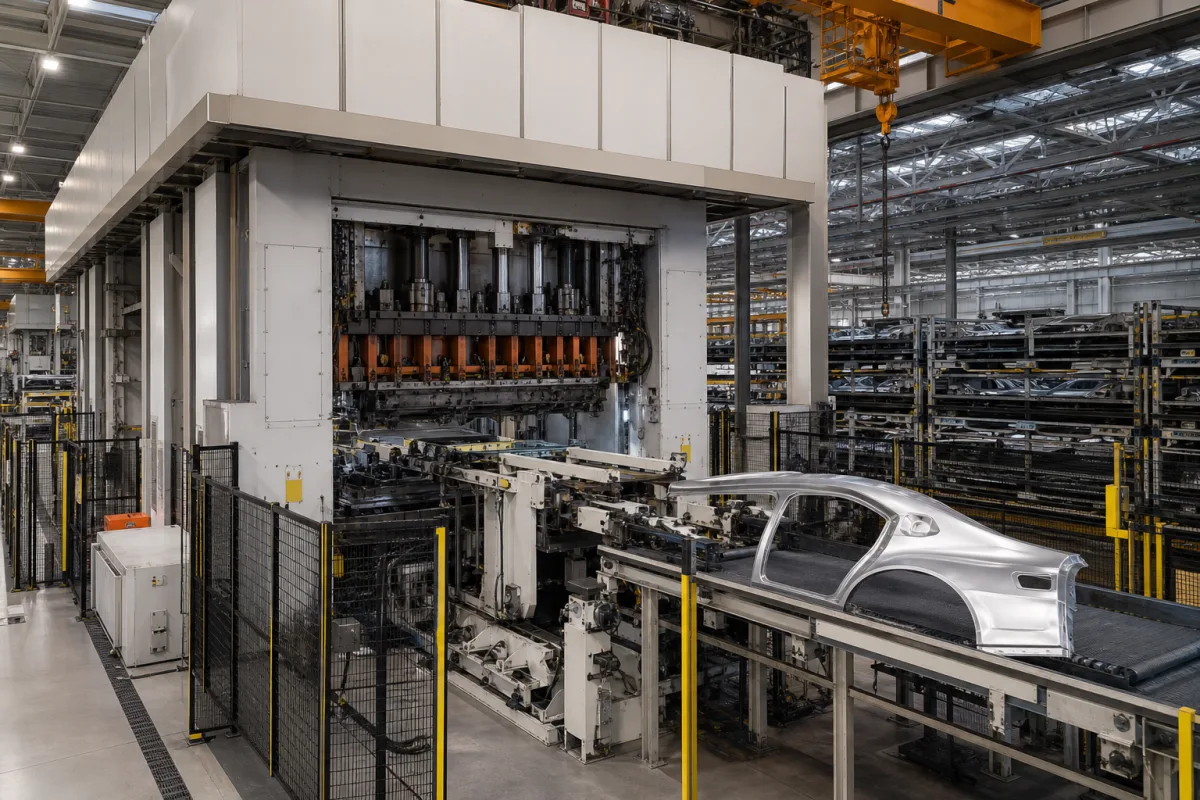
Technical details and manufacturing context for Automotive Body Panel Stamping Press
| Parameter | Typical range | Notes & selection driver |
|---|---|---|
| Tonnage CapacityRequired | 2000–5000 tons | Maximum pressing force |
| Stroke LengthRequired | 500–1000 mm | Maximum ram travel distance |
| Press SpeedRequired | 10–30 strokes/min | Maximum operating cycles per minute |
| Bed SizeRequired | 2000×1500–4000×2500 mm | Working area dimensions (width x depth) |
| Shut HeightRequired | 800–1200 mm | Distance between bed and ram at bottom dead center |
| Motor Power | 90–250 kW | Main hydraulic pump motor rating |
| Operating Pressure | 25–31.5 MPa | Hydraulic system pressure; affects force and speed. |
| Positioning Accuracy | ±0.05 mm | Ensures consistent part quality and die alignment. |
| Repeatability | ±0.02 mm | Critical for high-volume production consistency. |
| Electrical Supply | 380±10% V AC | Three-phase; voltage tolerance for industrial grid.IEC 60038 |
| Operating Temperature | 5–40 °C | Hydraulic oil viscosity and seal performance. |
| Ingress Protection | IP54–IP65 | Protection against dust and water for industrial environment.IEC 60529 |
| Frame Material | Q235–Q345 | Steel grade for welded frame; higher grade for higher tonnage.GB/T 700 |
| Machine Weight | 30–80 t | Affects foundation and installation requirements. |
Ranges are indicative industry figures for RFQ preparation, not a supplier commitment. Confirm every value and standard with the legal manufacturer before ordering.
| pressure: | Up to 500 bar (system pressure) |
| other spec: | Flow rate: 200-800 L/min, Stroke length: 500-1500 mm, Tonnage capacity: 500-3000 tons |
| temperature: | 10°C to 40°C (operating ambient) |
Indicative industry ranges for design and RFQ preparation. Confirm the exact figures and applicable standard with the manufacturer before specifying.
Quoted from the published standard.
A practical evidence checklist for RFQ preparation and supplier evaluation.
Compare the published product scope and source details, then include your specifications and quantity in an enquiry.
2 companies list this product among what they make. Company figures are quoted from each company's own website; every card states where the relationship came from.
The official 630T product page describes a three-beam four-column hydraulic press designed for forming car door panels, with welded and annealed Q355B beams and chrome-plated columns, in four-column or frame designs; the parameter table lists stroke, daylight, table, speeds and ejector force by tonnage, with custom 100–3000 t available. The About page on the same domain states it was founded in 2020 in Xuzhou, Jiangsu, on about 147,000 m², developing and producing composite moulding, forging and deep drawing hydraulic presses. Read parameters within the same tonnage column.
Explore company information and manufacturing capabilities, then discuss the scope of your project with a relevant supplier.
Ask for use case, specification boundaries, supplier type, and RFQ preparation information for this product.
The press is designed for forming sheet metal blanks, typically high-strength steel, into automotive body panels. The specific material grade and thickness must be confirmed with the manufacturer based on the die design and required part properties.
The tonnage capacity ranges from 2000 to 5000 tons, depending on the model. The required tonnage depends on the panel size, material strength, and complexity of the shape. Verify the exact capacity for your application with the supplier.
The press requires a three-phase electrical supply of 380 V AC ±10%, per IEC 60038. The motor power ranges from 90 to 250 kW. Ensure your facility's electrical system meets these requirements and consult the manufacturer for specific installation details.
The press achieves positioning accuracy of ±0.05 mm and repeatability of ±0.02 mm through precise hydraulic control and rigid frame construction. Regular calibration and maintenance of hydraulic components and die alignment are essential to maintain these tolerances.
Commonly used trade names and technical identifiers for Automotive Body Panel Stamping Press.
Editorial classification, named public sources where available, and source-reviewed manufacturer records.
Compare manufacturer profiles with relevant product and process capability.