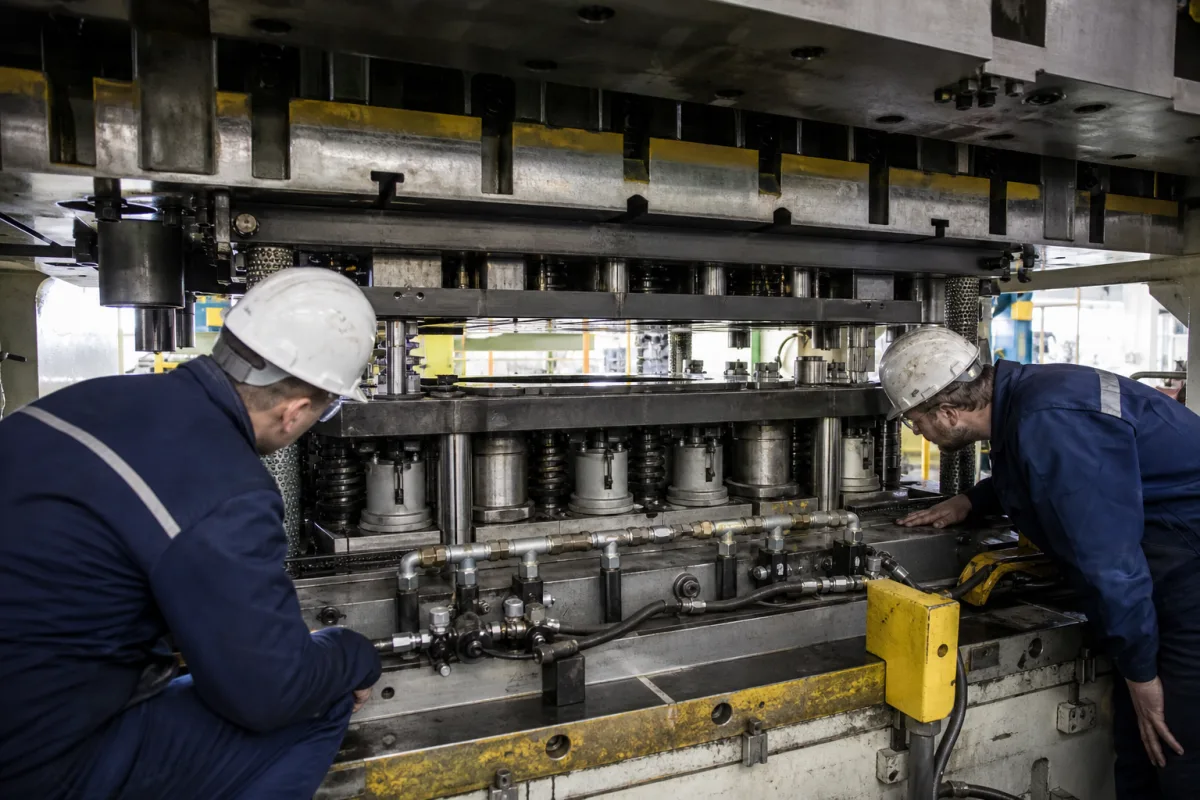
Die cushions under press beds for drawing body panels · Blank holder supported on cushion pins and pad, pneumatic, hydraulic and servo-hydraulic designs, pre-acceleration to cut impact, locking and secondary lift for part transfer, and cushion force response
A die cushion sits under the bed of a drawing press and pushes up on the blank holder through cushion pins, so the edge of the sheet is clamped between blank holder and upper die while the panel is drawn; the cushion gives way under controlled force as the slide descends. Too little force lets the sheet wrinkle; too much tears it. Ask three things first: which press, dies and panels it serves, what cushion force, stroke and control the parts need, and how impact at contact and part lifting after the stroke are handled.
Die cushion units for mechanical, servo and hydraulic presses used in sheet metal drawing, including pneumatic, hydraulic and servo-hydraulic or servo-electric cushions, pads, cushion pins and controls. Complete stamping presses (see precision mechanical stamping press, automated stamping line), dies, blank holders as die components and nitrogen gas springs inside dies are outside this page except where compared.
CNFX editorial research · Sources checked October 11, 2026 · 4 sources
US patent 6,804,983 B2 (Die cushion apparatus, 2004) describes the press lower structure: the punch on the bolster, the die on the slide, and a blank holder outside the punch that clamps the edge of the blank against the die so it does not wrinkle, and later carries the formed part up for unloading. In the conventional apparatus the blank holder is supported by pusher pins passing through the bolster onto a pusher pad below it; pneumatic cylinders under the pad provide a preset holding force, and a hydraulic servo cylinder, servo valve, stroke sensor and controller control the pad's motion. [1]
US patent 10,710,138 B2 (Die cushion device and method of controlling the die cushion device, 2020) reviews known designs that control the hydraulic pressure (die cushion force) in the cap-side chamber of the cylinder supporting the cushion pad using a servo motor driving a hydraulic pump, or a servo valve, and earlier methods that switch between position and pressure control; its aim is faster response of cushion force. [3]
Editorial note: ask the supplier for the cushion force range, force accuracy and rise time it guarantees at your slide speed, and whether force can be profiled over the stroke.
Give the supplier the press type (mechanical, servo, hydraulic), tonnage, bolster size and pin pattern, slide speed and strokes per minute, panels and dies, cushion force range and profile, cushion stroke, required force accuracy and response, pre-acceleration, locking and lift functions, part transfer timing, hydraulic power and energy recovery wishes, controls interface and safety.
02
Control impact at contact and lift after the stroke
US patent 5,339,665 (Die-cushion apparatus of press machine, 1994) explains that when the upper die meets the blank holder a large impact noise occurs and die and blank holder life is shortened; conventionally the cushion pad is pre-lowered at a speed below the slide's, starting at a set crank angle with a servo valve opened a set amount and closed when the die reaches the blank holder, but this open-loop control gave large speed scatter. It closes the loop on the pre-acceleration speed. [2]
US 6,804,983 lists the functions a die cushion must provide: the cushion function; clamping the blank edge to prevent creasing; a locking function that stops the blank holder travelling past bottom dead centre, preferably able to lower it with the part by a set distance (for example about 3 mm); and a secondary lifting function that raises the blank holder with the part by a set distance (for example about 35 mm) and stops it so the part can be passed quickly to the unloading device. [1]
03
Size cushion force and stroke against the press they serve
The University of Stuttgart's Institute for Metal Forming Technology (IFU) lists in its equipment directory an AIDA NST-S2-6300 servomechanical single-acting sheet metal forming press whose servo-hydraulic drawing cushion allows energy recovery during deep drawing. The listed figures are a maximum ram force of 6,300 kN, a maximum vertical ram stroke of 450 mm, a drawing cushion force of 1,500 kN, a drawing cushion stroke of 250 mm, a table of 3,050 × 1,500 mm, a maximum stroke rate of 30 per minute and a maximum tool installation height of 1,300 mm. [4]
Editorial calculation: on this press the cushion force is 1,500 ÷ 6,300 ≈ 24% of the maximum ram force, and the cushion stroke is 250 ÷ 450 ≈ 56% of the ram stroke. [4] Give the cushion supplier the press rating, ram stroke and stroke rate together with the cushion force and stroke you need, so both are checked against the same press.
Editorial note: the patent examples above use a lowering of about 3 mm after bottom dead centre and a secondary lift of about 35 mm. [1] Ask the supplier to confirm that the cushion stroke covers your deepest draw plus those motions, and whether energy is recovered while the cushion is pushed down.
Fill the specification fields with values for your press
A die cushion quotation needs values for your press and panels. The table explains each field, gives published values where a reviewed source states them, and says what to obtain from the supplier.
Explore company information and manufacturing capabilities, then discuss the scope of your project with a relevant supplier.
Share this page
Compiled and source-reviewed by the CNFX editorial team.
Published product pages show what a company offers, not tested performance. Confirm the legal seller, factory and scope for your order. How we source and review
· Page last updated 13 October 2026
Buyer questions
What does a die cushion do?
It supports the blank holder through cushion pins so the sheet edge is clamped and does not wrinkle while drawing (US 6,804,983). [1]
Why pre-accelerate the cushion pad?
To reduce the impact noise and die wear when the upper die meets the blank holder (US 5,339,665). [2]
How is cushion force controlled?
By a servo motor driving a hydraulic pump or by a servo valve on the cylinder's cap-side chamber (US 10,710,138). [3]
How large is a die cushion compared with its press?
In one example listed by the University of Stuttgart's IFU, a 6,300 kN servo press has a 1,500 kN servo-hydraulic drawing cushion with a 250 mm stroke, about 24% of the ram force (editorial calculation: 1,500 ÷ 6,300). [4]
Sources and what still needs a direct check
Sources checked 2026-10-11. All three sources are US patents (1994, 2004, 2020) describing die cushions and their own improvements in their own terms; distances quoted are the patents' examples.