Industry-Verified Manufacturing Data (2026)

Automotive Final Assembly System

Based on aggregated insights from multiple verified factory profiles within the CNFX directory, the standard Automotive Final Assembly System used in the Manufacture of Motor Vehicles sector typically supports operational capacities ranging from standard industrial configurations to heavy-duty production requirements.

Technical Definition & Core Assembly

A canonical Automotive Final Assembly System is characterized by the integration of Overhead Conveyor System and Chassis Assembly Station. In industrial production environments, manufacturers listed on CNFX commonly emphasize Structural Steel construction to support stable, high-cycle operation across diverse manufacturing scenarios.

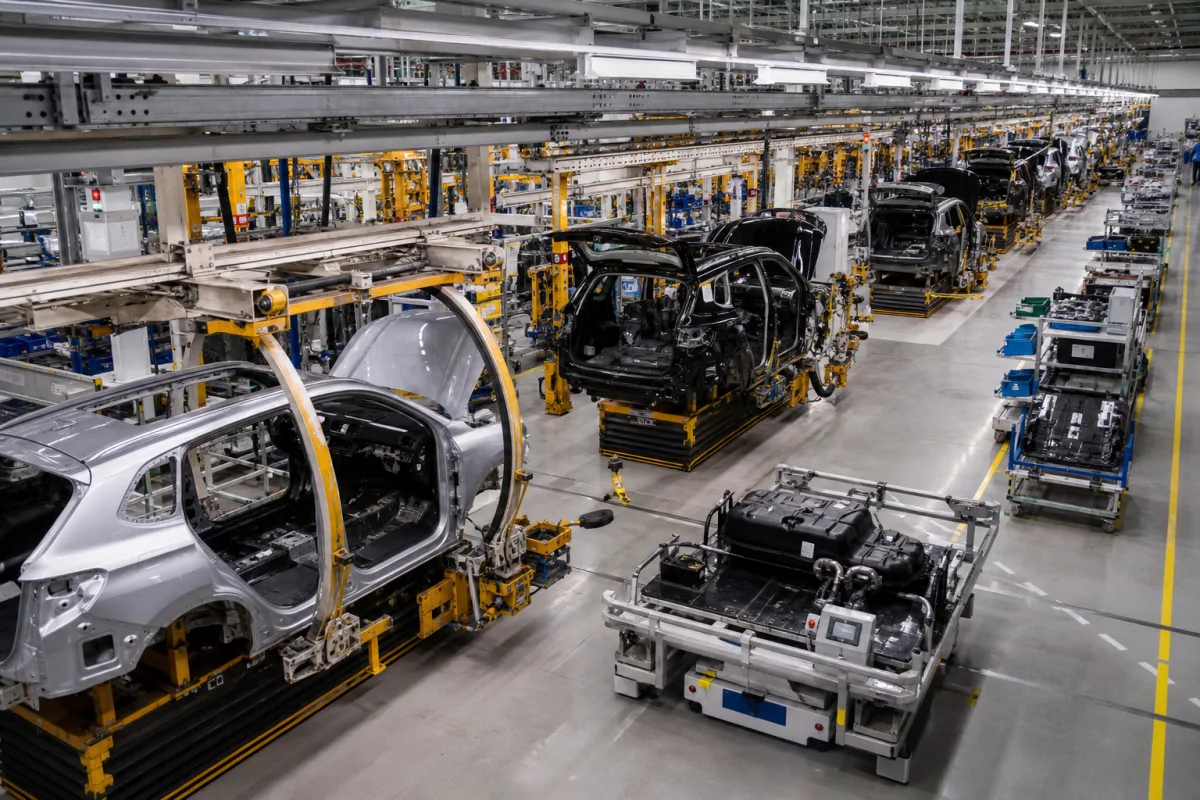
Integrated production line for complete vehicle assembly with automated stations and material handling.
Product Specifications

Technical details and manufacturing context for Automotive Final Assembly System

Definition
A comprehensive industrial system designed for the sequential assembly of complete motor vehicles including passenger cars, light trucks, and commercial vehicles. This integrated production line coordinates multiple specialized workstations through automated material handling systems to assemble chassis, powertrain, body, interior, and electrical components into finished vehicles. It serves as the core manufacturing infrastructure for automotive OEMs, enabling high-volume production with consistent quality control throughout the assembly process. The system represents a critical capital investment in automotive manufacturing facilities and requires precise synchronization of mechanical, electrical, and control subsystems.
Working Principle
Vehicles move sequentially through specialized stations on automated conveyors while robotic systems and human operators install components according to precise assembly sequences controlled by programmable logic controllers and manufacturing execution systems.
Common Materials
Structural Steel, Aluminum Alloy, Industrial Plastics, Electrical Wiring
Technical Parameters
  • Maximum production throughput capacity (vehicles/hour) Customizable
  • Total system length including all stations (meters) Customizable
Components / BOM
Engineering Reasoning
0.5-1.2 MPa (5-12 bar) pneumatic pressure, 24-48 VDC control voltage, 0.1-1.0 m/s conveyor speed
Pneumatic pressure below 0.35 MPa (3.5 bar) causes actuator stall; control voltage below 18 VDC triggers undervoltage lockout; conveyor speed exceeding 1.5 m/s induces harmonic resonance at 15-25 Hz natural frequency
Design Rationale: Bernoulli's principle violation in pneumatic systems below critical pressure (0.35 MPa) causes insufficient force generation; Joule heating in servo drives at >85% duty cycle exceeds 125°C insulation class rating; Rayleigh damping coefficient of 0.02-0.05 insufficient at >1.5 m/s conveyor speeds
Risk Mitigation (FMEA)
Trigger Pneumatic supply contamination with 15+ μm particulate concentration exceeding ISO 8573-1:2010 Class 4
Mode: Spool valve stiction causing 300+ ms response delay in robotic grippers
Strategy: Dual-stage filtration with 5 μm coalescing filter and 0.01 μm adsorption dryer maintaining -40°C pressure dew point
Trigger Harmonic torque ripple at 6× line frequency (300 Hz) in servo motors due to PWM inverter non-linearity
Mode: Angular position error accumulation exceeding ±0.1° tolerance in vision-guided assembly robots
Strategy: Sinusoidal commutation with 16-bit resolvers and adaptive feedforward compensation using Luenberger observers

Industry Taxonomies & Aliases

Commonly used trade names and technical identifiers for Automotive Final Assembly System.

Industrial Ecosystem & Supply Chain DNA

Complementary Systems
Downstream Applications
Specialized Tooling

Application Fit & Sizing Matrix

Operational Limits
pressure: 0.5-1.2 bar (pneumatic systems)
other spec: Cycle Time: 45-90 seconds per vehicle, Power Supply: 400-480V 3-phase 50/60Hz, Humidity: 30-70% RH non-condensing
temperature: 15-35°C (operating environment)
Media Compatibility
✓ Automotive steel/aluminum body panels ✓ Plastic/composite interior components ✓ Electronic control modules and wiring harnesses
Unsuitable: Corrosive chemical processing environments (e.g., acid baths, plating lines)
Sizing Data Required
  • Annual production volume (vehicles/year)
  • Vehicle platform dimensions (length × width × height)
  • Required automation level (manual vs. fully automated stations)

Reliability & Engineering Risk Analysis

Failure Mode & Root Cause
Conveyor System Jamming
Cause: Accumulation of debris, misaligned pallets, or worn drive components causing mechanical obstruction and production stoppage.
Robotic Arm Positioning Drift
Cause: Wear in harmonic drives, encoder feedback errors, or thermal expansion in servo motors leading to inaccurate assembly operations.
Maintenance Indicators
  • Unusual grinding or squealing noises from conveyor motors or robotic joints indicating imminent bearing failure.
  • Visible misalignment or wobbling in robotic end-effectors during precision tasks like windshield installation.
Engineering Tips
  • Implement predictive maintenance using vibration analysis on critical rotating equipment and thermal imaging on electrical panels to detect early degradation.
  • Establish strict contamination control protocols with regular cleaning schedules and use of protective covers to prevent debris ingress in sensitive assembly areas.

Compliance & Manufacturing Standards

Reference Standards
ISO 9001:2015 - Quality Management Systems ISO/TS 16949:2009 - Quality management for automotive production CE Marking - Conformity with EU safety, health, and environmental requirements
Manufacturing Precision
  • Body Panel Gap: +/- 0.5mm
  • Wheel Alignment: +/- 0.1 degrees
Quality Inspection
  • Dimensional Verification with CMM (Coordinate Measuring Machine)
  • Functional Testing of Electrical Systems

Factories Producing Automotive Final Assembly System

Verified manufacturers with capability to produce this product in China

✓ 92% Supplier Capability Match Found

P Procurement Specialist from United States Feb 08, 2026
★★★★★
"The Automotive Final Assembly System we sourced perfectly fits our Manufacture of Motor Vehicles production line requirements."
Technical Specifications Verified
T Technical Director from United Arab Emirates Feb 05, 2026
★★★★★
"Found 51+ suppliers for Automotive Final Assembly System on CNFX, but this spec remains the most cost-effective."
Technical Specifications Verified
P Project Engineer from Australia Feb 02, 2026
★★★★★
"The technical documentation for this Automotive Final Assembly System is very thorough, especially regarding Production Capacity (vehicles/hour)."
Technical Specifications Verified
Verification Protocol

“Feedback is collected from verified sourcing managers during RFQ (Request for Quote) and factory evaluation processes on CNFX. These reports represent historical performance data and technical audit summaries from our B2B manufacturing network.”

16 sourcing managers are analyzing this specification now. Last inquiry for Automotive Final Assembly System from USA (12m ago).

Frequently Asked Questions

What is the typical production capacity of this automotive final assembly system?

The system is designed for high-volume production with capacities typically ranging from 20-60 vehicles per hour, depending on configuration and cycle time optimization.

How does the automated guided vehicle system integrate with assembly stations?

The AGV system transports vehicle bodies between stations using precision navigation, synchronizing with overhead conveyors and assembly stations for seamless material flow and reduced manual handling.

What maintenance requirements does this assembly system have?

Regular maintenance includes conveyor system lubrication, AGV battery and sensor checks, electrical system inspections, and preventive maintenance on automated stations to ensure optimal performance and uptime.

Can I contact factories directly on CNFX?

CNFX is an open directory, not a transaction platform. Each factory profile provides direct contact information and production details to help you initiate direct inquiries with Chinese suppliers.

Get Quote for Automotive Final Assembly System

Request technical pricing, lead times, or customized specifications for Automotive Final Assembly System directly from verified manufacturing units.

Your business information is encrypted and only shared with verified Automotive Final Assembly System suppliers.

Thank you! Your message has been sent. We'll respond within 1–3 business days.

Need to Manufacture Automotive Final Assembly System?

Connect with verified factories specializing in this product category

Add Your Factory Contact Us
Previous Product
Automotive Body Panel Stamping Press
Next Product
Automotive Modular Chassis Assembly System