Hydraulic systems · Power, reservoir, heat and layout
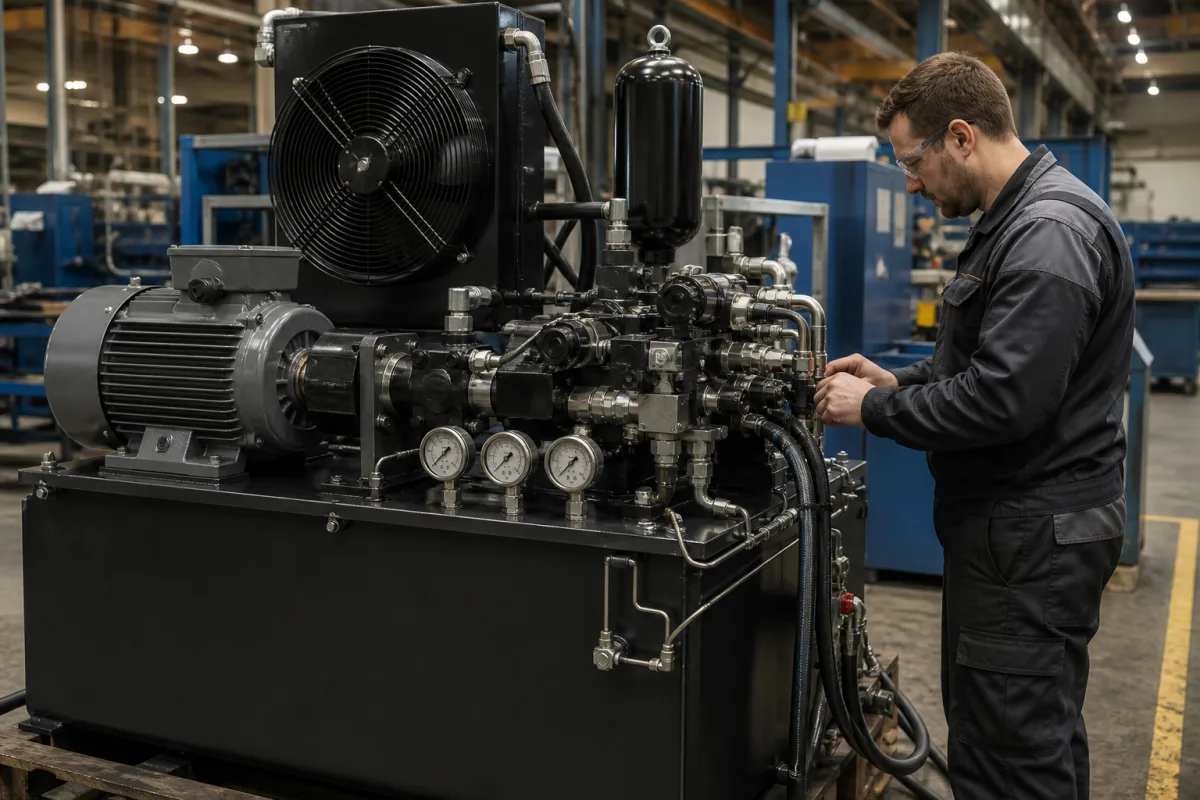
A hydraulic power unit is a motor or engine, pump, reservoir, filters and valves on one frame. Flow and pressure set the drive power; the reservoir and cooler must remove the energy that does not become useful work; the pump position decides whether suction is easy or a cavitation risk.
Electric (AC and DC) hydraulic power units and power packs for machines, lifts, trailers and industrial systems, and portable engine-driven units for tools. Hydraulic systems built into vehicles and complete machines are outside this page.
CNFX editorial research · Sources checked October 11, 2026 · 8 sources
Hydraulic power is the product of pressure and flow. Bailey International gives HP = (psi × gpm) / 1714 for the power flowing through the lines. [1]
Editorial calculation (unit conversion of the same formula): in metric units, kW = bar × L/min / 600. A unit delivering 20 L/min at 160 bar carries about 5.3 kW of hydraulic power; the motor or engine must be larger, because pump and system losses are added on top.
Losses become heat. In Hydraulics & Pneumatics, Parker engineer John Trott writes that "A cooler’s size often is based on approximate system efficiency at full power", estimated at 70–75% for constant (fixed-displacement) pump systems and 75–80% for variable pump systems. [4]
Give the supplier the flow and pressure each actuator needs, the duty cycle and how long the unit runs at peak. Motor size, cooler size and tank size all follow from those three.
02
Size the reservoir for heat, settling and air release
Fluid Power World describes the reservoir as a buffer: returning fluid is hot, contaminated and possibly aerated, and tank volume buys time for heat to dissipate, bubbles to rise and particles to settle. It defines dwell time as reservoir volume divided by pump flow; 10 gpm through a 50-gallon tank is a five-to-one ratio, and it says "The above five-to-one example is typical for hydraulic systems, and in fact, many consider this to be a minimum value". [2]
Another Fluid Power World article gives the general rule of pump flow per minute × 3 or × 5 and warns that an undersized tank can create a whirlpool at the pump inlet, affecting suction head and risking cavitation; it also advises 20% overcapacity, and describes JIC tanks held at least 6 in off the floor so heat can leave through the bottom, with free airflow around the tank. [3]
Trott adds that "In many systems, the reservoir is the only heat sink that provides cooling" and that it has "become impractical to sustain the rule-of-thumb volume equal to 2½ to 3 times the pump flow". A 20 °C rise can halve oil viscosity, affecting lubrication and leakage. [4]
03
Add a cooler where the tank cannot carry the heat
Trott explains that designers have pushed the flow-to-volume ratio down to about one, and that a cooler may be needed below that, in hot environments with little temperature difference, or with heavy duty cycles. A more accurate heat load comes from a time-weighted average of peak loads over the cycle. [4]
Ask the supplier how it sized the cooler: from full-power efficiency, from component losses or from your duty cycle, and for what ambient temperature.
04
Choose the pump layout and reservoir features
Fluid Power World compares layouts: a pump mounted on top of a horizontal (JIC or DIN) tank must lift oil and risks suction cavitation, especially with cold oil; a vertical unit with the pump submerged below oil level gives ideal suction; L-shaped or elevated tanks give a flooded inlet. [2]
With flooded suction, it recommends a level switch that stops the unit on low oil, a lockable ball valve in the suction line for maintenance, a baffle separating return and suction sides, cleanout panels and a sloped bottom for draining. The same article remarks that you would "search far and wide" to find a power unit without a filter, a level/sight gauge and a filler/breather. [2]
05
Stock packs with 1.2–30 L tanks, 120 HP industrial units and engine-driven rescue packs
The range on these supplier sites runs from Hydraflu's stock packs with tanks from 1.2 L to AiSoar's industrial units of up to 120 HP and FURD's engine-driven packs for rescue and repair tools. [5][6][7]
Hydraflu lists stock power packs with gear pumps of 1.2–9.8 cc/rev (0.4–8 gpm), tanks of 1.2–30 L, 2500–4000 psi ratings and over 70 manifold circuits; AiSoar lists industrial units up to 120 HP (90 kW); FURD lists portable engine-driven units, stating for its FHP-40 a 23 HP gasoline engine, 40 L/min maximum flow, 155 bar maximum pressure and a 13 L oil tank; Fengle lists 800 W and 2.2 kW DC48V units for forklifts. These figures are the suppliers' own catalogue data. [5][6][7][8]
06
Motor, pump, reservoir, filters, manifold and cooler on one frame
Part
Role
Fix in the order
Electric motor or engine
Drives the pump; sized from flow, pressure and losses. [1][4]
Flow, relief setting, motor rating, tank volume and cooling for a power-unit order
Flow, pressure and motor power are tied together by Bailey's (psi × gpm) / 1714 relation; for tank volume, set Fluid Power World's 3–5 × flow rule against Trott's remark that 2½–3 × flow has become impractical to sustain. Work these out from your actuators before comparing offers.
Field
What it means and published values
Ask the supplier for
Rated flow (L/min)
Sets actuator speed; with pressure sets power. [1]
Paste it into your enquiry below or into an email to a maker, then replace every bracket.
Actuators: [cylinders or motors; force or torque; speed; single or double acting]
Hydraulics: [flow; working pressure; relief setting; circuit or valve list]
Duty: [cycle time; time at peak; hours per day]
Power: [AC voltage and frequency, or DC battery voltage]
Reservoir and cooling: [tank volume; ambient temperature; cooler type]
Installation: [indoor or outdoor; IP rating; space; mounting; noise limit]
Documents: [hydraulic schematic; outline drawing; parts list; test report]
12 companies list this product among what they make. Company figures are quoted from each
company's own website; every card states where the relationship came from.
Hydraflu Hydraulic Co.
Manufacturing site to be confirmed for the order
Supplier listing AC and DC power packs for dump trailers, tail lifts and dock levellers, with over 70 manifold circuits.
Explore company information and manufacturing capabilities, then discuss the scope of your project with a relevant supplier.
Share this page
Compiled and source-reviewed by the CNFX editorial team.
Each manufacturer above links to the page on that company's own website where the product is listed, with the date we checked it. How we source and review
· Page last updated 13 October 2026
Buyer questions
How do I calculate hydraulic power unit horsepower?
Hydraulic power is HP = (psi × gpm) / 1714 (in metric, kW = bar × L/min / 600). The motor must be larger to cover pump and system losses. [1][4]
How big should a hydraulic reservoir be?
Fluid Power World gives a general rule of pump flow per minute × 3 or × 5. For compact systems, Parker's John Trott reports designs pushed down to a flow:volume ratio of one, with a cooler possibly required below that. [2][3][4]
Why does a power unit overheat?
Energy that does not do useful work becomes heat; Parker's John Trott gives an estimated full-power efficiency of 70–75% for constant (fixed) pump systems as a basis for cooler size, so the tank and cooler must remove the rest. [4][2]
Sources and what still needs a direct check
Sources checked 2026-10-11. Bailey International is a hydraulic component supplier publishing standard formulas. Fluid Power World articles describe reservoir design practice. John Trott (Parker Hannifin) wrote on thermal design in Hydraulics & Pneumatics. Supplier pages describe their own offers.