Industry-Verified Manufacturing Data (2026)

Automotive Powertrain Assembly System

Based on aggregated insights from multiple verified factory profiles within the CNFX directory, the standard Automotive Powertrain Assembly System used in the Manufacture of Parts and Accessories for Motor Vehicles sector typically supports operational capacities ranging from standard industrial configurations to heavy-duty production requirements.

Technical Definition & Core Assembly

A canonical Automotive Powertrain Assembly System is characterized by the integration of Robotic Assembly Station and Torque Control System. In industrial production environments, manufacturers listed on CNFX commonly emphasize Structural Steel construction to support stable, high-cycle operation across diverse manufacturing scenarios.

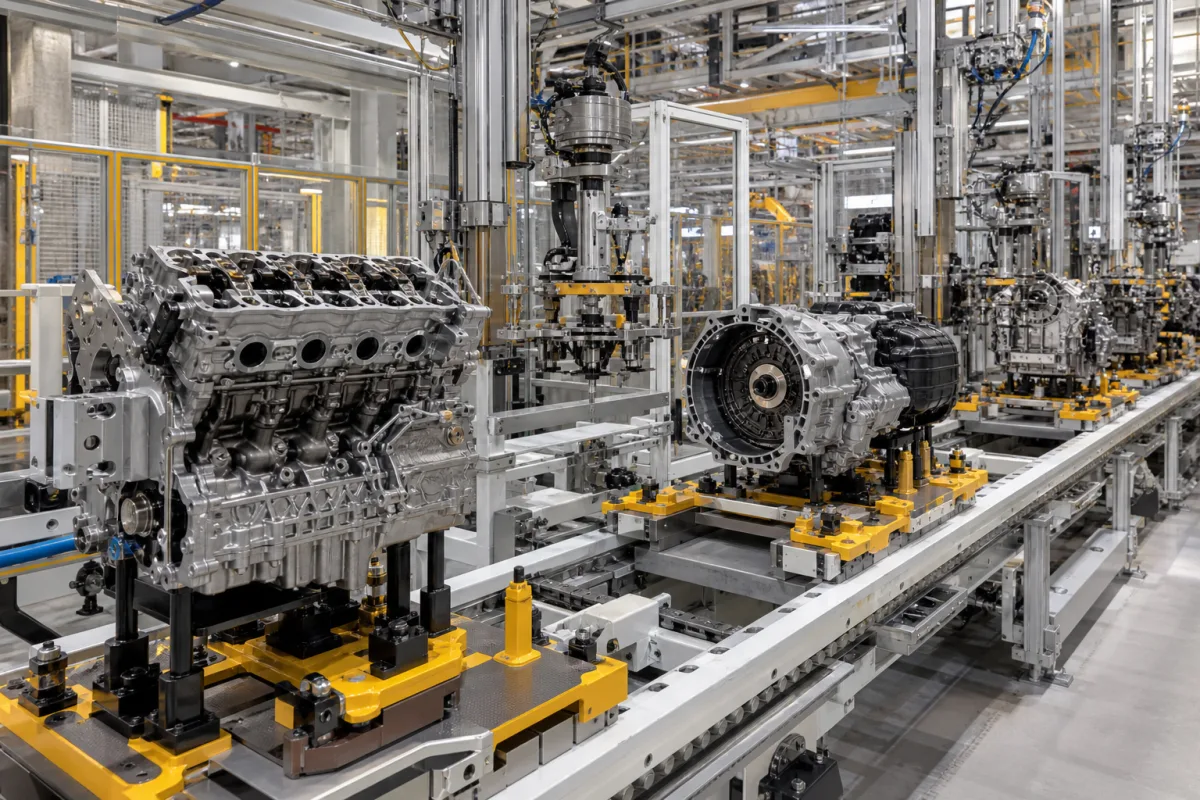
Integrated production line for assembling vehicle powertrain components

Product Specifications

Technical details and manufacturing context for Automotive Powertrain Assembly System

Definition
A fully integrated manufacturing system designed for the assembly of automotive powertrain components including engines, transmissions, and drivetrain elements. This coordinated multi-module solution incorporates automated stations for precision component mating, torque-controlled fastening, and quality verification. The system enables high-volume production with consistent quality control throughout the assembly process, supporting both conventional and hybrid powertrain configurations.
Working Principle
Automated stations sequentially assemble powertrain components using robotic manipulation, precision tooling, and sensor-guided alignment, with integrated quality control checkpoints ensuring dimensional accuracy and functional integrity at each assembly stage.
Common Materials
Structural Steel, Aluminum Alloy, Industrial Plastics
Technical Parameters
  • Time per complete assembly cycle (seconds) Customizable
  • Precision of fastening torque application (Nm ±%) Customizable
Components / BOM
  • Robotic Assembly Station
    Automated component handling and placement
    Material: Steel Frame with Aluminum Fixtures
  • Torque Control System
    Precision fastening with torque monitoring
    Material: Steel Housing with Electronic Components
  • Conveyor System
    Component transport between assembly stations
    Material: Steel Frame with Polyurethane Belts
  • Quality Inspection Module Optional
    Automated dimensional and functional verification
    Material: Aluminum Frame with Optical Sensors
  • Control Cabinet
    Centralized system control and monitoring
    Material: Steel Enclosure with Electrical Components
Engineering Reasoning
0.5-2.5 MPa hydraulic pressure, 20-80°C coolant temperature, 0.1-0.5 mm assembly tolerance
Hydraulic pressure exceeding 3.2 MPa causes seal rupture, coolant temperature above 95°C induces thermal expansion mismatch, assembly tolerance beyond 0.8 mm creates bearing misalignment
Design Rationale: Seal failure occurs via elastomer extrusion through gland clearance (Hooke's Law limit exceeded), thermal fatigue from cyclic ΔT=75°C induces crack propagation per Paris' Law, misalignment generates Hertzian contact stresses exceeding 1.5 GPa yield strength
Risk Mitigation (FMEA)
Trigger Hydraulic fluid contamination exceeding ISO 4406 18/16/13 cleanliness level
Mode: Servo valve spool jamming at 0.15 mm particle size threshold
Strategy: Install 3 μm absolute beta₃=200 filtration with pressure differential monitoring
Trigger Robot arm TCP positional drift accumulating 0.25 mm over 1000 cycles
Mode: Torque converter bolt cross-threading at 15 N·m deviation from 85 N·m specification
Strategy: Implement laser tracker feedback with 0.02 mm resolution and adaptive path correction

Industry Taxonomies & Aliases

Commonly used trade names and technical identifiers for Automotive Powertrain Assembly System.

Industrial Ecosystem & Supply Chain DNA

Complementary Systems
Downstream Applications
Specialized Tooling

Application Fit & Sizing Matrix

Operational Limits
humidity: 30% to 70% RH (controlled environment)
pressure: 0.5 to 10 bar (pneumatic/hydraulic systems)
flow rate: Up to 120 components/hour (assembly throughput)
temperature: 5°C to 40°C (operating environment)
vibration tolerance: ≤ 0.5g (ISO 10816-3 compliant)
slurry concentration: Not applicable (dry assembly system)
Media Compatibility
✓ Engine blocks (aluminum/iron alloys) ✓ Transmission housings (cast aluminum) ✓ Driveshaft components (steel alloys)
Unsuitable: Corrosive chemical processing environments (acid/alkaline baths)
Sizing Data Required
  • Annual production volume (units/year)
  • Powertrain configuration complexity (engine/transmission variants)
  • Available factory floor space (length × width × height)

Reliability & Engineering Risk Analysis

Failure Mode & Root Cause
Bearing fatigue spalling
Cause: Cyclic loading from engine torque variations and transmission shifts exceeding material endurance limits, often accelerated by improper lubrication or contamination
Gear tooth pitting
Cause: Surface contact stress exceeding material yield strength due to misalignment, overloading, or inadequate heat treatment, leading to subsurface crack propagation
Maintenance Indicators
  • High-frequency metallic whining during acceleration indicating gear mesh issues or bearing wear
  • Visible metallic particles in transmission fluid (silvery suspension) suggesting component degradation
Engineering Tips
  • Implement condition-based lubrication with filtered oil analysis to detect wear metals before catastrophic failure
  • Use laser alignment tools during assembly/rebuild to ensure shaft parallelism within 0.05mm tolerance, reducing gear and bearing edge loading

Compliance & Manufacturing Standards

Reference Standards
ISO 9001:2015 - Quality Management Systems ISO/TS 16949 - Automotive Quality Management ISO 26262 - Road Vehicles Functional Safety
Manufacturing Precision
  • Cylinder Bore Diameter: +/-0.015mm
  • Crankshaft Journal Roundness: 0.005mm
Quality Inspection
  • Coordinate Measuring Machine (CMM) Dimensional Verification
  • Helium Leak Test for Sealing Integrity

Factories Producing Automotive Powertrain Assembly System

Verified manufacturers with capability to produce this product in China

✓ 96% Supplier Capability Match Found

P Project Engineer from Australia Jan 21, 2026
★★★★★
"The Automotive Powertrain Assembly System we sourced perfectly fits our Manufacture of Parts and Accessories for Motor Vehicles production line requirements."
Technical Specifications Verified
S Sourcing Manager from Singapore Jan 18, 2026
★★★★★
"Found 19+ suppliers for Automotive Powertrain Assembly System on CNFX, but this spec remains the most cost-effective."
Technical Specifications Verified
P Procurement Specialist from Germany Jan 15, 2026
★★★★★
"The technical documentation for this Automotive Powertrain Assembly System is very thorough, especially regarding Production Capacity (units/hour)."
Technical Specifications Verified
Verification Protocol

“Feedback is collected from verified sourcing managers during RFQ (Request for Quote) and factory evaluation processes on CNFX. These reports represent historical performance data and technical audit summaries from our B2B manufacturing network.”

17 sourcing managers are analyzing this specification now. Last inquiry for Automotive Powertrain Assembly System from Thailand (46m ago).

Frequently Asked Questions

What is the production capacity of this powertrain assembly system?

The system has a production capacity measured in units per hour, designed for efficient high-volume manufacturing of automotive powertrain components.

What materials are used in the construction of this assembly system?

The system is constructed using structural steel for framework, aluminum alloy for lightweight components, and industrial plastics for specific functional parts.

What are the main components included in the system's BOM?

The Bill of Materials includes a control cabinet, conveyor system, quality inspection module, robotic assembly station, and torque control system for complete powertrain assembly.

Can I contact factories directly on CNFX?

CNFX is an open directory, not a transaction platform. Each factory profile provides direct contact information and production details to help you initiate direct inquiries with Chinese suppliers.

Get Quote for Automotive Powertrain Assembly System

Request technical pricing, lead times, or customized specifications for Automotive Powertrain Assembly System directly from verified manufacturing units.

Your business information is encrypted and only shared with verified Automotive Powertrain Assembly System suppliers.

Thank you! Your message has been sent. We'll respond within 1–3 business days.

Need to Manufacture Automotive Powertrain Assembly System?

Connect with verified factories specializing in this product category

Add Your Factory Contact Us