Editorial Technical Reference

Control Cabinet

This page explains how Control Cabinet is classified within Electrical Equipment Manufacturing. Technical values and manufacturer relationships are research references; confirm the current specification and supplier evidence for each order.

Technical Definition & Core Assembly

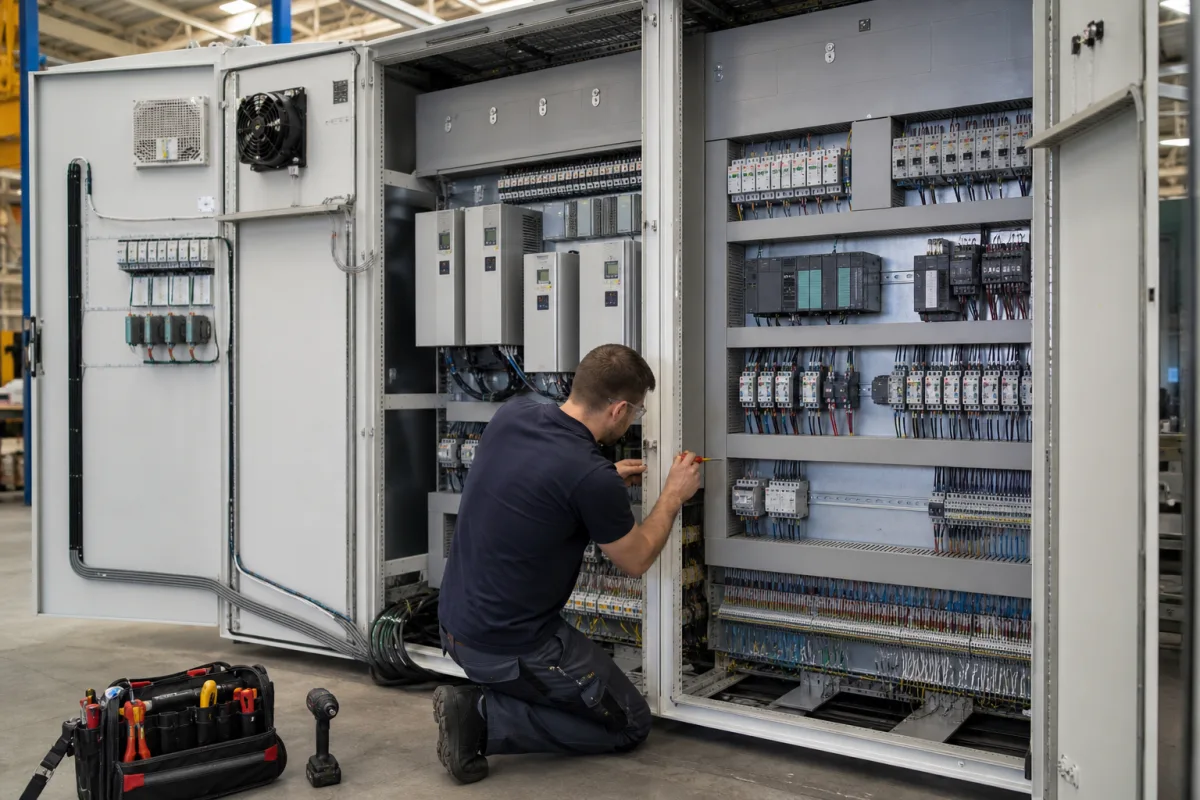
The control cabinet is a protective enclosure designed to house the electrical control systems of automated industrial equipment, such as the Automated Slag Skimming Robot.

Representative product image. Confirm appearance and specifications with the manufacturer.

Product Specifications

Technical details and manufacturing context for Control Cabinet

Definition
The control cabinet is a protective enclosure designed to house the electrical control systems of automated industrial equipment, such as the Automated Slag Skimming Robot. It serves as the central nervous system, coordinating all robotic movements, sensor inputs, and operational commands. The cabinet contains programmable logic controllers (PLCs), relays, circuit breakers, and wiring, all organized to ensure reliable operation in industrial environments. Constructed from galvanized steel, polycarbonate, and copper wiring, the cabinet offers robust protection against dust and water ingress, with an IP rating of IP54 to IP65 as per IEC 60529. External dimensions range from 600 to 2000 mm in height, width, and depth, and the cabinet can be configured for floor or wall mounting. It operates within a voltage range of 230/400 V and a temperature range of -20°C to 55°C, with a rated current of 63 to 630 A and a short-circuit withstand rating of 10 to 50 kA (1s rating) per IEC 61439. The enclosure material is typically cold-rolled steel (SPCC) or stainless steel (SUS304) per GB/T 11253, with a standard powder coating finish in RAL7035, though other RAL colors are available. Weight varies from 50 to 500 kg depending on size and installed components. Cable entry can be from the bottom or top via gland plates or cable glands. Cooling is achieved through natural convection or forced ventilation using fan/filter units. All listed parameters are reference ranges and must be verified with the legal manufacturer or supplier for the specific model and application. The control cabinet is a component, not a standalone product, and its performance depends on the integration with the overall system.
Working Principle
The control cabinet receives power from the main supply and distributes it to various components. It processes sensor data through programmable logic controllers (PLCs) and executes programmed instructions to control motors, actuators, and safety systems of the slag skimming robot. The PLCs coordinate inputs from sensors and outputs to actuators, ensuring precise movements and safe operation. The cabinet also houses protective devices like circuit breakers and relays to safeguard against electrical faults. The working principle relies on the correct configuration of the PLC programs and the proper wiring of all components. Verification of the system's operation involves checking power distribution, signal integrity, and response to commands. Maintenance signals include abnormal temperature, unusual noises, or fault indicators on the PLC. Failure boundaries are defined by the electrical ratings and environmental limits specified in the parameters.
Common Materials
Galvanized Steel, Polycarbonate, Copper Wiring
Technical Parameters
ParameterTypical rangeNotes & selection driver
DimensionsRequired600–2000 mmExternal cabinet dimensions (H×W×D)
IP RatingRequiredIP54–IP65 IPXXIngress protection rating for dust and water resistanceIEC 60529
Voltage RatingRequired230/400 VOperating voltage rangeIEC 61439
Temperature RangeRequired-20–55 °COperating temperature range
Rated Current63–630 ADepends on configuration and coolingIEC 61439
Short-Circuit Withstand Rating10–50 kA1s rating; verify with system impedanceIEC 61439
Degree of Protection for EnclosureIP54–IP65Same as IP rating; redundant but requiredIEC 60529
MaterialSPCC/SUS304Cold-rolled steel or stainless steelGB/T 11253
Surface TreatmentRAL7035Powder coating; other RAL colors available
Weight50–500 kgDepends on size and installed components
Mounting TypeFloor/WallFree-standing or wall-mounted
Cable EntryBottom/TopGland plates or cable glands
Cooling MethodNatural/ForcedNatural convection or fan/filter units

Ranges are indicative industry figures for RFQ preparation, not a supplier commitment. Confirm every value and standard with the legal manufacturer before ordering.

Components / BOM
  • Cabinet Body
    The cabinet itself: houses the equipment, carries the mounting rails and provides the ingress rating.
  • Programmable Logic Controller
    Central processing unit that executes control logic and coordinates robot operations
    Material: Electronic components, plastic housing
  • Power Distribution Unit
    Distributes electrical power to various components with circuit protection
    Material: Copper busbars, insulating materials
  • Motor Control Center
    Controls and protects motors for robotic arm and movement systems
    Material: Contactors, relays, thermal overload protectors
  • Human-Machine Interface
    Touchscreen interface for operator control and monitoring
    Material: LCD screen, touch panel, plastic bezel

Industry Taxonomies & Aliases

Commonly used trade names and technical identifiers for Control Cabinet.

Applied To / Applications

This component is essential for the following industrial systems and equipment:

Industrial Ecosystem & Supply Chain Structure

Complementary Systems
Downstream Applications
Specialized Tooling

Application Fit & Sizing Matrix

Operational Limits
pressure: Atmospheric (non-pressurized enclosure)
other spec: IP54/IP65 ingress protection, 85% max relative humidity (non-condensing)
temperature: -20°C to +40°C (operating), -40°C to +70°C (storage)
Media Compatibility
✓ Indoor industrial environments ✓ Clean manufacturing facilities ✓ Warehouse automation systems
Unsuitable: Washdown areas with high-pressure water jets or corrosive chemical exposure
Sizing Data Required
  • Total heat dissipation of internal components (W)
  • Number and dimensions of installed devices (mm)
  • Required cable entry/exit points and conduit sizes

Reliability & Engineering Risk Analysis

Failure Mode & Root Cause
Overheating of electrical components
Cause: Inadequate ventilation, dust accumulation blocking airflow, or overloading circuits beyond rated capacity
Corrosion of contacts and terminals
Cause: High humidity environment, condensation due to temperature fluctuations, or exposure to corrosive chemicals
Maintenance Indicators
  • Burning smell or visible smoke from cabinet vents
  • Audible buzzing, arcing, or intermittent relay clicking sounds
Engineering Tips
  • Implement regular thermographic inspections to identify hot spots before failure occurs
  • Maintain positive pressure ventilation with filtered air to prevent dust ingress and control humidity

Indicative industry ranges for design and RFQ preparation. Confirm the exact figures and applicable standard with the manufacturer before specifying.

Compliance & Manufacturing Standards

Applicable Standards
IEC 61439-1: Low-voltage switchgear and controlgear assemblies UL 508A: Standard for Industrial Control Panels ISO 13849-1: Safety of machinery - Safety-related parts of control systems

Quoted from the published standard.

Manufacturing Precision
  • Panel flatness: ≤ 0.5mm per meter
  • Hole position tolerance: ±0.2mm
Quality Inspection
  • Dielectric withstand test (hipot test)
  • IP rating verification test

Manufacturers of Control Cabinet

12 companies list this product among what they make. Company figures are quoted from each company's own website; every card states where the relationship came from.

Romtronic International Co., Limited
Dongguan, Guangdong, CN
Founded 199710,000㎡
ISO 9001:2015 ISO 13485:2016 IATF 16949
Managed by the manufacturer
Listed on the company's own website
GWEIKE (Jinan G.Weike Science & Technology Co., Ltd.)
Jinan, Shandong, CN
Founded 2004
Listed on the company's own website · profile compiled by CNFX from public sources
Hebei Shouke Yuantuo Technology Co., Ltd.
Hebei, CN
Listed on the company's own website · profile compiled by CNFX from public sources
JOCHAMP
Rui'an, Zhejiang, CN
Founded 2005
CE ISO9001 SGS
Listed on the company's own website · profile compiled by CNFX from public sources
Shandong Huaquan Power Co., Ltd.
Weifang, Shandong, CN
42,000 m²
ISO CE
Also makes: Water Pump, Diesel Engine, High-Pressure Pump and 8 more
Listed on the company's own website · profile compiled by CNFX from public sources
Climatest Symor
Shanghai, CN
Listed on the company's own website · profile compiled by CNFX from public sources
CNC Electric
Zhejiang, CN
Listed on the company's own website · profile compiled by CNFX from public sources
GIM FLUID Equipment (Shanghai) Co., Ltd.
Shanghai, CN
Listed on the company's own website · profile compiled by CNFX from public sources
Hangzhou Color Powder Coating Equipment Co., Ltd.
Shanghai, CN
Listed on the company's own website · profile compiled by CNFX from public sources
KDMfab
Wuxi, Jiangsu, CN
Listed on the company's own website · profile compiled by CNFX from public sources
ODES Electric
Jiangsu, CN
Listed on the company's own website · profile compiled by CNFX from public sources
PCM Cable
Dongguan, Guangdong, CN
Listed on the company's own website · profile compiled by CNFX from public sources
View All Factories

Manufacturer listings support early research and capability understanding. They are not certification, ranking, or transaction guarantees.

Technical documentation
Request current drawings, revision history, and a signed specification sheet.
Manufacturing capability
Verify equipment lists, process limits, capacity, and representative production evidence.
Inspection readiness
Confirm test methods, calibrated equipment, sampling plans, and traceable reports.
Supplier transparency
Check the legal entity, factory address, ownership, certifications, and direct contacts.

CNFX does not score or rank suppliers. Buyers must verify all claims and documents with the legal manufacturer before ordering.

Supply Chain Compatible Machinery & Devices

Circuit Breaker Arc Chute

The Circuit Breaker Arc Chute is a critical safety component in electrical circuit breakers, designed to rapidly extinguish electric arcs that form during circuit interruption.

Explore Specs →
Medium Voltage Switchgear Assembly Line

Automated production system for assembling medium voltage electrical switchgear.

Explore Specs →
Motor Terminal Block

A motor terminal block is a standardized electrical component that provides secure, insulated connection points for motor winding leads.

Explore Specs →
PLC Control System

A digital industrial computer control system that monitors inputs, makes decisions based on a custom program, and controls outputs to automate industrial processes.

Explore Specs →

Frequently Asked Questions

What is the purpose of a control cabinet in automated equipment?

The control cabinet houses the electrical control systems, including PLCs, relays, circuit breakers, and wiring, that coordinate the operation of automated equipment. It acts as the central hub for power distribution, sensor data processing, and command execution, ensuring the equipment operates correctly and safely.

What are the typical IP ratings for this control cabinet?

The control cabinet is available with an ingress protection rating of IP54 to IP65, as per IEC 60529. IP54 provides protection against dust and water splashes, while IP65 offers protection against dust ingress and low-pressure water jets. The specific rating depends on the configuration and should be verified with the manufacturer.

What standards apply to the control cabinet?

The control cabinet references IEC 61439 for low-voltage switchgear and controlgear assemblies, covering voltage, current, and short-circuit withstand ratings. The enclosure's degree of protection is per IEC 60529. Material specifications may reference GB/T 11253 for cold-rolled steel. These standards serve as verification references; compliance must be confirmed with the supplier.

How should I verify the suitability of a control cabinet for my application?

You should check the required dimensions, IP rating, voltage, current, short-circuit withstand, temperature range, and mounting type against your system's specifications. Also, consider the cooling method and cable entry options. Always confirm the exact values with the legal manufacturer or supplier, as the listed parameters are reference ranges.

Data Basis

Editorial classification, named public sources where available, and source-reviewed manufacturer records.

Preliminary Technical Classification
This page supports structured research, RFQ preparation, and supplier evaluation. It does not replace buyer-led supplier qualification, standards review, or technical approval.
Buyer enquiry

Request manufacturing insight for Control Cabinet

Ask for use case, specification boundaries, supplier type, and RFQ preparation information for this product.

Where it goes
Straight to the CNFX editorial desk, and to the manufacturer if this product is linked to a claimed profile. Nothing is broadcast to a supplier list.
Your details stay here
We do not sell or rent enquiry data, and we do not add you to a mailing list. Used only to answer this request.
No commission, no middleman
CNFX is a directory. We take no cut of any order and never negotiate on a supplier's behalf.
What we don't claim
A listing is not an endorsement. Qualify every supplier and verify every figure yourself before ordering.

Your business information is used only to process this request.

Thank you! Your message has been sent. We'll respond within 1–3 business days.
Sorry, we couldn't send your message. Please try again, or email us at contact@cnfx.com.

Need to Manufacture Control Cabinet?

Compare manufacturer profiles with relevant product and process capability.

Previous Product
Wire Tensioning System
Last Product
Get QuotesChat