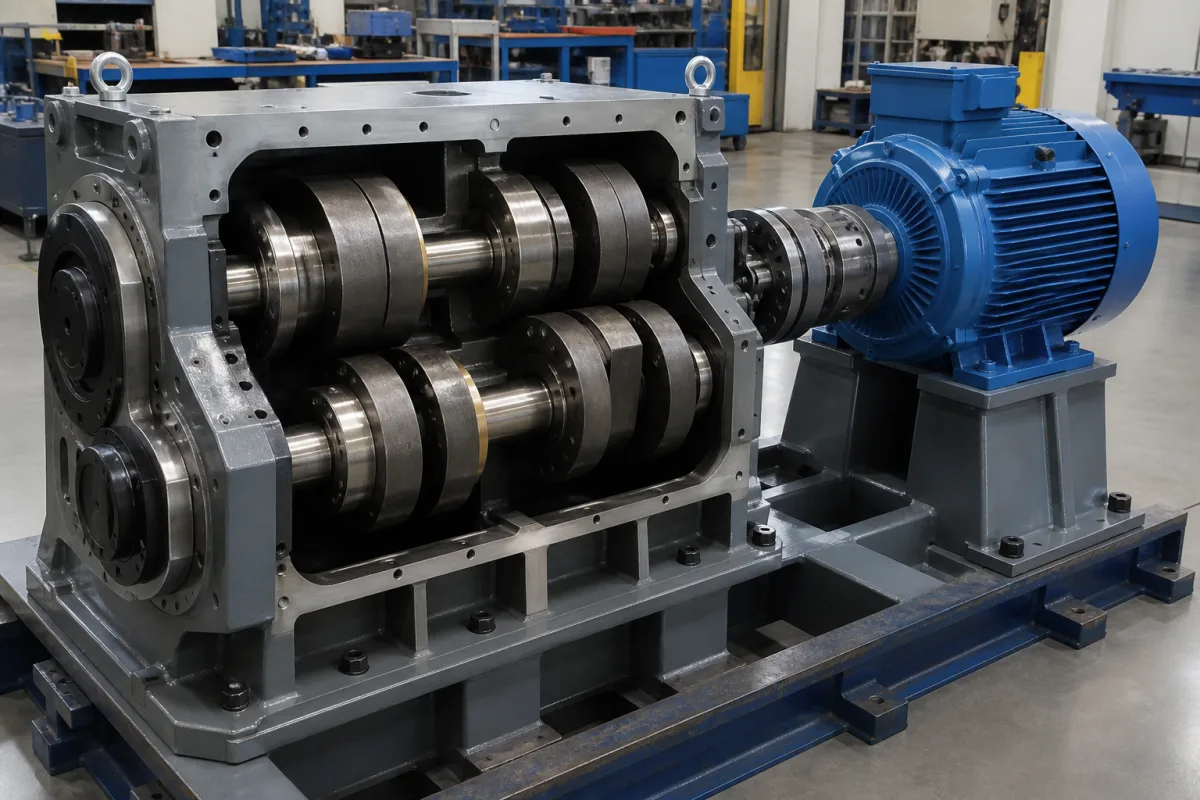
Geared two-shaft vibration exciter for screens and feeders: static moment, speed limits and synchronising-gear lash
The geared two-shaft exciter that bolts onto a vibrating screen or feeder · static moments of about 10,700 to 150,500 kgmm across one maker's range, up to 453 kN of centrifugal force in another's, and gear lash that lets the force line follow the machine's centre of gravity
The exciter is the part of a vibrating screen or heavy feeder that actually makes the motion: two parallel shafts carrying eccentric weights, geared so that they turn in opposite directions and their sideways forces cancel while the forces along one line add. It is bought by static moment, the mass-times-radius of its weights, because that and the vibrating mass set the stroke, and the speed then sets the force on bearings and structure.
Geared two-shaft (directional or unidirectional) unbalanced-mass exciters as separate units: their static moment and its adjustment, speed limits, synchronising gears, bearings, lubrication and seals, and how two or more are coupled on one machine. Complete bulk-material vibrating feeders are covered on the Vibrating feeder page and complete screens on the Vibrating screen page; linear tracks and escapements after a parts feeder are covered on the Feeding mechanism between bowl feeder and assembly page; single-shaft external vibrator motors, compaction tables and machinery isolators are not covered here.
CNFX editorial research · Sources checked October 12, 2026 · 3 sources
Static moment from 10,719 to 150,459 kgmm, adjusted with steel or lead inserts
Haver & Boecker Niagara lists five standard exciter models with the minimum and maximum static moment of each, changed by mounting steel or lead weight inserts in different configurations; its catalogue prints thousands with a point (70.474 kgmm), written here with commas. [1]
The catalogue does not print a unit for maximum frequency; the values are consistent with revolutions per minute. Across the insert configurations, the permitted speed falls or stays level as the static moment rises. [1] Editorial calculation, assuming rpm and centrifugal force = static moment × ω²: the HB 25 at its largest static moment, 24.392 kg·m, turning at 1,050 rpm (ω ≈ 110 rad/s) produces about 295 kN; at its smallest, 10.719 kg·m at 1,500 rpm, about 265 kN. The speed limits keep force within a band as the inserts change.
For comparison, Italvibras presented its VU series of unidirectional exciters at the April 2010 trade fairs, for linear vibration of large, heavy machines, with centrifugal forces of 88 to 453 kN and static moments from 8,000 to 734,400 kgmm, housings in spheroidal graphite iron and spherical roller bearings. [2]
Haver states that its exciters are built to set the stroke, frequency and static moment required for each application, and that the adjustable static moment fine-tunes the amplitude. [1] Editorial note: the stroke a given static moment produces depends on the total vibrating mass of the machine, including the exciters themselves, so the screen or feeder builder, not the exciter catalogue alone, fixes the insert configuration.
Give the supplier the vibrating mass, the stroke and speed wanted, and how many exciters the machine carries, so the model and insert configuration can be checked against its speed limit.
02
Synchronising gears with deliberate lash: letting the force line follow the centre of gravity
Ludowici Mineral Processing Equipment's exciter patent (granted 2005) describes a pair of counter-rotating eccentric masses on driven shafts, coupled by gears that bring them into a phase relationship giving a net direction of excitation. [3]
The patent reports that allowing lash in the synchronising gears, up to 10°, lets the direction of excitation shift toward the machine's centre of gravity when that moves, while still synchronising the masses at start-up; it prefers about ±4.0 to 4.5° each side of zero lash for a screen of about 6.5 tonnes operating at about ±5 g. An earlier Australian design it cites achieved independent running in steady state with 4 mm (1.43° of rotation) of lash, so the gears carry no power and noise drops. [3]
In the described embodiment each gear has 9 teeth on an 18-tooth module, every second tooth removed, at 325.0 mm pitch circle diameter and 65 mm wide, with a 20° pressure angle, giving 9° of lash; the eccentric masses on the two shafts are set 180° out of phase, gears and bearings run partly immersed in oil, and the assembly operates at 16 Hz on a 6.5-tonne machine. Its side-plate torsion and bending modes are tuned at least 2 Hz, preferably about 4 Hz, away from that frequency. [3] Editorial calculation: at 16 Hz (ω ≈ 100.5 rad/s), 5 g of peak acceleration corresponds to about 4.9 mm of amplitude, about 9.7 mm peak to peak.
Ask how the exciter's shafts are synchronised, the backlash designed into the gears, and the natural frequencies of the machine it will be mounted on.
03
Spherical roller bearings, oil and labyrinth seals
Haver uses spherical roller bearings designed for vibrating equipment, a combination of oil and grease chosen per model and application to lower operating temperature, and a seal system with an oil deflector, a mechanical labyrinth and O-rings and V-rings that resist vibration. Its shafts, housings and counterweights were designed by analytical calculation and finite element analysis based on AGMA, ISO, DIN and BS standards, and its exciters leave the factory ready for a condition-monitoring system. [1]
Ludowici's embodiment seals its shafts to the bearing retainers with a grease-purged labyrinth, a V-ring grease seal and a lip oil seal with slinger, and feeds oil to the bearings through drillings in the retainers, holding the level by aspiration. [3] The Italvibras report cites spherical roller bearings and a long B10 service life for the VU series. [2]
Ask for bearing designation and calculated life at your speed and static moment, lubricant type and change interval, and seal arrangement.
04
Information for an exciter enquiry
Paste it into your enquiry below or into an email to a maker, then replace every bracket.
Machine: [screen or feeder; vibrating mass including exciters; mounting]
Motion: [linear or other; stroke; speed; g level]
Exciter: [number per machine; coupled or separate drives; static moment range; insert type]
Drive: [motor power; cardan or belt; start-up]
Bearings and lubrication: [bearing type; oil or grease; temperature]
Monitoring: [condition-monitoring connection]
Explore company information and manufacturing capabilities, then discuss the scope of your project with a relevant supplier.
Share this page
Compiled and source-reviewed by the CNFX editorial team.
Each manufacturer above links to the page on that company's own website where the product is listed, with the date we checked it. How we source and review
· Page last updated 13 October 2026
Buyer questions
What is the static moment of a vibration exciter?
The eccentric weights' mass times their radius, given in kgmm; one maker's five models span 10,719 to 150,459 kgmm, changed by steel or lead inserts. [1]
How much force can a two-shaft exciter produce?
Italvibras's VU series spans 88 to 453 kN; by editorial calculation a Haver HB 25 gives about 265 to 295 kN at its listed limits, assuming the speeds are in rpm. [2][1]
Why would exciter gears be given backlash?
A Ludowici patent found that up to 10° of lash lets the force line track the machine's centre of gravity while still synchronising at start-up. [3]
Sources and what still needs a direct check
Sources checked 2026-10-12. Model data come from Haver & Boecker Niagara's exciter catalogue and from a 2010 trade-press report on Italvibras's VU series; the gear synchronisation detail from a patent granted to Ludowici, a screen builder.