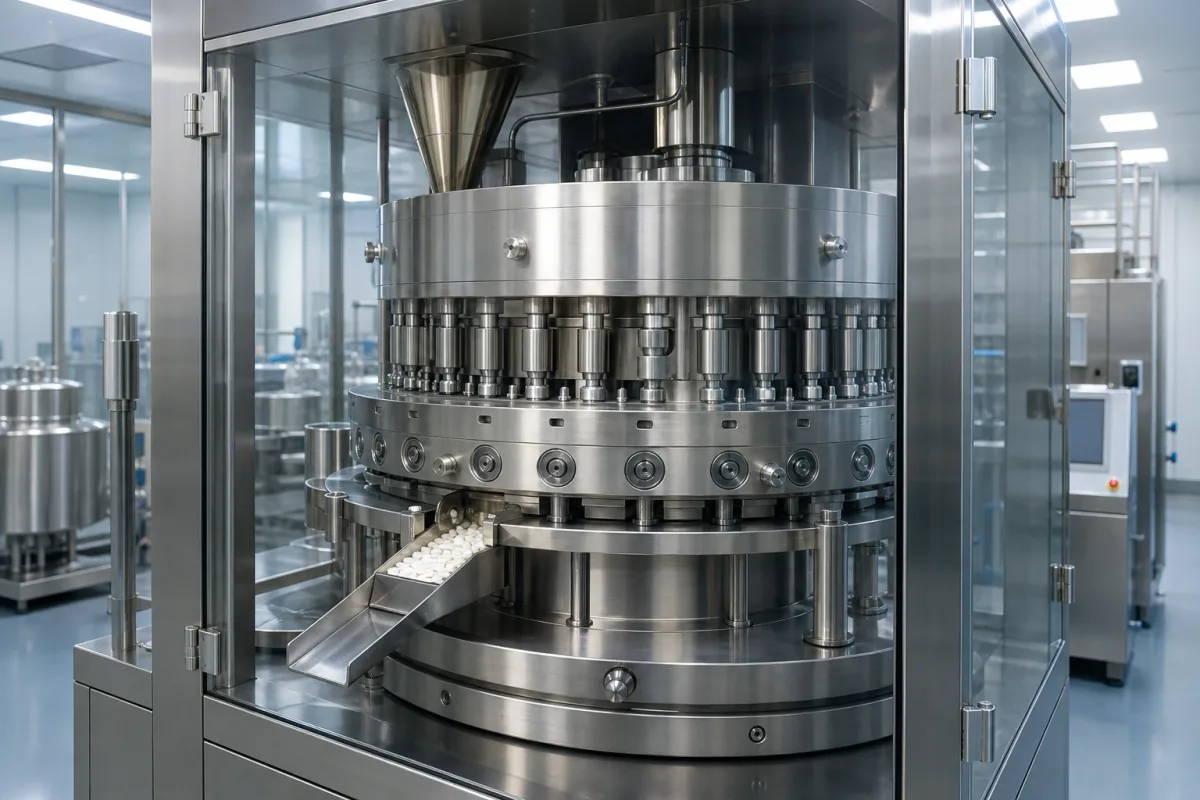
Pharmaceutical rotary tablet presses · press stations, main and pre-compression force, maximum tablet diameter, die filling depth, output in tablets per hour, EU and TSM B/D tooling, compression rollers and bearings, GMP construction under 21 CFR 211.65
A rotary tablet press is a pharmaceutical compression machine in which a rotating die table (turret) carries punches and dies past a filling system, then between pre-compression and main-compression rollers that drive the upper and lower punches together, before the tablet is ejected to a chute. Ask three things first: how many stations and which die type the turret carries, what main and pre-compression force and output it reaches with your tablet size, and how its product-contact parts and lubricants meet GMP construction rules.
Rotary tablet presses for pharmaceutical solid dosage forms, from R&D and clinical-batch machines to production presses, including the turret, EU or TSM B and D tooling, compression rollers and their bearings, and the filling system. Punch tips and feed frames are covered on their own pages; single-punch (eccentric) presses, powder-metallurgy compacting presses, tablet coating machines and tablet testers are outside this page.
CNFX editorial research · Sources checked October 11, 2026 · 4 sources
Romaco's Kilian KTP 180X is a single-sided press for pharmaceutical mono-layer tablets from R&D through clinical batches to small-scale production. It lists 4 to 19 press stations; with 19 stations (BB dies) it reaches 13 mm tablets, 18 mm die filling and 79,800 tablets/hour, and with 8 stations (D dies) 25 mm tablets, 20 mm filling and 33,600 tablets/hour. Maximum pre-compression force is 10 kN and main-compression force 50 kN, at 400 V 50/60 Hz, 6 bar compressed air and 560 kg. [1]
The KTP 420X is a mid-sized single-sided production press with 22 to 66 stations. Its table lists 66 stations with segment dies for 12 mm tablets, 22 mm filling and 475,200 tablets/hour; 37 stations with B dies for 16 mm, 18 mm and 266,400 tablets/hour; 30 stations with D dies for 25 mm, 20 mm and 198,000 tablets/hour; and 22 stations for 35 mm tablets at 105,600 tablets/hour. Pre- and main-compression force are each up to 100 kN; it weighs 3,500 kg. [2]
Romaco notes for both presses that output depends on tablet size and compressed material and that maximum pre- and main-compression force depend on tooling and tablet design. [1][2]
Editorial calculation: on a single-sided press each station makes one tablet per turret revolution, so turret speed = output ÷ (stations × 60). That gives 79,800 ÷ (19 × 60) = 70 rpm for the KTP 180X, and 475,200 ÷ (66 × 60) = 120 rpm, 198,000 ÷ (30 × 60) = 110 rpm and 105,600 ÷ (22 × 60) = 80 rpm for the KTP 420X formats. [1][2]
Give the supplier the tablet shape and size, target weight and thickness, the main and pre-compression force your formulation needs, the required output, die type and station count, mono- or bi-layer production, batch size and number of products, and the containment level.
02
Check tooling standard, compression rollers and GMP construction
A PharmTech article by tooling maker I Holland explains that the Eurostandard, first published in 1992, and the North American Tablet Specification Manual (TSM) differ in punch head form and under-head cam angles, so European and TSM tooling are not interchangeable, and Euro/ISO-length punches cannot be used in a TSM press; ISO 18084 covers punches and dies internationally. [3]
The article states that the ISO/Eurostandard domed punch head blends a radius into the dwell flat, giving a smoother lead onto the compression rollers, reducing wear on tooling and press and giving sufficient dwell time for compaction; version 7 of the TSM recommends this head shape for new punches. Romaco lists special compression rollers, bolts and bearings for low friction on the KTP 420X. [3][2]
Turret direction and keying matter for shaped tablets: the article notes anticlockwise turrets on IMA, Fette, Korsch and Kilian presses and clockwise turrets on Cadmach and Manesty presses, and that shaped and multi-tipped upper punches need an anti-turn key. [3]
Under 21 CFR 211.65, surfaces that contact components, in-process materials or drug products must not be reactive, additive or absorptive so as to alter the drug product, and lubricants or coolants must not contact the product in that way. Romaco's KTP 420X claims hermetic separation of the compaction and service areas, closed punch bellows against black-spotted tablets, radii of at least 15 mm in the process area and a process area kept below 30 °C; the KTP 180X lists tool-free dismantling of product-contact parts. [4][2][1]
03
Data tables, tooling standard, force monitoring and contact-material certificates to request
When requesting quotations, ask each supplier for the technical data table for each die type, the tooling standard (EU or TSM) and turret direction, force-monitoring and rejection functions, the product-contact material certificates and lubricant data, and the cleaning and containment design.
04
Turret, punches and dies, compression rollers, filling system, tablet chute and contact surfaces
The punches and dies tie the press to a tooling standard: EU and TSM tooling differ in head form, cam angles and length, so an existing tooling stock decides which turret the new press needs. [3]
Part
Role
Fix in the order
Turret (die table)
Carries punches and dies; exchangeable on the KTP 180X; segment dies on the KTP 420X. [1][2]
Stations, die type.
Upper and lower punches, dies
EU or TSM B, BB, D tooling; not interchangeable between standards. [3][1]
Standard, head form, keying.
Pre- and main-compression rollers and bearings
Drive the punches; special rollers, bolts and bearings for low friction. [2][3]
Force rating, bearing type.
Filling system (fill shoe or feed frame)
Fills the dies; fill shoe swings out for changeover. [2]
Filling depth, feeder type.
Tablet chute
Takes ejected tablets; mounted on a swivel arm. [2]
Single- or double-sided.
Product-contact surfaces and seals
Non-reactive, non-additive, non-absorptive; lubricants kept off the product. [4]
Materials, lubricant data.
05
Stations, compression force, output, tablet diameter, filling depth and tooling for a press quotation
Station count, force, diameter and output move together by die type: Romaco's KTP 180X makes 13 mm tablets at 79,800 an hour with 19 BB stations but 25 mm tablets at 33,600 an hour with 8 D stations. [1]
Field
What it means and published values
Ask the supplier for
Turret rotation speed (rpm)
Not stated in reviewed sources; see the editorial calculation above.
Maximum speed per die type.
Maximum compression force (kN)
50 kN main, 10 kN pre (KTP 180X); 100 kN main and pre (KTP 420X). [1][2]
Main and pre-compression.
Tablet production rate (tablets/hour)
Up to 79,800 (KTP 180X); up to 475,200 (KTP 420X). [1][2]
2 companies list this product among what they make. Company figures are quoted from each
company's own website; every card states where the relationship came from.
Explore company information and manufacturing capabilities, then discuss the scope of your project with a relevant supplier.
Share this page
Compiled and source-reviewed by the CNFX editorial team.
Each manufacturer above links to the page on that company's own website where the product is listed, with the date we checked it. How we source and review
· Page last updated 13 October 2026
Buyer questions
How does die type change tablet size and output?
On Romaco's KTP 180X, 19 BB stations make tablets up to 13 mm at 79,800/hour, while 8 D stations make tablets up to 25 mm at 33,600/hour. [1]
Can EU tooling run in a TSM press?
No: the PharmTech article explains that head form, under-head cam angles and punch length differ, so the two are not interchangeable. [3]
What GMP rule applies to press contact parts?
21 CFR 211.65 requires product-contact surfaces to be non-reactive, non-additive and non-absorptive, and keeps lubricants and coolants off the product. [4]
Sources and what still needs a direct check
Sources checked 2026-10-11. Romaco publishes its own press data, the PharmTech article is written by a tooling maker, and 21 CFR 211.65 is the US GMP rule on equipment construction; values for your press must come from the supplier's technical data and qualification documents.