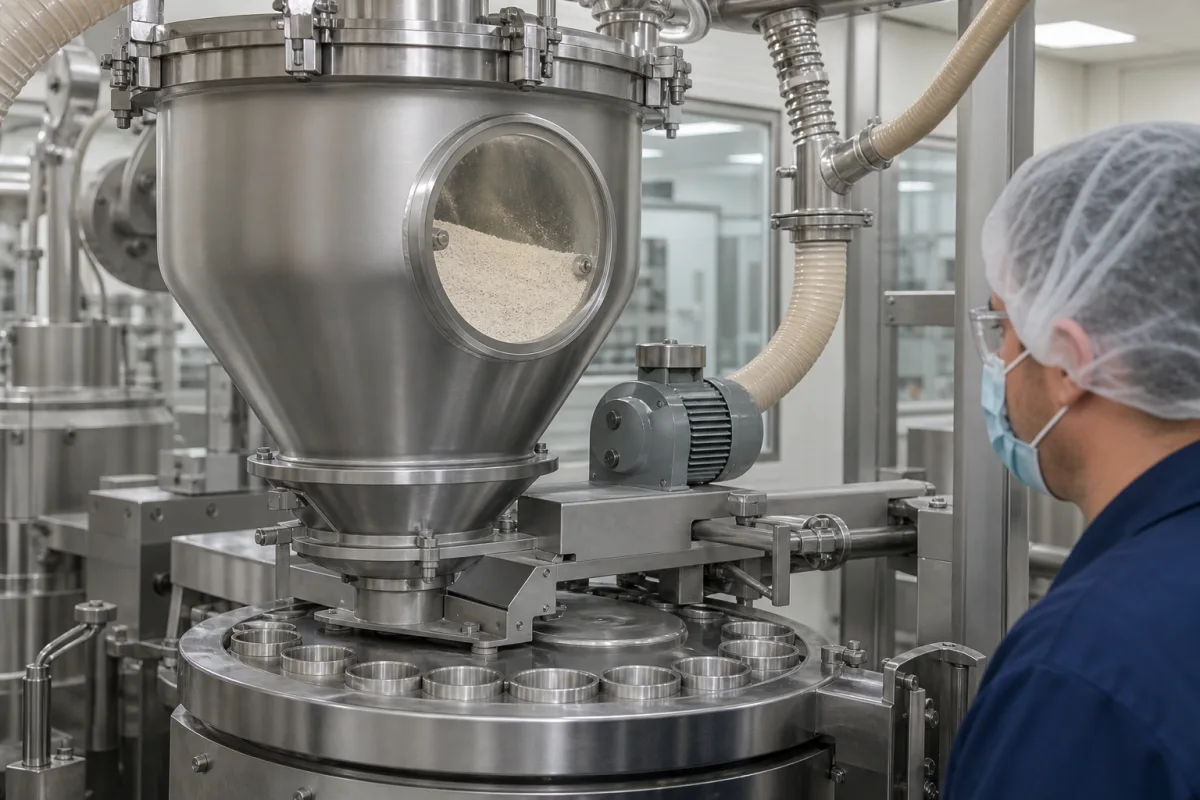
Powder supply system for a rotary tablet press: vacuum loader, press hopper and drop pipe that carry the blend to the feed frame without segregating it
Tablet compression rooms · how the blend gets from its container into the press hopper and down to the feed frame without un-mixing: vacuum loaders, chutes, hopper shape and in-line blend checks
A blend that leaves the blender uniform can still reach the dies un-mixed. Between the container and the feed frame of a rotary tablet press it falls through a chute or is sucked through a vacuum line, lands in the press hopper, and drains towards the feed frame, and each of those steps can sort fine particles from coarse ones. The powder supply system is the set of equipment that does this transfer: a loader or chute, the press hopper with its level control, and the pipe that drops into the feed frame. Choosing it is a question of which transfer method the blend tolerates, what hopper shape keeps it in mass flow, and how blend uniformity is checked before it is compressed.
Powder supply equipment for rotary tablet presses upstream of the feed frame: vacuum loaders and conveyors mounted on the press, gravity chutes and drop pipes from containers on an upper floor, press feed hoppers and their level control, the lifting and swivelling mounts used to move loaders off the press, and in-line blend uniformity measurement on the way into the press. The paddle feed frame that fills the dies is covered on the Pharmaceutical tablet press feed frame page and the press itself on the Rotary tablet press (pharmaceutical) page; fill-depth cams and lower punches on the Lower punch assembly in a rotary tablet press turret page. Loss-in-weight metering screws are covered on the Powder feeder with loss-in-weight control page, general powder and granule conveying on the Pneumatic conveyor for powders and granules page, plastics hopper loaders on the Vacuum material feeding system for plastics processing page, and blenders on the Automated pharmaceutical powder blender page.
CNFX editorial research · Sources checked October 13, 2026 · 3 sources
Gravity chute, vacuum line or scoop: how each transfer route can un-mix a blend on its way to the press
Jakubowska and Ciepluch's 2021 review in Pharmaceutics sets out three ways of moving a blend from its bulk container to the press hopper, each with its own segregation risk. In gravity transfer an IBC sits on an upper level and the blend runs down a pipe or chute, where sifting or trajectory segregation can occur at discharge and fine particles can be entrained by air in free fall. Vacuum transfer reduces flow problems and percolation, but fines can still fluidise in the line. Manual scooping avoids both but is labour-intensive and may be poorly repeatable or dusty. [1]
The review summarises chute experiments in numbers. In a laboratory 120 cm vertical glass chute of 7 cm diameter with an airtight bottom, fine particles collected in the top layer, and the accumulation of large particles at the bottom or small ones at the top reached a limit of 46 % of the d90 value; tests without an airtight bottom confirmed that air escaping upwards through the powder drives the effect. A longer free fall increased segregation, and wider pipes reduced it. [1] Another study it cites traced lower API content at the end of a direct compression run to segregation during discharge through a sealed vertical chute, where displaced air rose through the falling powder. [1]
The design measures the review lists for chutes are short drop heights, larger pipe diameters, a smaller container outlet or a rotary valve that drops powder in small increments, and, above all, a separate path for the displaced air so that it does not escape through the powder. For vacuum transfer it reports that connecting the conveying line tangentially to the side of the press hopper, rather than centrally, mitigates the effect of fines fluidised in the line. [1]
Before choosing the transfer method, test the blend's tendency to segregate by sifting and by fluidisation (the review cites ASTM D6940 and D6941 for these), and give the equipment supplier the floor-to-floor drop available, the container outlet size and the press hopper inlet.
02
The press hopper: mass flow versus funnel flow, and why an eccentric outlet feeds one side of a double-sided press differently
Once in the hopper, the blend can segregate again as it drains. The review distinguishes mass flow from funnel flow: funnel flow, in hoppers whose walls are too shallow or rough, leaves powder near the walls stagnant while the centre discharges first, and it is a cause of segregation; mass flow, achieved by design choices such as conical rather than pyramidal hoppers or inserts, removes that risk. [1]
Simulation studies the review summarises looked at hopper angles of 15°, 55° and 90° and at concentric against eccentric conical hoppers, the latter being a design used on tablet presses. Eccentric hoppers showed no difference in segregation extent but up to 35 % higher discharge rate; they can however produce an asymmetric profile, with fine-rich powder leaving along the inclined wall, which matters when the stream is split afterwards, as on a double-sided rotary press or in a feed frame with paddles turning in opposite directions. Concentric geometry, or a steeper wall and lower wall friction on an eccentric hopper, reduced the segregation index. [1] Filling the hopper also sorts particles: in a simulated conical hopper large particles rolled towards the walls and small ones stayed in the centre, more so in the upper regions. [1]
Hopper and drop pipe dimensions come from the press. Fette Compacting's FE Series brochure marks the feeding hopper of its FE35, FE55 and FE75 presses as Ø176 mm on its dimension drawings, and gives maximum outputs of 367,200, 626,400 and 1,656,000 tablets per hour. [3] Editorial calculation: at the FE55's 626,400 tablets per hour and an assumed 500 mg tablet, the supply system has to deliver about 313 kg of blend per hour; the tablet weight is an example, not a Fette figure.
Ask the press maker for the hopper inlet size and volume and the maximum blend flow at full output, and ask the hopper or loader supplier whether the hopper is designed for mass flow with your blend's wall friction.
03
Vacuum loaders on the press: conveying rate, swing-away mounting for cleaning, and checking blend uniformity on the way in
Volkmann, a German maker of vacuum conveyors, describes the duty on a tablet press as reliable, gentle supply of powder or granules without segregation of components or particle sizes, and gives its VS series conveying rates from about 100 up to 10,000 kg/h. [2]
In one installation Volkmann reports on, a double rotary press of type FE55 from Fette Compacting is fed from containers by two conveying lines with VS 200 vacuum conveyors, each on a lifting column that swivels the conveyor 180° away from the press and lowers it electrically for cleaning and maintenance, then returns it to its position over the press; the column was adapted to a low ceiling. Its PPC pharmaceutical conveyors are built with a one-piece, electropolished, gap-free body that can be dismantled without tools, and are shown fitted on tablet presses with washing-in-place extensions. [2] Editorial calculation: the 313 kg/h needed by an FE55 in the example above sits near the low end of the VS range of about 100 to 10,000 kg/h. [2][3]
Uniformity can be watched in the supply stream. Fette's brochure describes NIR-based process analytics that monitor powder blend uniformity and tablet uniformity in the process stream, with a blend uniformity sensor giving up to 10 independent measurements per second and flexible positioning. [3] The review cites a case in which an NIR probe in a press feed frame picked up a rise in API signal at the end of a run, attributed to large API crystals leaving the hopper last, made worse by press vibration and fines from paddle attrition. [1]
For a vacuum loader, give the supplier the blend's bulk density and particle size distribution, the required kg/h at full press output, the conveying distance and height, the cleaning method (dismantle or wash in place), the ceiling height above the press and any containment requirement.
04
What to send with a press powder supply enquiry
Paste it into your enquiry below or into an email to a maker, then replace every bracket.
Blend: [bulk density; particle size distribution; API size and loading; segregation test results]
Press: [model; single or double sided; hopper inlet size; maximum output]
Throughput: [kg/h at full output; tablet weight]
Transfer: [gravity from upper floor or vacuum; drop height; container type and outlet]
Hopper: [volume; mass-flow design; level control]
Cleaning: [dismantle or WIP; swing-away or lifting column]
Monitoring: [NIR blend uniformity position]
Room: [ceiling height; containment class]
Explore company information and manufacturing capabilities, then discuss the scope of your project with a relevant supplier.
Share this page
Compiled and source-reviewed by the CNFX editorial team.
Each manufacturer above links to the page on that company's own website where the product is listed, with the date we checked it. How we source and review
· Page last updated 13 October 2026
Buyer questions
Is vacuum transfer better than a gravity chute for a tablet press?
Jakubowska and Ciepluch's review notes that vacuum transfer reduces flow problems and percolation but fines can still fluidise in the line, mitigated by entering the hopper tangentially; gravity chutes risk air-entrainment segregation that grows with drop height. [1]
How much does a drop chute segregate a blend?
In a 120 cm, 7 cm diameter test chute with an airtight bottom, fine particles collected at the top, with accumulation limited to 46 % of the d90 value; longer drops increased and wider pipes reduced the effect. [1]
What conveying rate does a press vacuum loader need?
It follows the press: Fette gives up to 626,400 tablets per hour for an FE55, which at an assumed 500 mg tablet is about 313 kg/h (editorial calculation); Volkmann's VS conveyors cover about 100 to 10,000 kg/h. [3][2]
Does hopper shape matter?
Yes. The review links funnel flow to segregation, and reports eccentric hoppers discharging up to 35 % faster but with a risk of fine-rich powder leaving along one wall. [1]
Sources and what still needs a direct check
Sources checked 2026-10-13. Segregation mechanisms and test results come from a 2021 review in Pharmaceutics; vacuum loader rates and mounting from Volkmann's product and application pages; press output, hopper connection and NIR monitoring from Fette Compacting's FE Series brochure.