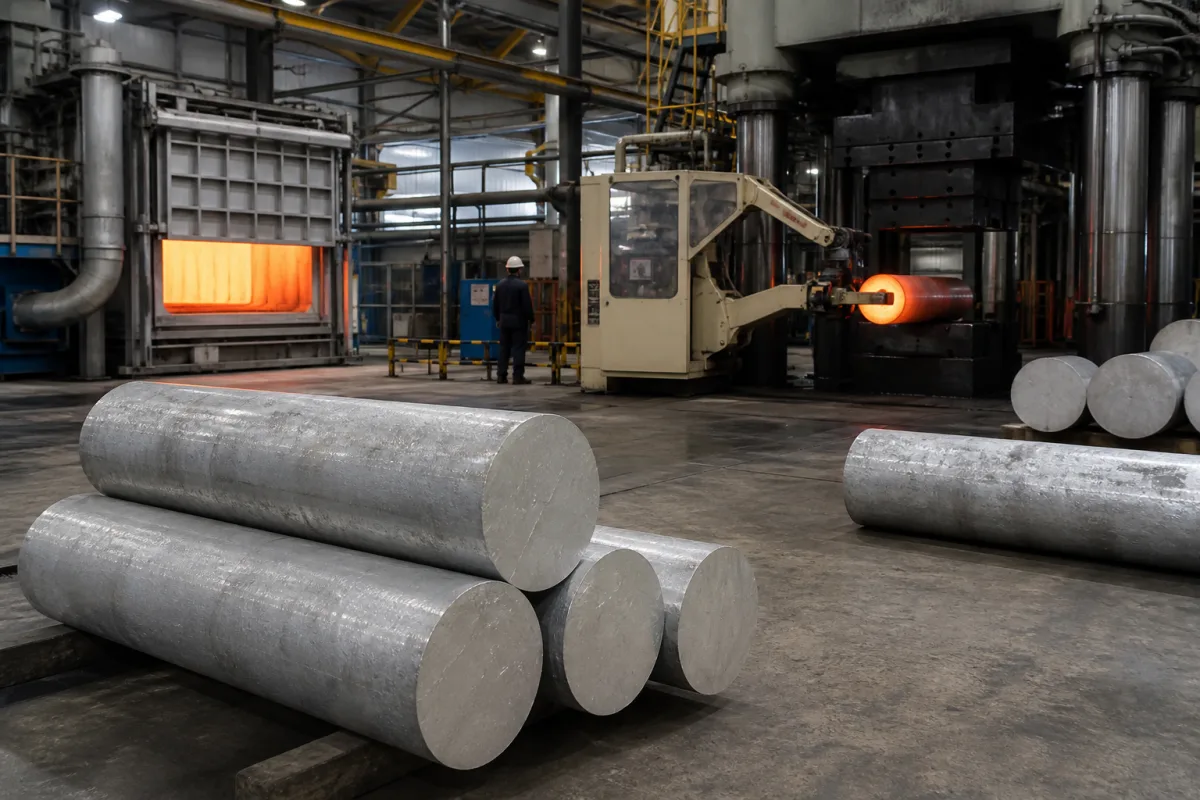
Forging-grade aluminium alloy billet cast to size: 6082 cast forging stock that replaces extruded bar for closed-die suspension parts
Cast round stock in place of extruded bar for closed-die 6082 suspension forgings · coarse surface grain after solution treatment, isotropy, scalping and homogenising, and what full-scale control-arm trials measured
Closed-die aluminium suspension arms have traditionally been forged from extruded round bar, which means the metal is cast, homogenised, extruded and only then forged. Casting the billet directly at forging diameter removes the extrusion step, and the published trials show it also changes how the forging behaves in heat treatment: a thinner layer of coarse grains at the surface, more even strength in different directions, and in one study lower and in another higher strength than the extruded route. A buyer of cast forging stock needs to know which of these results applies to the stock being offered.
Cast round billets of heat-treatable 6xxx alloys, chiefly 6082, supplied at forging diameter (horizontal direct-chill, continuous or low-pressure cast) as feedstock for closed-die forging of automotive suspension and chassis parts, compared with extruded forging stock. Direct-chill cast logs and billets for extrusion are covered on the Aluminium alloy extrusion billet page; open-die forged bar and hand forgings in 6061 and 7075 on the Hot-forged aluminium alloy billet page; large DC-cast 7050 and 7075 billets and their stepped homogenising on the 7xxx high-strength aluminium billet page. Forging stock in other metals is on the Titanium alloy bar and billet and Magnesium alloy billet pages. Finished forgings and extruded bar sold as such are outside this page.
CNFX editorial research · Sources checked October 12, 2026 · 3 sources
Coarse surface grain after solution treatment: 0.28–0.34 mm on cast stock against 0.72–0.76 mm on extruded
Arbo and co-authors at SINTEF, Hydro and Raufoss Technology describe the problem cast stock is meant to solve: forgings made from extruded material grow columnar coarse surface grains during post-forging solution heat treatment, which is a risk to fatigue performance and can initiate fracture in use. They attribute it to strain accumulated in extrusion, which drives recrystallisation in heat treatment. [1]
In their generic trial, 38 × 180 mm 6082 specimens were preheated to 500 °C, forged on a 1,000 t hydraulic press with tools at 430 ± 5 °C and 20 mm/s, then solution treated at 550 °C for 15 min, quenched and aged at 185 °C for 4 h. The coarse surface layer on the outer edge averaged 0.72 to 0.76 mm for extruded stock, 0.28 to 0.34 mm for 90 mm low-pressure-cast stock homogenised at 550 °C for 2 h, and 0.42 to 0.50 mm for cast stock pre-formed by cross-wedge rolling. [1]
In full-scale production of front lower control arms, the maximum coarse surface grain layer in the highly deformed pin area was 3.3 mm with extruded stock and 1.2 mm with cast stock; in the less deformed bulk area the cast-stock arm showed no significant surface grain layer while the extruded one did. [1]
Editorial calculation: in the generic trial the cast-stock layer is about 37 to 47% of the extruded-stock layer (0.28 / 0.76 to 0.34 / 0.72); in the control-arm pin area it is about 36% (1.2 / 3.3). [1]
Jia and co-authors, comparing 6082 control arms forged from continuously cast ingots and from extruded rods of the same diameter, report the same direction of effect: extruded feedstock led to abnormal grain growth in heat treatment, and the cast-ingot arms had a finer average grain size and a higher volume fraction of uniformly dispersed secondary phases. [2]
Ask the supplier which casting route the stock comes from, its diameter, whether and how it was homogenised, and for a forged-and-heat-treated section showing the surface grain layer on a part close to yours.
02
Strength along and across the stock axis, and 135,745 to 162,360 cycles on cast-stock control arms
After forging and T6 in the generic trial, extruded stock gave the highest longitudinal strength, Rp0.2 391.5 MPa and Rm 406.5 MPa, against 356.5 and 376.5 MPa for cast stock. Across the stock axis the order changed: cast stock reached 370.3 and 393.3 MPa with 12.2% elongation, extruded 363.3 and 382.0 MPa with 8.9%. The authors read this as anisotropy in the extruded material, which lost roughly 30 MPa from longitudinal to transverse, while cast stock gained about 10 MPa. [1]
Editorial calculation from the table: extruded Rp0.2 falls by 28.2 MPa (391.5 − 363.3) and cast Rp0.2 rises by 13.8 MPa (370.3 − 356.5) between the two directions. [1]
On the production control arms in T5, extruded stock gave Rp0.2 376.3 MPa and Rm 399.2 MPa in the standard bulk position against 345.5 and 378.1 MPa for cast stock, while cast stock had the higher reduction of area (42.4% against 36.8%). Cast-stock arms given a full T6 instead reached 376.0 and 403.5 MPa with 13.1% elongation. In assembled-arm fatigue tests the automaker required 18,040 cycles; three cast-stock arms lasted 162,360, 135,745 and 139,794 cycles, against an average of 141,466 for arms from extruded stock in current production. [1]
Editorial calculation: the lowest cast-stock result, 135,745 cycles, is about 7.5 times the 18,040-cycle requirement and about 4% below the extruded-stock average. [1]
Jia and co-authors report the opposite strength ranking for their arms: tensile strength 350 MPa, yield strength 300 MPa, elongation 16.5% and 122.7 HV0.1 from continuously cast ingot, described as 7.7% higher tensile strength, 20% higher yield strength and 3% higher microhardness than arms from extruded rod. [2] Editorial note: the two studies used different casting routes, part geometries and heat treatments; ask for test results from the casting route and temper you will buy rather than relying on either ranking.
Specify the temper route (T5 after forging or T6 with separate solution treatment), the test positions and directions for tensile specimens, and any component fatigue requirement, and ask for results on parts forged from the offered stock.
03
Scalping, homogenising and surface roughness: what cast forging stock may skip
Arbo and co-authors note that conventional cast material has a surface segregation zone with a slightly different composition from the core, which has to be scalped off before forging, adding scrap and cost; low-pressure casting produces cast billets of 80 mm diameter or more with high surface quality and a much shallower segregation depth. [1]
Hydro, which runs low-pressure casting for forging stock at Husnes in Norway, says eliminating the metallostatic pressure on the mould virtually eliminates the inverse segregation zone, so the logs may be forged without scalping. It gives the surface requirement for forging ingots as below Rz 20 µm in the typical case, with its LPC ingots well within it, and says that removing scalping and homogenising before forging could cut the cost of a forged part by as much as 20%. [3]
The published trial did homogenise its LPC stock, at 550 °C for 2 h with rapid air cooling, and the authors link homogenising temperature and time to dispersoid distribution, hot formability and grain-growth resistance. [1] Editorial note: whether a given cast stock is delivered homogenised, and whether it is scalped, are therefore order items, not assumptions.
Hydro also explains why small diameters are harder to cast: every mould on the casting table must fill evenly, and the start-up window between forming a solid shell and freezing the mould narrows as the diameter decreases. [3]
Put in the order: alloy and casting route, diameter and tolerance, cut length, surface condition (as cast or scalped) with a roughness limit, homogenising practice, and the segregation-zone depth the supplier will guarantee.
04
Casting route, surface and forging data for cast 6082 forging stock
Paste it into your enquiry below or into an email to a maker, then replace every bracket.
Alloy: [6082 or other; chemistry limits]
Casting route: [horizontal DC; continuous; low-pressure]
Diameter and length: [mm; tolerance; cut length]
Surface: [as cast or scalped; roughness Rz; segregation depth]
Homogenising: [temperature; time; cooling]
Forging: [part; preheat temperature; die temperature; pre-forming]
Temper: [T5 or T6; solution and ageing practice]
Acceptance: [surface grain layer on a forged section; tensile by direction; component fatigue]
Explore company information and manufacturing capabilities, then discuss the scope of your project with a relevant supplier.
Share this page
Compiled and source-reviewed by the CNFX editorial team.
Each manufacturer above links to the page on that company's own website where the product is listed, with the date we checked it. How we source and review
· Page last updated 13 October 2026
Buyer questions
Why use cast billet instead of extruded bar as forging stock?
It removes the extrusion step, and in published 6082 trials it grew a thinner coarse surface grain layer after heat treatment, for example 0.28–0.34 mm against 0.72–0.76 mm. [1]
Is forged cast stock weaker than forged extruded stock?
It depends on the study. In SINTEF and Hydro's trial extruded stock was stronger along the axis but cast stock was stronger across it; Jia and co-authors found cast-ingot control arms 7.7% higher in tensile and 20% higher in yield strength. [1][2]
Do cast-stock control arms pass fatigue tests?
In one full-scale trial three cast-stock arms lasted 135,745 to 162,360 cycles against an 18,040-cycle requirement and a 141,466-cycle average for extruded stock. [1]
Does cast forging stock have to be scalped?
Conventional cast stock has a surface segregation zone that is scalped off; Hydro says its low-pressure cast logs may be forged without scalping. [1][3]
Sources and what still needs a direct check
Sources checked 2026-10-12. Trial data come from a 2024 SINTEF, Hydro and Raufoss Technology paper in Metals and a 2025 paper in Metallurgical Research & Technology; process statements from a Hydro technical article on low-pressure casting.