Forging-grade copper alloy billets · Forging brass C37700 versus lead-free and naval brasses, composition limits, forgeability and machinability ratings, hot-working temperature, density and billet weight, and certificates
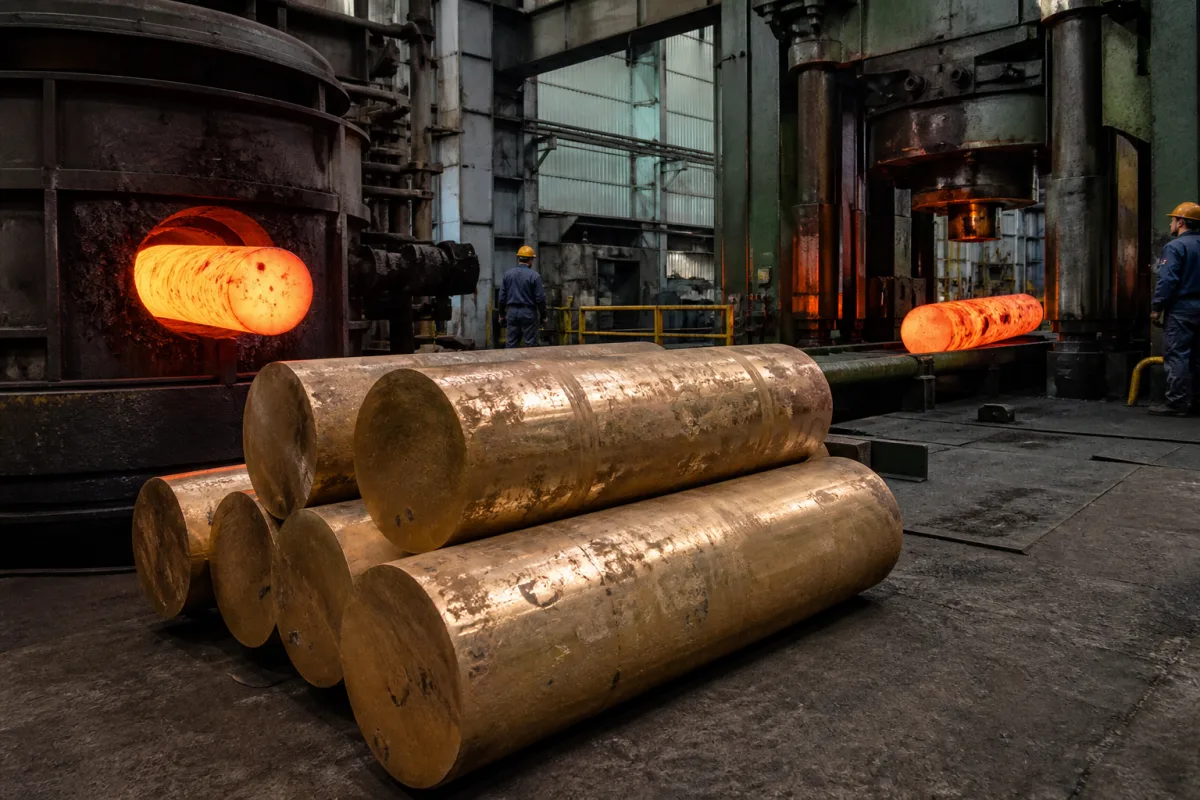
A forging-grade copper alloy billet is a cast or extruded bar of brass or bronze cut into lengths (slugs) that are heated and hot-forged in closed dies into valve bodies, fittings, hardware and similar parts, with the alloy chosen for hot forgeability and machinability. Ask three things first: which alloy and lead limit the parts and their market require, what billet diameter, length and tolerances the forging press needs, and what composition and property certificates come with each lot.
Brass and other copper alloy bars and billets supplied for hot die forging, including leaded forging brass, lead-free silicon brass and naval brass. Copper cathode, continuous-cast copper billets for extrusion, wire rod, sheet and finished forgings are outside this page except where compared.
CNFX editorial research · Sources checked October 12, 2026 · 5 sources
The Copper Development Association (CDA) alloy database lists C37700 forging brass with 58.0–61.0% copper, 1.5–2.5% lead, 0.30% maximum iron and zinc remainder, a forgeability rating of 100 and machinability rating of 80, excellent capacity for hot forming but poor capacity for cold working, and typical uses including door handles, decorative knobs and valve bodies for refrigeration and chemicals; as hot-extruded rod it gives typical tensile strength of 52 ksi and 45% elongation. [1]
CDA lists C69300 (ECO Brass), a lead-free option, at 73.0–77.0% copper, 2.7–3.4% silicon, 0.04–0.15% phosphorus, 0.09% maximum lead and zinc remainder, with forgeability 95 and machinability 85; and C46400 naval brass, uninhibited, at 59.0–62.0% copper, 0.50–1.0% tin and 0.20% maximum lead, with forgeability 90 and machinability 30. [2][3]
Editorial note: drinking-water and food-contact rules can restrict lead in brass; confirm which lead limit applies to your parts before choosing between leaded forging brass and a lead-free alloy, and ask the supplier for the matching certification.
Forging stock of these alloys is specified under ASTM B124/B124M, the specification for copper and copper alloy rod, bar and shapes intended for hot forging. Its alloy list in the 2020 edition includes C37700, C46400 and C69300, along with coppers such as C11000 and EN 1412 grades CW612N and CW617N. The starting material must be a cast rod, bar or billet pure and sound enough to be hot worked, cold worked and annealed to a uniform wrought structure. Products are supplied in tempers H50 (extruded and drawn), M20 (as hot rolled) or M30 (as hot extruded). They are tested for dimensions (diameter, thickness, width, length, shape and straightness), mechanical properties and chemical composition. [4]
Give the supplier the alloy designation (for example C37700, C69300, C46400 or national equivalent), lead limit, bar or billet form (cast, extruded), diameter and tolerance, cut length and squareness, surface condition, straightness, quantity per lot, composition and mechanical certificates, packing and delivery.
02
Set billet size and hot-working temperature
CDA gives a hot-working temperature of 1,200–1,500 °F and annealing at 800–1,100 °F for C37700, with density 0.305 lb/in³ (specific gravity 8.44), liquidus 1,640 °F and solidus 1,620 °F; C69300 is hot worked at 1,202–1,517 °F and C46400 at 1,200–1,500 °F. [1][2][3]
Editorial calculation: 1,200–1,500 °F is about 649–816 °C. A C37700 slug 100 mm in diameter and 100 mm long has a volume of about 785 cm³ and, at 8.44 g/cm³, a mass of about 6.6 kg; use the forging's net weight plus flash and scale allowance to set slug length, and check with the forger. [1]
General requirements come from ASTM B249/B249M, which applies to B124 and other wrought copper rod, bar, shape and forging specifications. It covers sampling and testing for dimensions, tensile strength, Rockwell hardness, elongation, electrical resistivity, chemical composition and grain size. Performance tests named include residual stress, mercurous nitrate, ammonia vapour and semiguided bend tests. The product specification prevails where the two conflict. [5] Name both specifications, the alloy and the temper in the purchase order.
Editorial note: ask the supplier for diameter and length tolerances and end squareness suited to automatic feeding, and whether billets are supplied cut to length or as full bars.
Fill the specification fields with values for your forgings
A forging billet quotation needs values for your parts and press. The table explains each field, gives published values where a reviewed source states them, and says what to obtain from the supplier.
Explore company information and manufacturing capabilities, then discuss the scope of your project with a relevant supplier.
Share this page
Compiled and source-reviewed by the CNFX editorial team.
Published product pages show what a company offers, not tested performance. Confirm the legal seller, mill, certificates and scope for your order. How we source and review
· Page last updated 13 October 2026
Buyer questions
What is the standard forging brass?
C37700 forging brass, with 58–61% copper and 1.5–2.5% lead, rated 100 for forgeability in the CDA database. [1]
Is there a lead-free brass for forging?
C69300 ECO Brass, a silicon brass with lead at most 0.09%, rated 95 for forgeability and 85 for machinability. [2]
At what temperature is forging brass hot worked?
CDA gives 1,200–1,500 °F for C37700, about 649–816 °C. [1]
Which ASTM specification covers brass forging stock?
ASTM B124/B124M, for copper and copper alloy rod, bar and shapes intended for hot forging; general requirements are in ASTM B249/B249M. [4][5]
Sources and what still needs a direct check
Sources checked 2026-10-12. The CDA database gives typical properties and composition limits for UNS alloys; supply standards and certified values for your order come from the mill. ASTM B124 and B249 scope pages give the purchase specifications; the standards themselves are sold by ASTM.