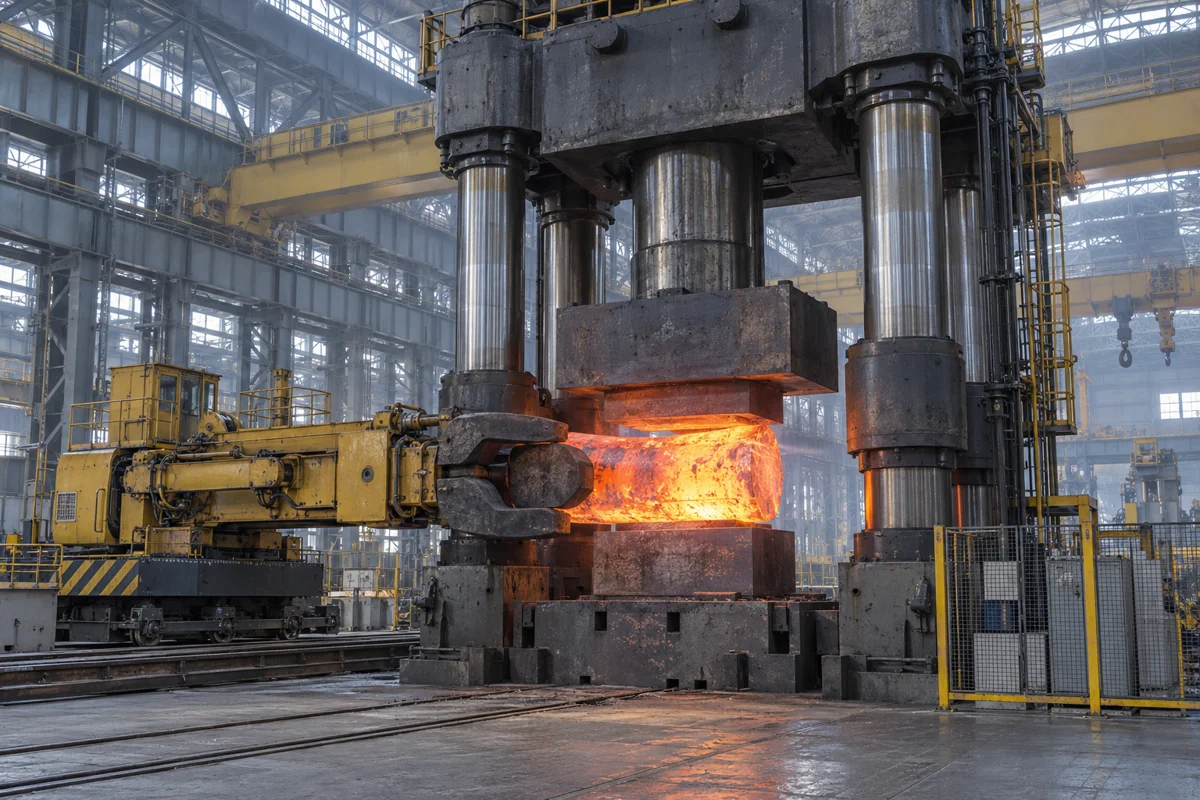
Start with the forging route: upsetting a billet and drawing it into a longer section are different duties. Match the force, die opening and handling system to that route, then check the building and foundation. The reference data below keeps nominal press ratings separate from billet limits and complete-cell requirements.
CNFX editorial research · Sources checked October 10, 2026 · 9 sources
Follow the force path and the billet-handling path separately
In open-die forging, upper and lower tools deform the billet without enclosing it in a fixed closed die. The hydraulic system drives the slide; a manipulator positions the workpiece between strokes. SMS describes independent manipulator control synchronized with the press. [6][3]
Functional assembly / BOM reference
Role in the cell
Evidence and configuration limit
Hydraulic cylinders and press slide
Apply the press motion and load through the upper tooling.
Zhengxi lists slide stroke and approach/pressing/return speeds. SMS distinguishes above-floor push-down layouts from pull-down designs with cylinders below floor. No cylinder alloy or seal set is specified here. [1][3]
Hydraulic power and control circuit
Supply and control hydraulic pressure for the press movement.
Zhengxi publishes a maximum liquid operating pressure of 25 MPa and model-specific main-motor power. Those values do not specify pump quantity, oil volume, filtration or cooling equipment. [1]
Frame and columns
Support the loaded press structure and define the space around the tooling.
Zhengxi offers four-column or split-frame construction and describes welded Q355B structural plates followed by full annealing. That claim does not establish the cylinder, die or column material grade. [1]
Dies and tool handling
Contact the forging; the selected tool arrangement must suit the planned passes.
PDH describes upper/lower anvils and operating tools; SMS’s 2023 order includes a tool shifting device and magazine. Die geometry, material, mounting and supplied quantities remain project specifications. [6][2]
Moving worktable / shifting device
Position the lower working station for the required operation.
Zhengxi lists table size, travel and speed. The SMS order separately includes table shifting for upsetting; the two descriptions are not identical supplied assemblies. [1][2]
Manipulator and ingot car
Grip, position and transfer the billet as the press sequence progresses.
SMS describes rail-bound manipulators with hydraulic drives and synchronized tong motion; the 2023 order includes a loading ingot car. Zhengxi lists its manipulator as an option. [3][2][1]
Press and cell controls
Coordinate press motion, handling, selected operating mode and pass schedules.
Zhengxi describes servo control; the SMS order uses ForgeBase and automatic, semi-automatic or manual modes. One maker’s software is not part of another maker’s standard machine. [1][2]
Measurement and viewing equipment
Compare the workpiece with the target geometry and observe the operation.
The SMS order includes online geometry/temperature measurement and nine cameras per press. These are recorded order features, not universal equipment or an independent performance test. [2]
A functional structure reference, not a manufacturing bill of materials. Request the project drawings, tool schedule, hydraulic schematic and replaceable-part references for the selected press and cell.
02
Size the force to the ingot
Zhengxi’s YZ12-titled page contains a nine-model Y214 table: nominal force 8–63 MN and maximum liquid operating pressure 25 MPa. Confirm the series and quoted configuration before using its values in a contract. [1]
Use the billet limit for the intended operation
The table assigns different ingot masses to upsetting and drawing. For Y214-4000T they are 35 t and 65 t; the ratio is not exactly two for all nine models. These published masses are not a force calculation for an arbitrary alloy, temperature or shape. Provide the forging route and have the supplier size that duty. [1]
A model suffix is not an exact force conversion
NIST gives 1 kgf = 9.80665 N. On a metric tonne-force basis, 800 tf = 800 × 1,000 × 9.80665 N = 7.84532 MN, approximately 7.85 MN. Zhengxi nevertheless labels its Y214-800T row 8 MN. Retain the published nominal force and confirm it; do not claim the suffix and MN value are exactly equal. [4][1]
Model
Nominal force
Ingot: upsetting / drawing
Main motor power
Height above ground
Y214-800T
8 MN
2.5 / 5 t
440 kW
7.0 m
Y214-1600T
16 MN
7.5 / 15 t
850 kW
8.5 m
Y214-2500T
25 MN
20 / 40 t
1,320 kW
9.6 m
Y214-4000T
40 MN
35 / 65 t
2,200 kW
11.7 m
Y214-6300T
63 MN
60 / 120 t
3,200 kW
13.2 m
Selected rows from Zhengxi’s nine-model table. SMS’s 25 April 2023 order announcement separately describes a four-column push-down press with 40 MN forging and 45 MN upsetting force and billets up to “55 tons” (the release’s wording). The announcement is an order specification, not proof of its later commissioning or a direct capacity ranking against Y214-4000T. [1][2]
03
Check the opening, stroke and speeds
Read daylight, slide stroke, table size and column centres as different dimensions. Tooling and billet-handling clearance must be checked on the proposed layout; the catalogue values alone do not define the largest usable workpiece. [1]
Zhengxi labels ±1 mm as “Forging Control Accuracy” without a measurement method, load condition or finished-part tolerance. Keep that label; do not convert it into guaranteed forging dimensions. [1]
Permitted eccentricity entry
The table prints φ80 to φ150 mm by model. Obtain the load-position diagram and permitted load at that offset; the page does not define whether the symbol denotes a circle of positions or another measurement convention. [1]
The tabulated pressing speed is 50 mm/s, while the feature text says 50–140 mm/s forming speed. Ask for force-versus-speed and rapid-cycle conditions, including stroke length; 40–60 beats/min is not finished forgings/min. Column centre distances are not the clear gap between column surfaces. [1]
04
Fit the press to the building and ground
SMS recommends push-down layouts where deep foundations are impractical and building height is sufficient, citing low moving mass as an advantage at high stroke rates. Pull-down layouts place cylinders below floor to reduce above-floor height. These are layout choices, not site-specific foundation approvals. [3]
Push-down
Taller above ground; shallower foundations; lower moving mass [3]
Pull-down
For buildings too low for the required press; all hydraulic cylinders below floor, close to the press, with small piping volumes [3]
Height check
Zhengxi’s table gives above-ground height from 7.0 to 13.2 m, without a complete below-ground or service-space envelope. Obtain the general arrangement, crane access, foundation depth and loads for the quoted design. [1]
Frame
Zhengxi describes four-column or split-frame options and Q355B welded structural plates, fully annealed after welding. Obtain the selected frame drawing and material schedule rather than assigning this grade to all components. [1]
05
Plan the whole forging cell
The April 2023 SMS order illustrates a defined press-cell package. It scheduled operation for the second half of 2024; this source alone does not establish the later operating status. Use its scope to identify interfaces and exclusions in a new quotation. [2]
Quote the cell, not just the press
Ask each bidder to price the manipulator, tool handling, measurement and controls separately, with interfaces defined, so offers can be compared on the same scope.
Rail-bound manipulator, with an ingot car to load it [2]
Table shifting device for faster upsetting, tool shifting device and tool magazine [2]
Pass-schedule software with a material database, with automatic, semi-automatic and manual modes [2]
Online measurement of workpiece geometry and temperature, important for stepped shafts [2]
Viewing cameras: nine per press in the 2023 SMS order, not a prescribed count for every cell. [2]
Zhengxi options include manipulator, loading/unloading equipment, side-shift punch, centring and servo fast forging. Its item “Remove from the workbench” is unclear; have the supplier identify that assembly in the scope drawing. [1]
Service access belongs in the cell quotation too. Obtain the selected hydraulic and electrical maintenance instructions, isolation/support arrangements and replacement-part schedule. Zhengxi lists a locking mechanism and hydraulic support device, while Anyang describes pressure discharge and overload protection; catalogue features do not replace their project-specific operating procedures. [1][5]
06
Keep the press rating, process result and installation load distinct
A nominal force, a control-accuracy claim and a foundation load answer different questions. Use the published model data below with its stated label; define the missing project values before comparing quotations.
Open-die press makers and related equipment records
Zhengxi, Anyang and PDH publish open-die press pages. The other manufacturers below describe cold-forming or ancillary equipment. Compare their stated scope with the forging route and cell you need.
Chengdu Zhengxi Intelligent Equipment Group Co., Ltd.
Chengdu, Sichuan (entity and contact region), CN
The YZ12 page publishes a Y214 free-forging table covering 8–63 MN, separate upsetting/drawing ingot limits and four-column/split-frame options. Confirm the series, loaded speed and control-accuracy test; the manipulator and other cell equipment are options, not automatically included.
The Y13 page describes an open-die hydraulic press with fast/normal forging and pressure-holding, three crossbeams/four columns, optional matching manipulator, mobile/rotary table and upper-die changing. Confirm the selected press and handling scope.
PDH has a dedicated free-forging product page with press, tool and handling descriptions. Its title says 5000T while its displayed table covers 8–20 MN; the 20 MN column also lists a 21,000 kN third pressure level. Request a corrected model-specific schedule before using that table for sizing.
Supplies forging ancillaries: oxide-scale removal and graphite spraying, plus forging hammers. Consider it for the descaling and lubrication steps around the press, not the press itself.
Explore company information and manufacturing capabilities, then discuss the scope of your project with a relevant supplier.
Share this page
Compiled and source-reviewed by the CNFX editorial team.
Each manufacturer above links to the page on that company's own website where the product is listed, with the date we checked it. How we source and review
· Page last updated 13 October 2026
Buyer questions
How big an ingot can a 40 MN forging press handle?
Zhengxi lists 35 t upsetting and 65 t drawing for Y214-4000T. SMS’s 2023 order specifies 40 MN forging/45 MN upsetting and billets up to “55 tons” in the release’s wording. These are different published duties; agree the alloy, billet geometry and forging route before comparing capacity. [1][2]
What is the difference between push-down and pull-down forging presses?
SMS recommends push-down where a sufficiently tall building permits it and deep foundations are unsuitable. Its pull-down arrangement puts hydraulic cylinders below floor for lower above-floor height. A site-specific foundation and general arrangement are still required. [3]
How fast does a free forging press work?
Zhengxi lists 40–60 rapid-forging beats/min and 250–300 mm/s approach/return by model. Its pressing-speed table and feature text differ. Confirm loaded speed and rapid-cycle stroke; the rate is not completed forgings per minute. [1]
Is 800T the same as 8 MN?
On a metric tonne-force basis, 800 tf converts to 7.84532 MN, about 7.85 MN. Zhengxi lists nominal force as 8 MN for Y214-800T. Treat the model label and published rating separately and confirm the contracted force. [4][1]
Sources and what still needs a direct check
Sources checked 2026-10-10. Standards bodies and regulations define the requirements; manufacturer pages show published ranges for those models only. CNFX does not certify products or suppliers.
YZ12 page title versus Y214 model table; selected frame/layout and exact supply scope.
Loaded pressing speed, rapid-cycle stroke, ±1 mm control-accuracy method and the φ eccentricity notation are not resolved by the published table.
Complete installation/utility loads and actual forging trial performance require project documents; the 2023 SMS announcement is not commissioning evidence.
PDH’s 5000T title, 8–20 MN table and 21,000 kN pressure-level entry need a reconciled model schedule. Cold-forming and descaling profiles are not presented as evidence of open-die press manufacture.
Buyer enquiry
Request manufacturing insight
for Hydraulic Forging Press
Ask for use case, specification boundaries, supplier type, and RFQ preparation
information for this product.
Where it goes
Straight to the CNFX editorial desk, and to the manufacturer if this product is
linked to a claimed profile. Nothing is broadcast to a supplier list.
Your details stay here
We do not sell or rent enquiry data, and we do not add you to a mailing list.
Used only to answer this request.
No commission, no middleman
CNFX is a directory. We take no cut of any order and never negotiate on a
supplier's behalf.
What to include
Share your product specifications, quantity, destination and target delivery date.
Need to Manufacture Hydraulic Forging Press?
Compare manufacturer profiles with relevant product and process capability.