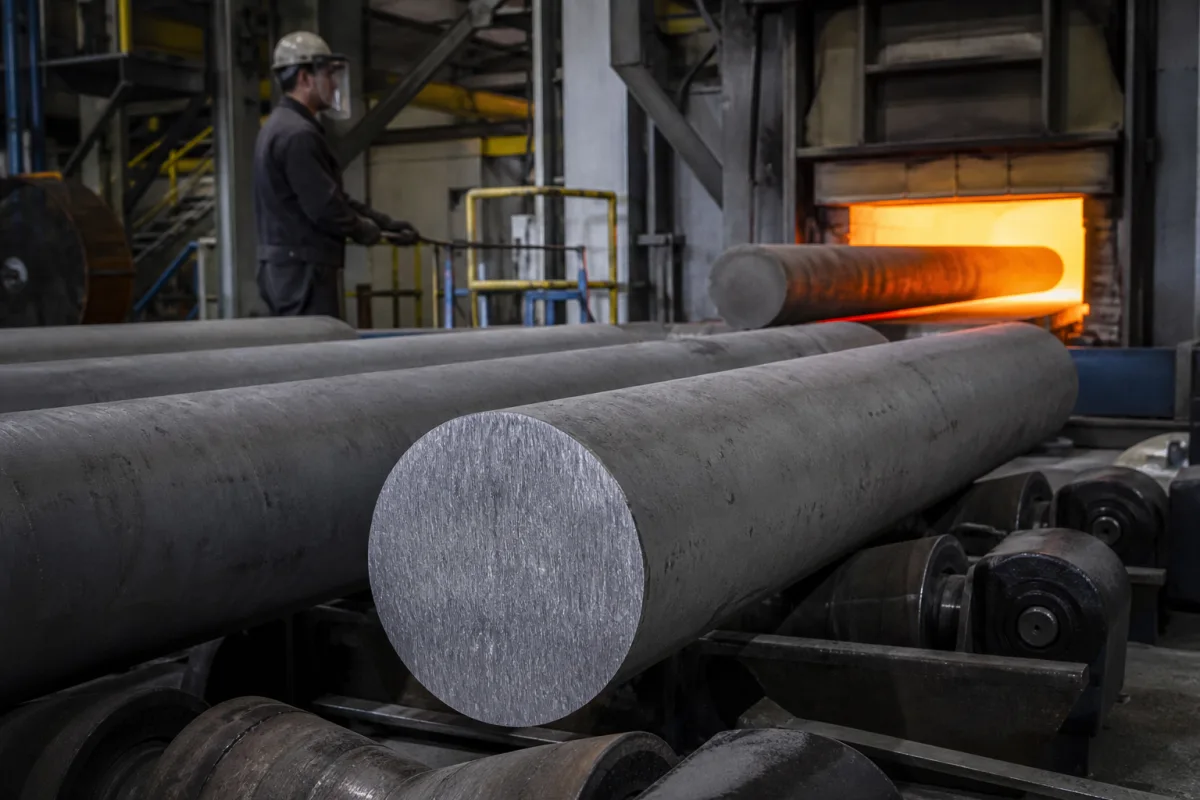
Titanium and titanium alloy bar and billet for forging · Grade by UNS number, annealed condition and surface finish, tensile testing, H grades, and the forging specification downstream
Forging-grade titanium bar and billet is the round or square stock a forge heats and shapes into forgings. Fix three things before ordering: the specification and alloy, identified by UNS number, that both the bar and the finished forging will be certified to; the condition, surface finish, size and tolerance the forge needs; and the chemistry, tensile and non-destructive tests to be reported with each heat.
Titanium and titanium-alloy bars and billets supplied as forging stock or for machining, to ASTM B348 or equivalent. Titanium plate, sheet, tube, wire, castings and finished forgings are outside this page, although the forging specification is referenced.
CNFX editorial research · Sources checked October 12, 2026 · 5 sources
ASTM B348/B348M covers annealed titanium and titanium-alloy bars and billets. Its grades include unalloyed titanium (UNS R50250, R50400, R50550, R50700); unalloyed titanium with palladium or ruthenium additions (for example R52400 with 0.12–0.25% Pd and R52404 with 0.08–0.14% Ru); and alloys such as Ti-6Al-4V (R56400), Ti-6Al-4V with extra-low interstitials, ELI (R56407), Ti-3Al-2.5V (R56320), Ti-5Al-2.5Sn (R54520), Ti-3Al-8V-6Cr-4Zr-4Mo (R58640) and Ti-15Mo-3Al-2.7Nb-0.25Si (R58210). [1]
The specification defines H grades — 2H, 7H, 16H and 26H — as identical to the corresponding numeric grade except for a higher guaranteed minimum tensile strength of 58 ksi (400 MPa), says they are intended primarily for pressure-vessel use, and allows them to be certified to the numeric grade as well. [1]
Editorial note: specify the UNS number as well as the alloy name, because B348 lists more than one variant of the same base alloy (for example Ti-6Al-4V with and without ELI, and with palladium or ruthenium additions). [1]
A supplier data sheet for Ti-6Al-4V ELI bar (UNS R56401, B348 Grade 23) from United Performance Metals gives the physical values a forger plans around: density 4.42 g/cm³, beta transus 966 ± 14 °C (1,825 ± 25 °F), liquidus 1,650–1,660 °C, thermal conductivity 6.6 W/m·K at 20 °C and specific heat 0.580 J/g·K at 20 °C rising to 0.930 J/g·K at 870 °C. For annealed B348 bar up to 3.00 in, it lists minimums of 828 MPa tensile strength, 759 MPa 0.2% yield, 10% elongation and 25% reduction of area; it states the data are for information only and not for design. [3]
Editorial calculation: at 4.42 g/cm³, a 100 mm round bar weighs about 34.7 kg per metre (π ÷ 4 × 0.1² × 4,420), and a 200 mm billet about 139 kg per metre. [3]
Give the supplier the specification and edition, UNS grade, product form (round or square bar, billet), diameter or section and tolerance, length, condition (annealed), surface condition, chemistry and tensile certification, ultrasonic or other NDT requirements, the downstream forging specification, quantity and heat or lot traceability.
02
Set condition, surface finish and tests
B348 requires every grade to meet its chemical composition, with intentionally added elements identified, analysed and reported, and requires tension-test specimens to be machined and tested at a specified strain rate through yield and an increasing rate after. Annealed material may be supplied descaled, sandblasted, ground or rough turned. [1]
ASTM B381, for titanium and titanium-alloy forgings, covers 39 annealed grades from F-1 to F-38 (including F-2H, F-7H, F-16H and F-26H), requires the specified tensile strength, yield strength and elongation, and leaves non-destructive tests — ultrasonic, X-ray or surface inspection — to be specified by the purchaser where required. [2]
Editorial note: because B381 leaves NDT to the purchaser, decide at the bar-ordering stage whether the stock must be ultrasonically tested, so that defects are found before forging rather than in the finished part. [2][1]
03
Cover aerospace stock and see what forging does to the bar
SAE publishes Aerospace Material Specifications (AMS) for the same alloy; the scope page for AMS4928 (revision W, December 2017; first issued July 1957) states that it covers the alloy as bars, wire, forgings, flash welded rings and drawn shapes up through 10.000 in (254.00 mm) inclusive in diameter or least distance between parallel sides, and stock of any size for forging or flash welded rings. SAE lists a later revision, AMS4928X, dated 2025-10-20, so name the revision on the order. [4]
A 2022 study from Henan Polytechnic University shows how far forging changes the properties of commercially produced Ti-6Al-4V (TC4) stock. The authors cite a β-transus of about 975 °C for their alloy, and forged it isothermally at 600 °C with a 33% height reduction per pass at a strain rate of 10⁻¹ s⁻¹, rotating the sample between passes; after four three-pass cycles, yield strength rose from 742 to 900 MPa, ultimate tensile strength from 747 to 921 MPa and elongation from 3.9% to 12.1%, which they attribute to an ultrafine-grained microstructure. [5]
Editorial note: the β-transus cited in that study (about 975 °C) and the 966 ± 14 °C on United Performance Metals' ELI data sheet differ by heat and grade, so ask the bar supplier to report the measured β-transus for each heat when forging temperatures are set relative to it. [5][3]
Item
Published value
Use in the order
AMS4928 size limit
Up through 10.000 in (254.00 mm) diameter or least distance; forging stock any size. [4]
Fill the specification fields with values for your forging
A titanium bar quotation needs values for your forging. The table explains each field, gives published values where a reviewed source states them, and says what to obtain from the supplier.
Field
What it means and published values
Ask the supplier for
Diameter Tolerance
Size tolerance for the form.
Tolerance.
Diameter
Bar or billet size.
Size.
Yield Strength
Per grade in B348; e.g. 759 MPa min for 6-4 ELI bar. [1][3]
Certified value.
Elongation
Per grade in B348; e.g. 10% min for 6-4 ELI bar. [1][3]
Explore company information and manufacturing capabilities, then discuss the scope of your project with a relevant supplier.
Share this page
Compiled and source-reviewed by the CNFX editorial team.
Published specifications describe requirements, not a supplier's tested output. Confirm the legal seller, mill and certificates for your order. How we source and review
· Page last updated 13 October 2026
Buyer questions
Which standard covers titanium bar and billet?
ASTM B348/B348M covers annealed titanium and titanium-alloy bars and billets. [1]
What is the UNS number for Ti-6Al-4V?
B348 lists Ti-6Al-4V as UNS R56400 and the ELI version as R56407. [1]
What are titanium H grades?
Grades 2H, 7H, 16H and 26H match their numeric grades but guarantee 58 ksi (400 MPa) minimum UTS. [1]
Which standard covers titanium forgings?
ASTM B381 covers 39 grades of annealed titanium and titanium-alloy forgings. [2]
What is the beta transus of Ti-6Al-4V ELI bar?
One supplier data sheet gives 966 ± 14 °C (1,825 ± 25 °F), with a density of 4.42 g/cm³. [3]
Which SAE specification covers Ti-6Al-4V bar and forging stock?
SAE AMS4928 covers annealed 6Al-4V bars, wire, forgings, flash welded rings and drawn shapes up through 10.000 in (254.00 mm), and stock of any size for forging or flash welded rings. [4]
Sources and what still needs a direct check
Sources checked 2026-10-12. ASTM B348/B348M covers titanium bars and billets; ASTM B381 covers titanium forgings; SAE AMS4928 covers aerospace 6Al-4V bar and forging stock. A supplier data sheet and a peer-reviewed forging study add property values.