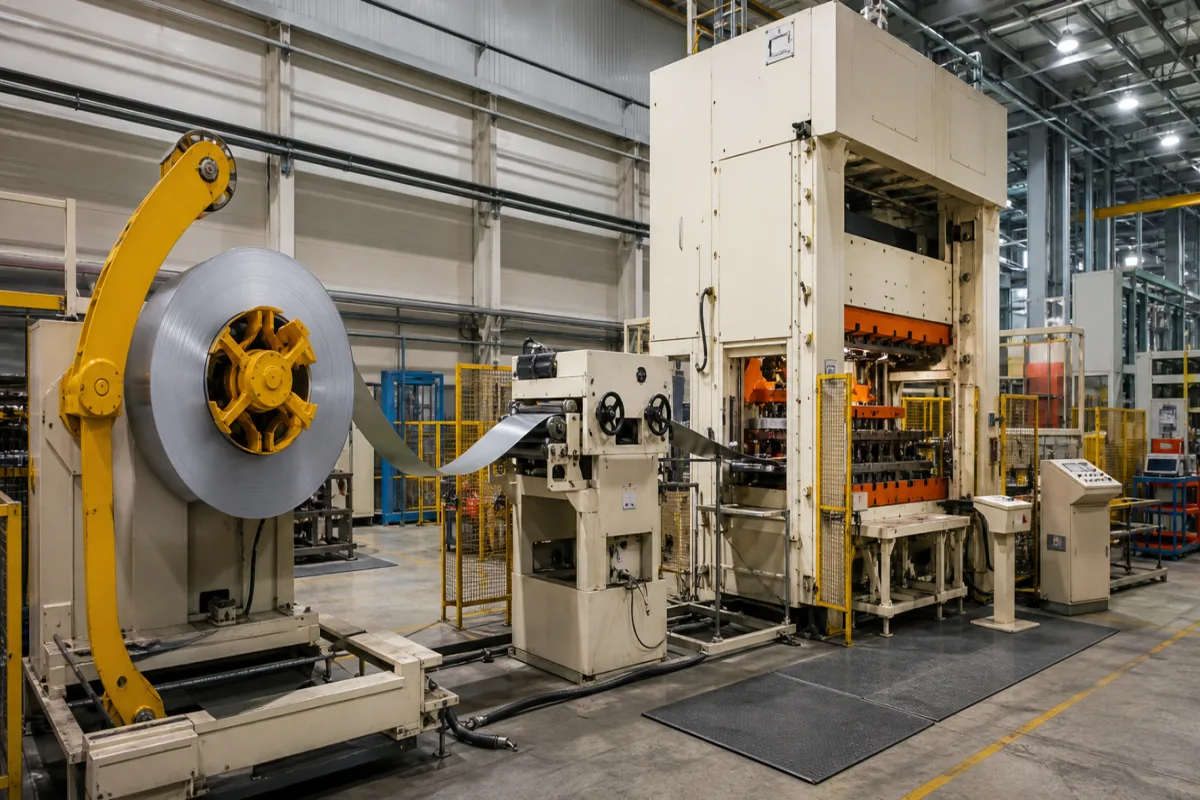
High-speed progressive stamping press for laminations and electrical parts: holding bottom dead centre to microns at 200–2,500 strokes per minute
Presses that run coil strip through multi-station dies at hundreds to thousands of strokes a minute, for motor laminations and small electrical parts · keeping bottom dead centre still against heat, speed changes and start-up, and the knuckle-link alternative
A progressive die turns coil strip into finished parts one station at a time, so every stroke of the press hits every station at once. For motor-core laminations, connector terminals and other thin, tightly toleranced electrical parts, the die runs at hundreds or thousands of strokes a minute with very small punch-to-die clearance. A high-speed progressive press is built for that case: dynamically balanced, stiffly guided and, above all, able to keep the slide's bottom dead centre (BDC) — the depth of punch penetration — the same from a cold start to full speed and through a long shift.
Mechanical presses designed for high-speed progressive-die stamping from coil — motor and transformer lamination presses, high-speed presses for connectors, terminals and other electrical parts, and multi-suspension-point high-speed presses — with their bottom-dead-centre control, thermal stabilisation, bearing systems, slide guiding and drive (crank, eccentric or knuckle link). General flywheel-driven mechanical presses, their rated tonnage curves, clutch-brake safety and guarding are covered on the Precision mechanical stamping press page; progressive dies on the Progressive die set page; coil feeders on the Servo feeder for press coil feeding page; complete press lines on the Automated stamping lines page. Hydraulic and servo-hydraulic presses are outside this page.
CNFX editorial research · Sources checked October 12, 2026 · 5 sources
Seven ways the die height moves when the press runs fast
Dennis Boerger, product manager at Aida-America, writing in MetalForming, calls dynamic accuracy the key requirement of a precision or high-speed press, because parts for the electrical industry are toleranced in microns with very small punch-to-die clearance. He lists seven characteristics: elapsed-time die-height variation, die-height variation with strokes per minute, start-up die-height variation, slide lateral displacement, slide tipping, component deflection and vibration. [1]
In a second MetalForming article Boerger adds that a high-speed press should be dynamically balanced with a stiff slide-guiding system and keep its accuracy under cold, warm, slow, fast and off-centre conditions, and that bed, bolster, connecting rods, crankshaft and crown must be more rigid than on a general-purpose stamping press. [2]
Editorial calculation: at 800 strokes per minute one stroke lasts 75 ms, and at 2,500 strokes per minute 24 ms, so a start-up that takes two strokes to settle passes in well under a quarter of a second — too fast for an operator to catch, which is why stopping and starting within one stroke and holding the feed until speed is reached matter.
Error
What causes it
Remedy he describes
Elapsed-time die-height variation
Press parts heat up and lengthen during production
Pre-timed oil heater runs warm oil before start; chiller removes heat once running [1]
Die-height change with speed
Inertia stretches parts and thins the oil film as speed rises, so shut height closes in
Connections at least 30% farther apart than on a conventional press; massive columns [1]
Component deflection and vibration
Load on slide, bed and crown; impact
Rigid bed, bolster, slide and frame; mixed cast materials to damp vibration [1]
Editorial note: ask for die-height (BDC) measurements, not only static accuracy figures — cold against warm after a stated running time, at minimum and maximum speed, and over the first strokes after a start — taken with a dial indicator or sensor on the slide at your die's weight and stroke.
02
Holding bottom dead centre: heated and chilled oil, combined bearings and compensation every 100 strokes
AIDA states that heat generated in high-speed stamping shifts the slide's BDC over time, and that parts with very small tolerances suffer from it. On its high-speed presses, sensors measure the change in BDC and specially designed suspension points adjust it in process, automatically at intervals down to every 100 strokes; the adjustment range is about 75 µm and AIDA states that BDC can be held to ±5 µm. [3]
Its HMX motor-lamination press combines roller and oil-film bearings in one housing to limit the BDC change that comes with speed, uses eccentric shafts with bearing supports on both sides of the eccentrics, omits a stroke-adjustment mechanism, and circulates temperature-controlled oil — through an external cooler if needed — to every moving part of the press and feed. [4]
Editorial calculation: at the HMX-1250's 800 spm maximum, a compensation every 100 strokes is a correction every 7.5 seconds; the ±5 µm band is about one fifteenth of the 75 µm adjustment range.
Stroke length and speed by application: thin interlocked laminations against miniature electronic parts
Boerger matches the press to the job. For interlocking lamination stacks, which are moving to thinner material for motor efficiency, he suggests that very thin laminations call for a multiple-suspension high-speed press with deflection and BDC control rather than a conventional lamination press. For precision miniature electronic parts he cites short strokes of 13–20 mm at speeds as high as 2,500 strokes per minute, and a moderately high-speed press of up to 1,000 strokes per minute where that speed is not needed. [2]
Where stroke and speed vary between jobs, he points to adjustable-stroke designs that change stroke without changing die height; and he notes that link motion lowers punch contact speed and can hold pressure on the workpiece as much as 60% longer than non-link presses, without lengthening the cycle. [2]
04
The knuckle-link alternative: cancelling thermal growth in the linkage
Kyori's ANEX fixed-stroke presses, 15 to 125 tons, take a different route to a stable BDC. Their symmetrical knuckle-link design, Kyori states, eliminates thermal displacement: as the links heat, one opens the shut height while the other closes it, so the press needs no thermal or dynamic stroke compensation mechanism, and BDC stays at 180° of crank angle whatever the stroke length. [5]
Kyori also claims that the slower slide movement through BDC extends the interval between die re-sharpenings by more than 25% compared with a conventional crank press; that its servo-driven slide adjustment repeats within 0.01 mm; that its air-friction clutch-brake moves about 1.59 mm from full brake to full engagement; and that iron has 2.5 to 4.5 times the damping capability of steel, which is why castings are used in its beds, crowns and uprights. It still offers an oil heater and chiller that pre-heats the oil and then holds its temperature according to the stroke rate. [5]
Editorial note: compensation (AIDA) and cancellation (Kyori) are two answers to the same drift; ask either type of supplier for BDC data measured the same way — at your stroke rate, from cold, over the same running time — so the two can be compared.
05
What to send for a high-speed progressive press quotation
Paste it into your enquiry below or into an email to a maker, then replace every bracket.
Parts: [laminations, terminals, lead frames or other; material and thickness; tolerances]
Die: [number of stations; die length and weight; upper die weight; die height]
Speed and stroke: [target strokes per minute; stroke length; fixed or adjustable stroke]
Force: [tonnage and energy per stroke; off-centre load]
BDC control: [thermal control; bearing system; compensation or link design; BDC data required]
Line: [coil width; servo feed; start-stop behaviour]
Acceptance: [die-height measurements cold, warm, at speed and at start-up]
Explore company information and manufacturing capabilities, then discuss the scope of your project with a relevant supplier.
Share this page
Compiled and source-reviewed by the CNFX editorial team.
Each manufacturer above links to the page on that company's own website where the product is listed, with the date we checked it. How we source and review
· Page last updated 13 October 2026
Buyer questions
Why does bottom dead centre drift on a high-speed press?
Boerger lists heat growth over time, die-height change with speed as inertia stretches parts and thins oil films, and start-up variation in the first strokes, among seven dynamic errors. [1]
How closely can BDC be held?
AIDA states its in-process compensation, at intervals down to every 100 strokes over a range of about 75 µm, holds BDC to ±5 µm. [3]
How fast do lamination presses run?
AIDA lists its HMX-1250 lamination press at 200–800 strokes per minute without load and a 30 mm stroke. [4]
What does a knuckle-link press do differently?
Kyori states that its symmetrical link cancels thermal displacement, so no BDC compensation mechanism is needed, and that dies run more than 25% longer between re-sharpenings than in a crank press. [5]
Sources and what still needs a direct check
Sources checked 2026-10-12. The seven dynamic errors and their remedies come from Dennis Boerger's 2004 MetalForming article, and application guidance from his second MetalForming article (both written as AIDA product manager); BDC compensation and the HMX-1250 data from AIDA's own pages; the knuckle-link approach from Kyori's ANEX bulletin. All are makers describing their own presses, so their performance figures are claims to verify on the machine offered.