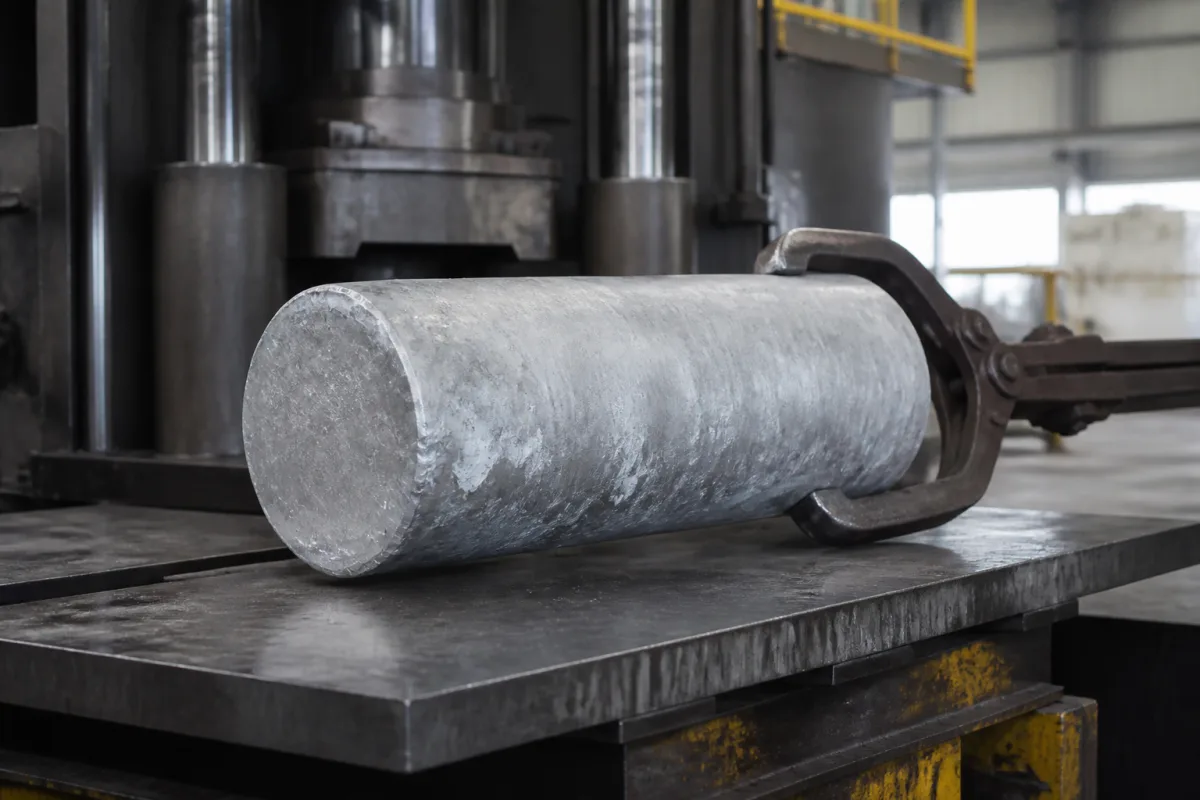
Hot-forged aluminium alloy billet: open-die forged bar and hand forgings in 6061 and 7075
Open-die forged aluminium billet and bar · forging windows for 6061 and 7075, reduction and press load, hand-forging specifications, ultrasonic acceptance
A hot-forged aluminium billet starts as a cast log, is heated into a narrow temperature window and worked on an open-die press or hammer, then is sold either as a finished hand forging or as forging stock for a closed-die part. Unlike the cast billet it came from, its structure and properties depend on how hot it was worked, how much it was reduced and which forging specification it is bought to. Four things to fix with the forge: the temperature window for the alloy, the reduction and press load, the specification and size limits, and the ultrasonic acceptance.
Open-die (hand) forged aluminium alloy billets, round and square bars and blocks in heat-treatable alloys such as 6061 and 7075, supplied as hand forgings or as forging stock, with their forging temperature, reduction, heat treatment, specifications and ultrasonic inspection. Direct-chill cast and homogenised logs and billets for extrusion and forging are covered on the Aluminium alloy extrusion billet page, and large DC-cast 7xxx billets and their homogenising on the 7xxx high-strength aluminium billet page. Forging stock in other metals has its own pages: Titanium alloy bar and billet, Magnesium alloy billet and Forging-grade copper alloy billet. Closed-die forged parts, extruded and rolled bar, and steel forging ingots are outside this page.
CNFX editorial research · Sources checked October 12, 2026 · 7 sources
Forging windows: 900–750 °F for 6061, 880–730 °F (470–390 °C) for 7075
All Metals & Forge Group, an open-die forge, publishes alloy reports giving the temperatures it works aluminium at. For 7075 it gives a recommended forging range of 880–730 °F (470–390 °C), a solution treatment at 860–930 °F (460–500 °C) for 10 minutes to 1 hour followed by a water quench, T6 precipitation treatment at 245–255 °F (120–125 °C), and a full anneal at 775 °F (415 °C) for 2–3 hours. [1] For 6061 it states the alloy can be hot forged between 900 °F and 750 °F, solution treated at 990 °F and water quenched, and aged at 350 °F for 8 hours to the T6 temper. [2]
Editorial calculation: the °C values for 6061 are converted from the forge's °F figures. Each forging window is only about 80 °C wide (7075: 470 − 390 = 80 °C; 6061: about 482 − 399 = 83 °C), so a large billet loses part of its window while it is transferred and handled on the press. [1][2] Bobba and co-authors list rapid heat loss to the dies, a narrow forgeable temperature range and high flow resistance among the reasons aluminium forgings show folding, underfilling, broken grain flow, cracking and coarse grain. [3]
Ask the forge for the furnace and die temperatures it will use, the reheat practice between passes, and the heat-treatment cycle that sets the final temper.
02
Reduction and press load: best forgeability at 450 °C with at least 30 % reduction
Bobba, Rao and Raj upset 6061 and 7075 specimens of 40 mm bar at room temperature, 400 °C and 450 °C on a 150-tonne hydraulic press and a pneumatic hammer, to 30–60 % deformation. Resistance to deformation rose as forging temperature fell and as strain rate rose; both alloys showed their lowest flow stress at 450 °C with a reduction of at least 30 % on the hydraulic press, 81.88 MPa for 6061 and 109.18 MPa for 7075. [3]
Cold, the two alloys behaved very differently: 6061 deformed to 70 % without failing at the press's maximum load, while 7075 failed in shear at 25 % deformation. In hot forging, flow stress rose up to about 50 % deformation and then fell, which the authors attribute to dynamic softening. At room temperature, 30 % deformation of 6061 took 294 kN at a flow stress of 163.77 MPa. [3]
Editorial calculation, as a lower bound that ignores die friction and billet height: a 150 mm diameter billet has a cross-section of about 17,700 mm²; at 109.18 MPa (7075) the force to keep it flowing is about 1.93 MN, about 197 tonnes-force; at 81.88 MPa (6061) about 1.45 MN. [3] The diameter is an example; real forging loads are higher once friction and the cooling of the billet surface against the dies are included.
State the starting log size, the finished section and the reduction (or forging ratio) you expect, and ask which press or hammer the forge will use.
03
ASTM B247 and AMS hand-forging limits: 6 in thickness and 156 in² for 7075-T7452
ASTM B247 covers aluminium-alloy die forgings, hand forgings and rolled ring forgings in alloys including 2014, 2219, 6061, 7050 and 7075, with tempers including T6, T652, T73, T7352 and T7452; the forgings may be made by pressing, hammering or rolling at the producer's option, and the maximum thickness covered is set in its property tables. It points to ASTM B211 for forging stock supplied as rolled or cold-finished bar, extruded bar or rod. [4]
Editorial calculation: a round hand forging of 6 in diameter has a cross-section of π × 3² ≈ 28.3 in², well inside the 156 in² limit of AMS4323D; a rectangular block 6 in thick reaches 156 in² at 26 in wide. [5] A billet ordered as forging stock rather than as a forging is bought to a different specification, and the scope of B247 says so. [4]
Up to 6 in (152 mm) as-forged thickness and not more than 156 in² (1,006 cm²) cross-section [5]
SAE AMS4131E, 7075-T74
Die and hand forgings
Up to 6.000 in (152.40 mm) nominal thickness at heat treatment [6]
Name the alloy, temper, specification and revision on the order; for hand forgings give the as-forged thickness and cross-section so the supplier can confirm they are inside the specification.
04
Ultrasonic acceptance to ASTM B594, and why it stops once the billet is forged again
ASTM B594 sets out pulse-echo ultrasonic inspection of aluminium-alloy wrought products, with quality levels, when the producer is required to test or when the purchaser tests on receipt. It detects internal discontinuities lying parallel or nearly parallel to the surface, by immersion or contact with longitudinal waves; through-transmission and angle-beam tests are not included. The practice is not applicable if plastic deformation is introduced into the material after delivery. [7]
For a hot-forged billet that will be forged again into a part, that last clause matters: an acceptance at delivery describes the billet as delivered, not the part made from it. B594 also says discontinuity sizes it implies must be regarded as apparent or estimated, and that it is not an exclusive indicator of the quality and performance of components made from the inspected product. [7] SAE lists non-destructive tests among the topics of AMS4323D for 7075-T7452 hand forgings. [5]
Agree the ultrasonic standard and quality class, whether the producer or the buyer tests, and whether the part made from the billet will be inspected again after forging.
05
Data to send for hot-forged aluminium billet or hand forgings
Paste it into your enquiry below or into an email to a maker, then replace every bracket.
Alloy and temper: [6061, 7075 or other; T6, T652, T7452 …]
Specification: [ASTM B247, AMS number and revision; or stock specification]
Shape and size: [round, square or block; diameter or thickness; length; cross-section]
Use: [finished hand forging or stock for die forging]
Forging: [reduction or forging ratio; grain-flow direction]
Heat treatment: [solution, quench, stress relief, ageing]
Tests: [tensile and hardness locations; ultrasonic standard and class; certificates]
Quantity: [pieces; weights; delivery lots]
Explore company information and manufacturing capabilities, then discuss the scope of your project with a relevant supplier.
Share this page
Compiled and source-reviewed by the CNFX editorial team.
Each manufacturer above links to the page on that company's own website where the product is listed, with the date we checked it. How we source and review
· Page last updated 13 October 2026
Buyer questions
At what temperature is 7075 aluminium forged?
All Metals & Forge Group recommends 880–730 °F (470–390 °C) for 7075 and gives 900–750 °F for 6061. [1][2]
How much reduction does an aluminium forging billet need?
In Bobba and co-authors' tests, 6061 and 7075 showed their lowest flow stress at 450 °C with a reduction of at least 30 % on a hydraulic press. [3]
How large can a 7075-T7452 hand forging be under AMS4323D?
Up to 6 in (152 mm) as-forged thickness and not more than 156 in² (1,006 cm²) in cross-section. [5]
Sources and what still needs a direct check
Sources checked 2026-10-12. All Metals & Forge Group's alloy reports give its forging and heat-treatment temperatures; Bobba and co-authors measured forging loads; ASTM and SAE scope pages give specification coverage.