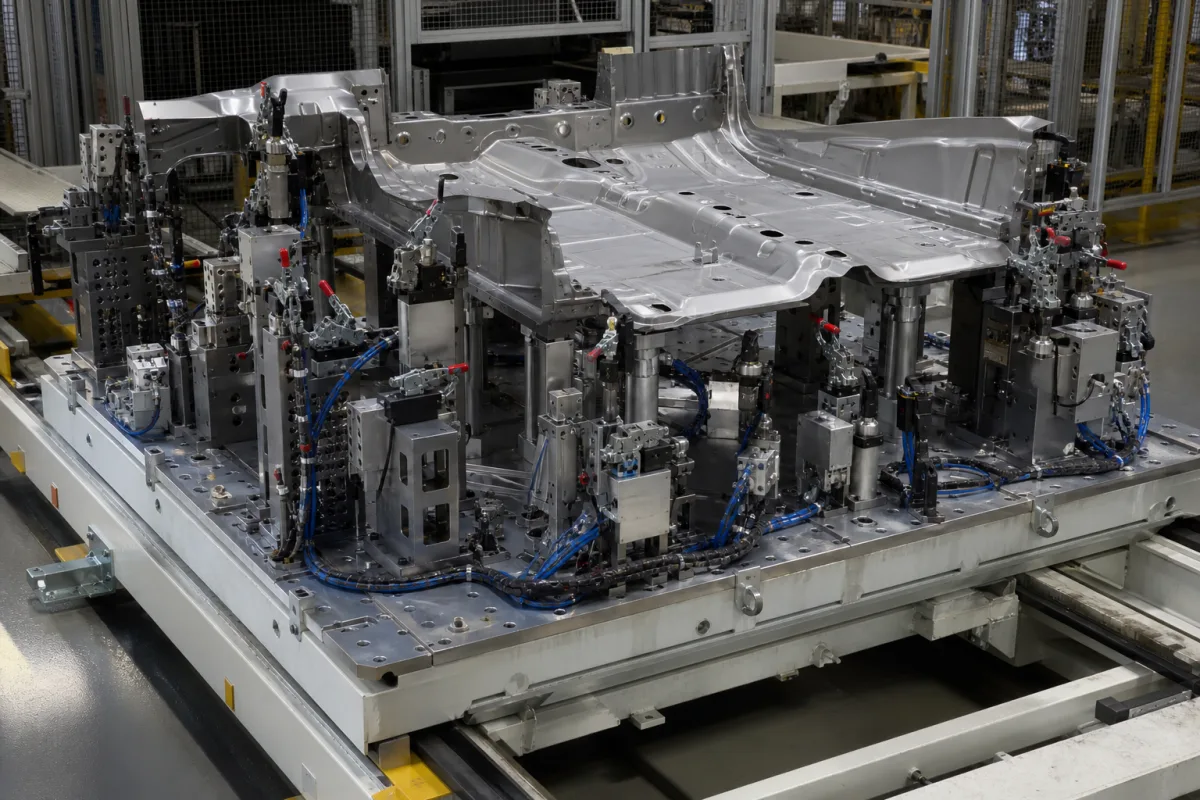
Pallet-mounted positioning fixture for vehicle floor-pan welding lines: locating the panels on a moving work pallet and re-referencing it at every station
The locator-and-clamp fixture that rides on a recirculating work pallet through a vehicle floor-pan welding line · pins referenced to the station rather than the pallet, a ±20 mm conveyor stop absorbed by ball-ended pins, and locators re-set by robot for each model
On a floor-pan line the front, centre and rear floor panels are not loaded into a fixed jig at each station. They travel on a work pallet whose own locator pins and rest surfaces hold them, and the pallet is stopped, located and released at every welding station. The fixture on the pallet therefore has two accuracy problems: holding the panels, and being found again by the station each time it arrives.
Positioning fixtures built on recirculating work pallets, hangers or carriers in vehicle floor-pan and underbody welding lines: the locator pins and rest surfaces carried on the pallet, the way those pins are referenced to each welding station, and adjustable locators that let one set of pallets run more than one model. Welding fixture bases, modular bore tables, datum selection and distortion control are covered on the Welding fixtures page; the N-2-1 locating principle, pin-and-slot locators and pneumatic clamp torque for fixed sheet-metal sub-assembly fixtures on the Assembly Fixture page; manual toggle clamps on the Toggle-clamp clamping fixture for welding page; machining fixtures and zero-point pallets on the Workpiece fixture for machining cast housings page.
CNFX editorial research · Sources checked October 13, 2026 · 3 sources
Front, centre and rear floor panels assembled on a pallet that circulates through the line
Utica Enterprises describes a floor-pan line in which a conveyor carries work pallets from an adjusting station to a front floor panel supply station, a centre floor panel supply and assembly station, a rear floor panel station where the assembly is completed, and an unload station, before the pallets return. Each pallet is a carriage carrying locators: locator members with vertical rest surfaces, some of them with an upward locator pin that engages a positioning hole in the floor parts. [1]
The application puts high-production body lines at “on the order of about 80 to 100 work pallets” recirculating, which is why a dedicated pallet set per model is costly and takes storage space when the line switches to another model. [1] Chrysler's patent adds that when the body is referenced through the pallet, all pallets must be made dimensionally the same, a large fabrication cost, and the pallet transfer and locating equipment must be kept in good condition or locating accuracy varies. [2]
In Utica's layout, two locators on one side of the carriage have close-tolerance pin-to-hole fits in the longitudinal direction and two have close fits in the sideways direction to stop the panels rotating; the locators on the other side have pins with greater clearance, giving only rough horizontal positioning plus vertical support so they do not bind against the close-fit side. [1]
Ask how many pallets the line circulates, which locators carry close-fit pins and which only support, and how a pallet found out of tolerance is taken out of the loop.
02
Clamping the locator pins in the station instead of locating the pallet: ball-ended pins, ±20 mm conveyor stops and 80 Shore A grouted clamp bases
Chrysler's design hangs the pallet from a monorail carrier. Each locator pin on the pallet arms has a pointed upper end on which the body rests and a lower end shaped as a cylinder on one pin and a ball on the other, so the two lower ends define a point and a line. Four fluid-cylinder clamping devices fixed to the floor of the working cell close jaws on those lower ends, so the pins are located directly by the station rather than through the pallet, and the pallets need not be dimensionally identical. [2] The clamp bases sit in channels on a floor plate and are locked in with a self-curing 80 Shore A urethane epoxy; the pins themselves are set in their pallet arms with poured urethane. [2]
FATA Automation's system carries the body on a self-mover hanger whose reference members end in a ball below a conical-tipped pin. Because the conveyor stops the hanger only to within a tolerance given as ±20 mm, the station's holding devices are sized so that each ball falls inside the jaws; as the jaws close, rollers above and below and beside the ball lift the pin off its seat on the hanger and centre it, and the jaw ends stop the pin turning. The pins are thus freed from the hanger for the welding operations and the hanger does not need accurate positioning. [3]
Ask whether the station clamps the pallet or the locator pins directly, the conveyor stop tolerance the station clamps can capture, and how the clamp bases are fixed to the floor.
03
Adjustable locators on the pallet: three linear bearings, a brake and a robot that re-sets each pin for the next model
To avoid a pallet set per model, Utica mounts each locator member on stacked linear bearings for vertical, sideways and longitudinal movement, each with a brake that is locked to hold the adjusted position and unlocked to let the member slide. At an adjusting station at the head of the line, a programmable robot grips a grab member located below the rest surface and moves the locator to the position for the model to be built next; the remote grab point is what lets all three axes be set in one move without binding the slides. [1]
Each locator member carries a positioning target at a known position relative to its rest surface and pin. A sensor at the adjusting station checks the target in X, Y and Z against a design tolerance range, and a deviation signal makes the control re-adjust that locator. [1] The application contrasts this with an earlier jig change-over unit that engaged the locator pin itself and could not adjust all three axes at the same time. [1]
For a multi-model line, ask which locators are adjustable and on which axes, how the adjusted position is locked and verified, and whether verification runs on every pallet cycle or only at model change.
04
What to send for a pallet-mounted floor-pan positioning fixture
Paste it into your enquiry below or into an email to a maker, then replace every bracket.
Parts: [front, centre and rear floor panels or underbody; locating holes and rest areas]
Line: [number of pallets; stations; conveyor or hanger type; stop tolerance]
Referencing: [station clamps on pallet or on locator pins; pin end shapes]
Locators: [close-fit and clearance pins; rest surfaces; clamps on pins]
Models: [models per line; adjustable axes; locking and verification method]
Utilities: [pneumatic or hydraulic clamps; couplings on the pallet]
Explore company information and manufacturing capabilities, then discuss the scope of your project with a relevant supplier.
Share this page
Compiled and source-reviewed by the CNFX editorial team.
Each manufacturer above links to the page on that company's own website where the product is listed, with the date we checked it. How we source and review
· Page last updated 13 October 2026
Buyer questions
Why do pallet errors reach the welded floor pan?
When the panels sit on pins referenced to the pallet and the pallet is located by the conveyor, pallet dimensional variation and worn transfer equipment both change the part position; Chrysler and FATA both describe this. [2][3]
How can a station locate the part if the conveyor stops only to ±20 mm?
In FATA's design the reference pins end in balls; station jaws sized to capture that tolerance close on the balls, lift the pins off the hanger and centre them. [3]
How many pallets does a floor-pan line need?
Utica's application puts high-production body lines at about 80 to 100 recirculating work pallets, which is why it makes the locators adjustable rather than building a set per model. [1]
How are adjustable locators checked after a model change?
Each locator carries a target sensed in X, Y and Z at the adjusting station; a deviation outside the design range makes the robot re-adjust it. [1]
Sources and what still needs a direct check
Sources checked 2026-10-13. The floor-pan pallet line, pin fits and adjustable locators come from a Utica Enterprises patent application; direct clamping of locator pins in the station from patents by Chrysler and by FATA Automation.