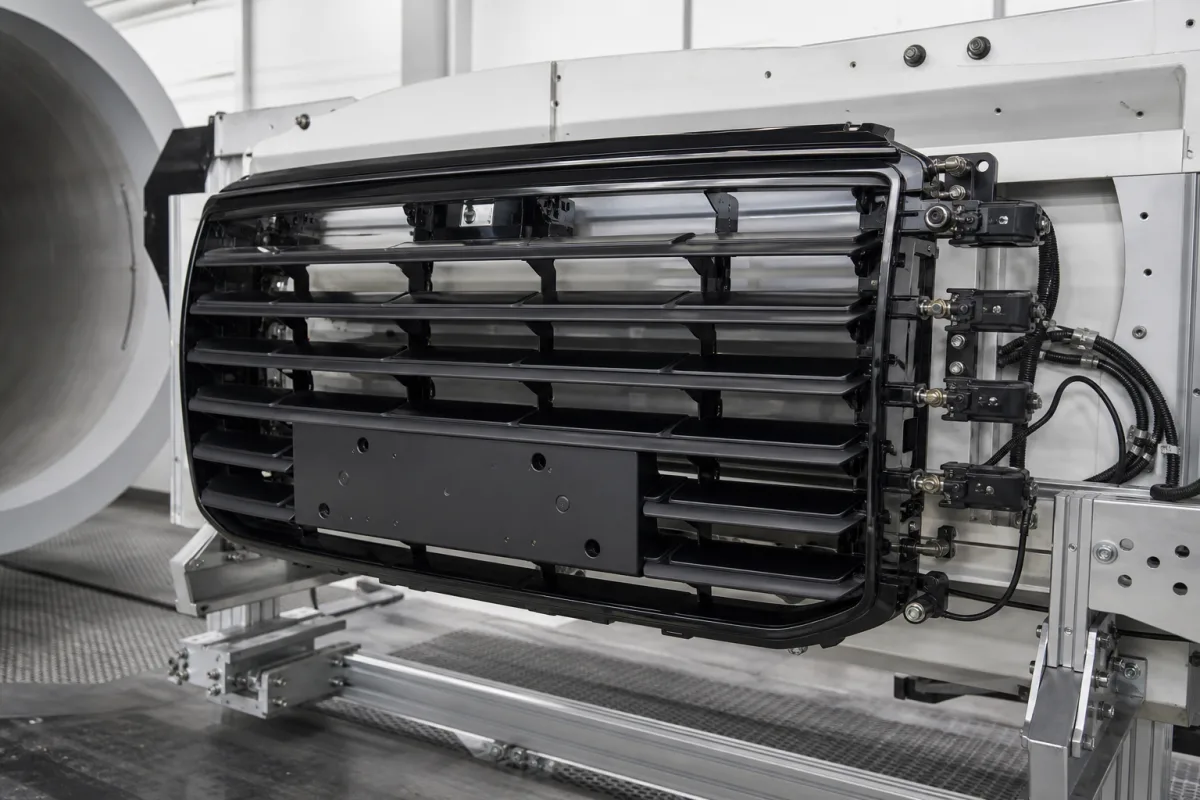
Automotive active grille shutters (AGS) · vane frame and electric actuator, LIN or PWM control, closing torque and time, drag-coefficient reduction, CO₂ and range benefit, fail-safe opening, snow and ice strategy, EPA off-cycle credit for active aerodynamics
An active grille shutter is a frame of motor-driven vanes behind the front grille or lower bumper opening that closes when the powertrain needs little cooling air, so air flows around the vehicle instead of through the engine bay, and opens when cooling is needed. Ask three things first: the actuator, its interface to the vehicle network and its torque and closing time; the drag reduction and cooling performance validated on the vehicle; and what the shutter does when communication fails or ice forms.
Active grille shutter assemblies for passenger cars and light trucks — vane frames in the upper grille or lower bumper opening, their electric actuators, and their control strategy — including actuators sold separately for AGS use. Fixed grilles, radiator fans, active spoilers and other active aerodynamic devices are outside this page except where compared.
CNFX editorial research · Sources checked October 11, 2026 · 5 sources
Valeo's active grille shutters sit at the front bumper lower opening and open and close automatically; its specification lists extruded vanes with screwless assembly, a closing torque of 1.2 Nm, a closing time of 5 s and a speed limit of 240 km/h and above, with start of production in 2017. [1] MinebeaMitsumi's PA241x family of AGS actuators uses a BLDC motor driving a single output, in a 99 × 57 × 25 mm housing weighing 75 g, sealed to IP6K7K and tested to CISPR25 EMC class 3 or 5. Nominal torque runs from 0.7 to 2.2 Nm depending on variant, output speed from 4 rpm (PA2412, range 2–6) to 15 rpm (PA2415), output power from 0.1 to 2.1 W, and the temperature range from −40 °C up to +80 to +90 °C (+105 °C peak for the PA2412); the PA2412 and PA2413 accept LIN 1.3, LIN 2.X or PWM, the others LIN 2.X. [2]
Ford's description of its system for EPA says the louvers are electrically actuated, with a variable-position control integrated in the powertrain control module that sets the opening from cooling requests based on engine coolant temperature, intake air temperature, ambient temperature, vehicle speed, throttle position and A/C head pressure; shutters can cover all or only part of the front openings (grille and/or bumper), and some turbocharged vehicles add a second, independently controlled set for the charge air cooler. [3]
Editorial note: the PA241x variants differ in torque, speed and interface, so state the vane load (including any ice-break requirement) and the closing time the vehicle needs, and let the supplier choose the variant.
Give the supplier the opening position and size, vane count and travel, frame mounting, the actuator interface (LIN version or PWM) and supply voltage, closing time, required torque, temperature range, ingress rating, EMC class, fail-safe position, end-of-line and diagnostic requirements, target drag reduction, and annual volume.
02
Check drag benefit, fail-safe opening and icing
Valeo states an optimized drag coefficient of −4.8% for its shutters, an engine warm-up benefit of up to 2–5 g CO₂/km and a 1.2 dBA reduction in exterior noise. [1] Ford's EPA filing says the drag improvement from closing the shutters varies approximately with the square of vehicle speed, that the shutters also help engine warm-up and windshield defrost, that they close on a closed pedal and open under braking, and that in potential snow and ice conditions they are kept partially open (about 30%) so they do not freeze shut; Ford measured the benefit in the wind tunnel with shutters disabled and then enabled, and requires the system to stay closed enough for at least 75% effectiveness over the FTP, Highway and US06 cycles. [3]
For failure behaviour, a Toyota patent describes a shutter controller on the vehicle's LIN line that opens the grille shutter when a communications fault is detected, so the cooling target does not overheat, and a diagnostic section that flags a shutter malfunction if the measured temperature of the cooling target exceeds a set threshold. [5]
In the United States, 40 CFR 86.1869-12 lets manufacturers claim off-cycle CO₂ credits for active aerodynamic improvements — technologies automatically activated to lower the drag coefficient while preserving other vehicle functions — calculated from the percent reduction in Cd; the section allows these credits through model year 2032, and ends them from model year 2027 for vehicles deemed to have zero tailpipe emissions. [4] As quoted in Ford's 2016 request, the equation multiplies the Cd reduction (as a value from 0 to 1) by 19.36 g/mile for passenger cars and 33.16 g/mile for light trucks. [3]
Editorial calculation: applying those multipliers to Valeo's −4.8% gives 0.048 × 19.36 ≈ 0.9 g/mile for a passenger car and 0.048 × 33.16 ≈ 1.6 g/mile for a light truck; the eCFR text reviewed shows the equation as an image, so confirm the current coefficients before relying on them. [1][3]
03
Cold-temperature torque, ice tests and wind-tunnel data to request from each bidder
When requesting quotations, ask each supplier for the actuator datasheet, wind-tunnel drag data on your vehicle, closing time and torque at cold temperature, ice and snow test results, the fail-safe position and diagnostic behaviour, EMC and ingress test reports, and samples.
04
Vanes, BLDC actuator, PCM control and LIN fail-safe in a shutter assembly
The temperature signals and the fail-safe default sit on the vehicle side rather than in the shutter: Ford's powertrain control module sets the opening from coolant, intake-air and ambient temperatures, and Toyota's controller opens the shutter on a LIN fault. [3][5]
Torque, closing time, sealing and drag figures for an AGS quotation
Five of the twelve rows have no value in the reviewed sources; the published figures come from the MinebeaMitsumi PA241x actuator datasheet and Valeo's shutter page. [2][1]
1 company lists this product among what they make. Company figures are quoted from each
company's own website; every card states where the relationship came from.
Ningbo Shintai Machinery Co., Ltd.
Manufacturing site to be confirmed for the order
Its group website lists grilles including Active Grille Shutters (AGS).
Explore company information and manufacturing capabilities, then discuss the scope of your project with a relevant supplier.
Share this page
Compiled and source-reviewed by the CNFX editorial team.
Each manufacturer above links to the page on that company's own website where the product is listed, with the date we checked it. How we source and review
· Page last updated 13 October 2026
Buyer questions
How much drag can an active grille shutter remove?
Valeo lists a −4.8% drag coefficient for its shutters, plus up to 2–5 g CO₂/km from faster engine warm-up. [1]
What happens if the shutter loses communication?
A Toyota patent opens the shutter on a LIN communications fault so the engine or other cooling target does not overheat. [5]
How do shutters avoid freezing shut?
Ford told EPA its shutters are kept about 30% open in potential snow and ice conditions. [3]
Sources and what still needs a direct check
Sources checked 2026-10-11. A Valeo product page, a MinebeaMitsumi actuator datasheet, a Ford credit request published by EPA, the eCFR off-cycle credit section, and a Toyota patent.