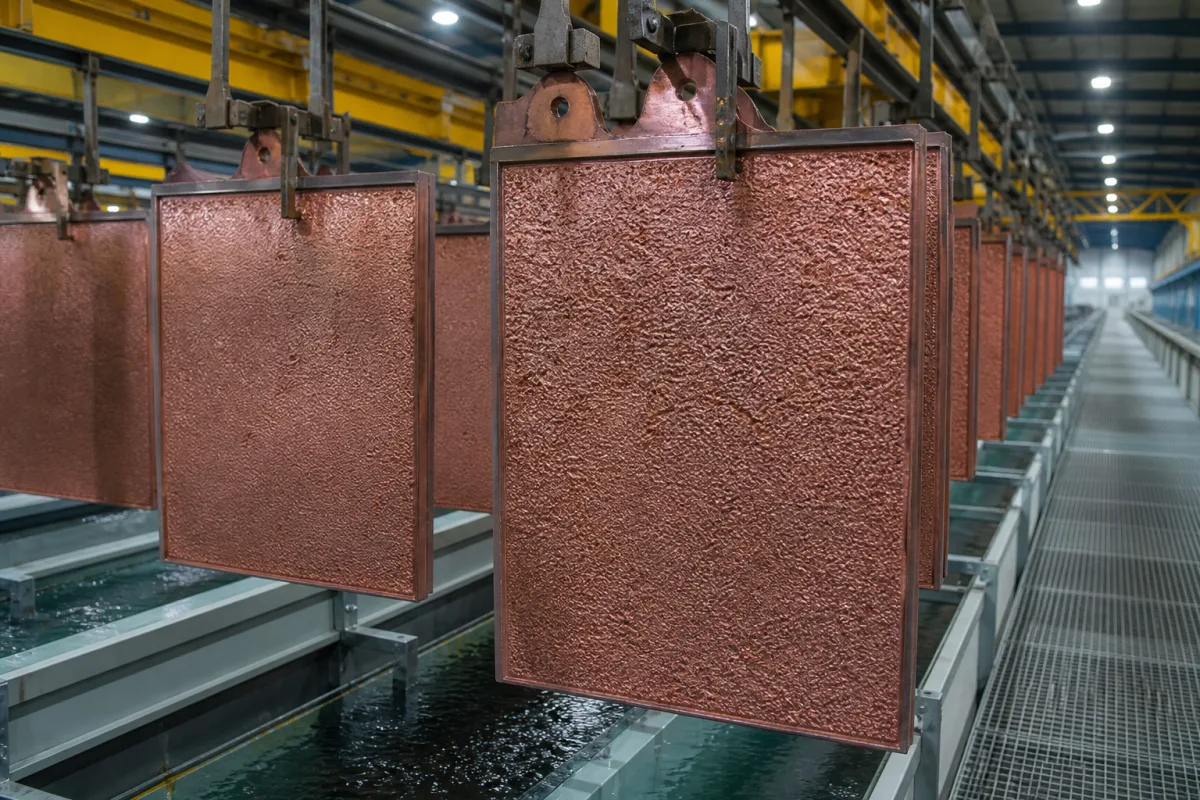
Anode plate for electrorefining and electrowinning
Anodes for refining and electrowinning · Copper refining anode impurities and current density; lead-alloy anode silver, current density and chloride
An anode plate is the positive electrode hung in an electrolytic cell. In copper electrorefining it is a cast plate of impure copper that dissolves and is replated as pure cathode copper; in zinc or copper electrowinning it is an insoluble lead-alloy plate at which oxygen is evolved. Ask three things first: which process the anode is for, what composition and impurity limits apply, and at what current density and electrolyte conditions it will run.
Cast copper anodes for copper electrorefining and insoluble lead-alloy (and similar) anodes for zinc and copper electrowinning, with their hanger lugs or bars. Electroplating anodes and baskets, sacrificial anodes for cathodic protection and battery electrodes are outside this page.
CNFX editorial research · Sources checked October 12, 2026 · 4 sources
Control impurities and current density for copper refining anodes
Glencore Technology, owner of the ISA PROCESS permanent stainless steel cathode technology introduced at Mount Isa Mines' Townsville refinery in 1978, explains that copper electrorefining dissolves impure anodes in acidic copper sulphate and replates copper on cathode blanks, and that "commercial operations typically run between 200 and 350 A/m², though some facilities push toward 400 A/m² or higher". Above the limiting current density, deposition becomes mass-transfer limited and cathodes become rough, nodular or dendritic. [1]
Glencore notes that gold, silver, platinum-group metals and lead report to the anode slime, while arsenic, antimony and bismuth are the troublesome soluble impurities: enough arsenic relative to antimony and bismuth helps them form insoluble compounds in the slime, otherwise they co-deposit on the cathode. Nickel dissolves readily and raises the risk of anode passivation. Cathodes next to damaged anodes, or warped and misaligned, develop current hotspots. [1]
Editorial calculation: by Faraday's law, copper deposits at 63.546 / (2 × 26.80) ≈ 1.19 g per ampere-hour, so 300 A/m² for 24 h deposits about 8.5 kg of copper per square metre of cathode face at 100% current efficiency — and dissolves a similar mass from the facing anode. The current density is an assumed example within Glencore's range. [1]
Give the supplier the process (copper electrorefining, zinc or copper electrowinning), cell and electrode dimensions, anode mass or thickness, composition and impurity limits, current density, electrolyte temperature, chloride and manganese levels, lug or hanger bar design, flatness and straightness tolerances, and expected service life.
02
Choose lead-alloy anode composition for electrowinning
Varganov and colleagues at Chelyabinsk Zinc Plant and Chelyabinsk State University, in Tsvetnye Metally (2023), studied rolled lead-alloy anodes with silver, tin, calcium and indium in zinc electrowinning. At current densities up to 400 A/m² and 36 °C, corrosion rate did not depend on alloy composition or cooling mode; but it rose 2–4 times when current density went from 385 to 450 A/m², and 3–5 times when chloride rose from 200 to 600 mg/L, with temperature and manganese also accelerating corrosion. [2]
They found silver the key element: halving surface silver from about 1 to about 0.5 at.% increased corrosion, indium-containing anodes with the coarsest surface crystals corroded fastest, adding 0.6–1.8 at.% tin increased corrosion to a lesser degree, and calcium below 0.1 at.% had no noticeable effect. [2] A supplier linked to this page lists Pb-Sn anode plates among its electrolysis equipment. [3]
Editorial note: because corrosion accelerates sharply just above about 400 A/m² and with chloride, ask the anode supplier for expected life at your actual current density, temperature and chloride level, and for the silver content guaranteed in the alloy.
03
Pb-Sn plates with cells, and anodes with titanium-clad copper hanger bars
Listings include Pb-Sn anode plates with electrolytic cells and anode flattening and cleaning units, and anode plates with titanium-clad copper hanger bars; ask which process each anode is designed for.
04
Ask whether lead anodes are cast or rolled, and how they condition
In a 2003 paper published by The Minerals, Metals and Materials Society (TMS), Andreas Siegmund describes a rolled Pb-Ag-Ca anode for zinc electrowinning developed by RSR Technologies. The abstract says cast lead-silver or lead-silver-calcium anodes can have holes, voids or laps in the surface that start internal corrosion locally, while rolling reduces internal porosity and extends service life. Cast or rolled Pb-Ag anodes need a relatively long time to form a stable protective PbO2/MnO2 layer and may be conditioned mechanically, chemically or electrochemically before use. [4]
The RSR anode has a controlled surface grain structure, with a preferred calcium content of 0.05–0.08% and silver of 0.3–0.4%. In industrial-scale tests at two zinc refineries in North America from May 2001, it formed an adherent protective oxide coating "within a short period of several days" without preconditioning, sludge grew evenly, the anodes stayed dimensionally stable and no short-circuits were observed, says Siegmund. [4]
Editorial note: the abstract is written by the maker of the anode and does not state whether its percentages are by weight or atomic; the Chelyabinsk study above reports silver in at.% and found lower silver increased corrosion. Ask the supplier for the silver and calcium basis, the casting or rolling route, conditioning needs and corrosion data at your current density. [4][2]
Point
What the 2003 abstract states
Ask the supplier for
Manufacture
Rolling reduces internal porosity found in cast anodes. [4]
Cast or rolled; porosity checks.
Alloy
Pb-Ag-Ca; preferred Ca 0.05–0.08%, Ag 0.3–0.4%. [4]
Certified Ag and Ca, wt% or at.%.
Conditioning
Oxide coating formed in the cell without preconditioning. [4]
Start-up conditioning steps.
Plant trials
Two North American zinc refineries from May 2001. [4]
Reference plants and life data.
05
Plate body, Ag-Sn-Ca alloying, impurity limits, hanger bar and flatness
Part
Role
Fix in the order
Plate body
Dissolves (copper) or carries current (lead alloy). [1][2]
Anode dimensions, mass, silver content and rated current density
The current density row carries the sharpest limit on this page: lead-alloy corrosion rose 2–4 times between 385 and 450 A/m² in the Chelyabinsk study, so ask for anode life at your own density. [2]
2 companies list this product among what they make. Company figures are quoted from each
company's own website; every card states where the relationship came from.
Hunan CHMM Metallurgy Engineering Co., Ltd.
Manufacturing site to be confirmed for the order
Lists Pb-Sn anode plates with electrolytic cells and anode flattening and cleaning units.
Explore company information and manufacturing capabilities, then discuss the scope of your project with a relevant supplier.
Share this page
Compiled and source-reviewed by the CNFX editorial team.
Each manufacturer above links to the page on that company's own website where the product is listed, with the date we checked it. How we source and review
· Page last updated 13 October 2026
Buyer questions
What current density do copper refineries use?
Glencore Technology says "commercial operations typically run between 200 and 350 A/m², though some facilities push toward 400 A/m² or higher". [1]
Why does silver matter in lead anodes?
A Chelyabinsk Zinc Plant study found silver the key element; halving it from about 1 to 0.5 at.% increased corrosion. [2]
What makes lead anodes corrode faster?
Higher current density, temperature, chloride and manganese; corrosion rose 2–4 times from 385 to 450 A/m². [2]
Which copper anode impurities cause trouble?
Soluble arsenic, antimony and bismuth, unless arsenic is balanced; nickel raises passivation risk. [1]
Do rolled lead-silver anodes need preconditioning?
In a 2003 TMS paper, Siegmund of RSR Technologies reported that rolled Pb-Ag-Ca anodes with 0.05–0.08% calcium and 0.3–0.4% silver formed a protective oxide coating in plant cells without preconditioning. [4]
Sources and what still needs a direct check
Sources checked 2026-10-12. Glencore Technology licenses copper refinery technology and explains its practice; Varganov et al. are plant and university researchers publishing measured results; CHMM is a linked supplier.