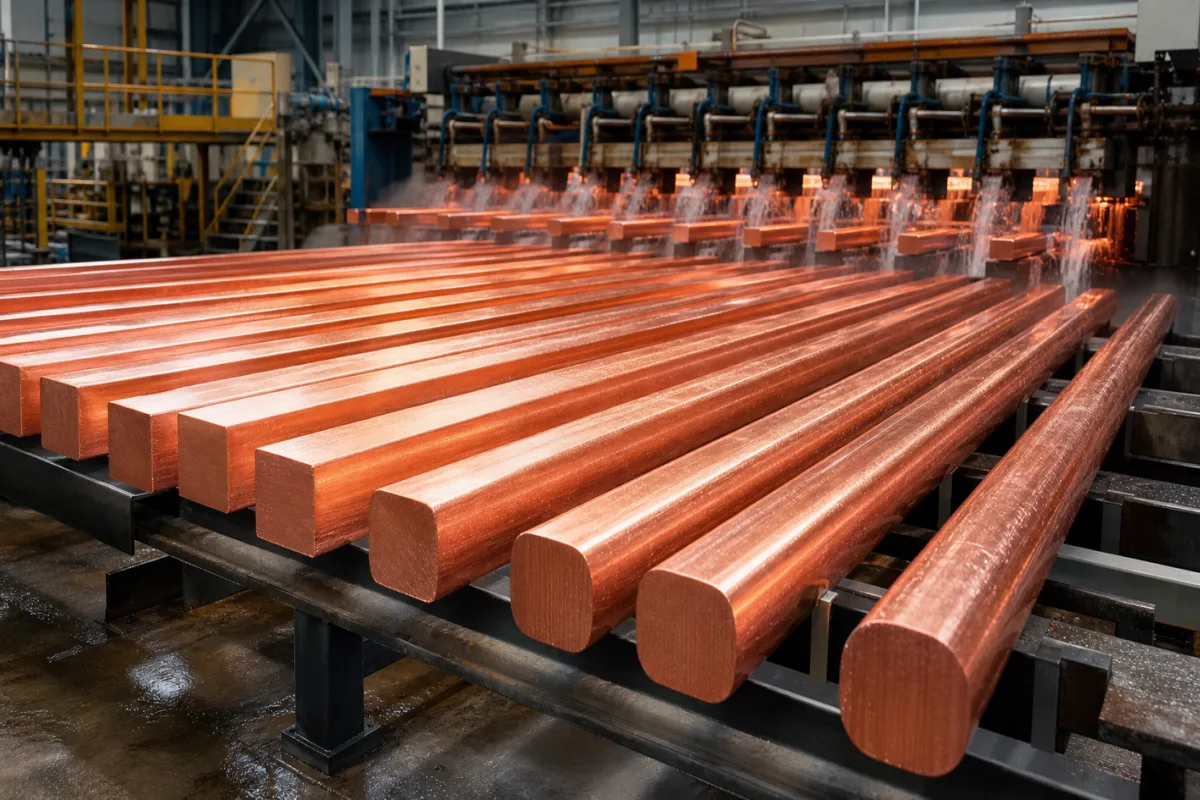
Continuously cast copper and brass billets for extrusion and rolling · Copper C11000 versus brasses C26000 and C36000, composition and lead limits, hot-working ranges, liquidus and solidus, conductivity and density, billet size and certificates
A copper alloy continuous casting billet is a round or rectangular bar of copper or brass cast continuously (or semi-continuously) from the melt through a water-cooled mould and cut to length, supplied as feedstock for hot extrusion into rod, tube and profiles or for rolling and forging. Ask three things first: which alloy and impurity limits the finished product requires, what billet diameter, length and tolerances the extrusion press or mill takes, and what composition, structure and surface checks come with each lot.
Continuously or semi-continuously cast billets and logs of copper and copper alloys (coppers, brasses and similar) for extrusion, rolling and forging. Forging slugs cut from extruded bar (see forging-grade copper alloy billet), copper cathode (see high purity copper cathode), master alloys, wire rod and finished extrusions are outside this page except where compared.
CNFX editorial research · Sources checked October 12, 2026 · 6 sources
Choose the alloy for the extruded or rolled product
The Copper Development Association (CDA) alloy database lists C11000 (electrolytic tough pitch copper) at 99.90% Cu minimum, a high-conductivity copper with at least 100% IACS annealed (101% IACS listed), excellent capacity for hot forming and a forgeability rating of 65; C26000 cartridge brass at 68.5–71.5% Cu, lead 0.07% maximum, iron 0.05% maximum and zinc remainder, fair hot formability and machinability 30; and C36000 free-cutting brass at 60.0–63.0% Cu, 2.5–3.0% Pb, iron 0.35% maximum and zinc remainder, fair hot formability and machinability 100. [1][2][3]
CDA gives liquidus and solidus of 1,981 and 1,949 °F for C11000, 1,750 and 1,680 °F for C26000 and 1,650 and 1,630 °F for C36000, with specific gravities of 8.91, 8.53 and 8.5 and conductivities of 101, 28 and 26% IACS. [1][2][3]
Editorial note: if the products go into drinking-water or food-contact use, confirm the lead limit that applies before choosing a leaded brass such as C36000, and specify the matching certification with the billet supplier.
Give the supplier the alloy designation and standard, impurity and lead limits, billet shape and diameter (or section) with tolerance, cut length and squareness, surface condition (as-cast, scalped), straightness, internal soundness and grain structure requirements, inspection (ultrasonic, macro-etch), certificates, packing and quantity per lot.
02
Set billet size and hot-working range
CDA lists hot-working temperatures of 1,400–1,600 °F for C11000, 1,350–1,550 °F for C26000 and 1,300–1,450 °F for C36000, with annealing ranges of 800–1,400 °F (C26000) and 800–1,100 °F (C36000). [1][2][3]
Editorial calculation: 1,300–1,600 °F is about 704–871 °C across these three alloys. A C36000 billet 200 mm in diameter and 600 mm long has a volume of about 18.8 dm³ and, at a specific gravity of 8.5, a mass of about 160 kg; check the press container size, butt length and product yield with the extruder before fixing billet length. [3]
Editorial note: ask the supplier how cast billets are checked for internal porosity, segregation and surface cracks, because these defects carry through into the extruded product. Uneven mould cooling is one cause the casting patents address. [5]
03
Choose vertical or horizontal casting and the mould
A patent from IMI Refiners (US 4,230,006) describes one vertical process for copper and copper-alloy billets and slabs. Molten copper is fed continuously into a water-cooled, graphite-lined mould, and the strand leaves downwards. The mould is reciprocated vertically to free the strand from its sides, spring-loaded pinch rolls below the mould support the strand, and a flying saw cuts it into lengths between 500 and 3,000 mm. The patent notes that the casting rate is limited by the solidification rate in the mould, so smaller billet moulds cast at a lower rate. [4]
Métallurgie Hoboken-Overpelt's patent US 3,981,351 covers the mould for vertical continuous casting of copper billets. In its example a tubular copper mould holds a graphite liner and sits inside a steel cooling jacket, with 24 steel ribs of 20 mm height around an inner tubular wall. The ribs make the cooling water flow evenly and without turbulence down the mould and out of an annular slot inclined at 20° towards the billet. The patent states that a strongly turbulent flow cools the mould and billet unevenly. [5]
SMS group offers horizontal continuous casting plants for extrusion billets in brass with and without lead, special brasses, copper-nickel and DHP copper, with one to four strands and an annual capacity of over 100,000 t. [6]
Editorial calculation: a 3,000 mm strand length at the upper end of the IMI range, cut into the 600 mm billets of the example above, gives five billets per cut length. Ask whether billets are sawn to your exact length or supplied in cast lengths for cutting at the press. [4]
Give the supplier the alloy and standard, billet diameter and tolerance, billet length or cast length, casting route (vertical or horizontal), soundness checks, surface condition (as cast or scalped), certificates and annual quantity.
04
Find copper alloy billet manufacturers
CNFX has not yet verified a cast house for these billets. The IMI vertical process and SMS group's horizontal casters are the two routes described above, so ask any supplier which one cast your billets and for the certificate per cast. [4][6]
05
Compare the alloy options
Values from the CDA alloy database; check the current standard for your market.
Billet length comes from the press, not the caster: the IMI process cuts strands to lengths between 500 and 3,000 mm, so fix the length from the container size and butt length agreed with your extruder. [4]
Explore company information and manufacturing capabilities, then discuss the scope of your project with a relevant supplier.
Share this page
Compiled and source-reviewed by the CNFX editorial team.
Each manufacturer above links to the page on that company's own website where the product is listed, with the date we checked it. How we source and review
· Page last updated 13 October 2026
Buyer questions
What is the purity of C11000 copper billet?
CDA lists C11000 at 99.90% copper minimum with conductivity of at least 100% IACS annealed. [1]
At what temperature are brass billets hot worked?
CDA gives 1,350–1,550 °F for C26000 and 1,300–1,450 °F for C36000. [2][3]
How much lead is in free-cutting brass?
C36000 contains 2.5–3.0% lead, which gives it a machinability rating of 100. [3]
How are copper alloy billets continuously cast?
In one vertical process molten copper is fed into a water-cooled, graphite-lined, reciprocating mould, and the strand is cut by a flying saw into lengths of 500 to 3,000 mm. Horizontal casters for brass and copper-nickel billets also exist. [4][6]
Sources and what still needs a direct check
Sources checked 2026-10-12. The CDA database gives composition limits and property data for UNS alloys; two patents describe vertical casting practice and mould cooling, and an equipment maker describes horizontal casters. Supply standards and certified values for your order come from the cast house.