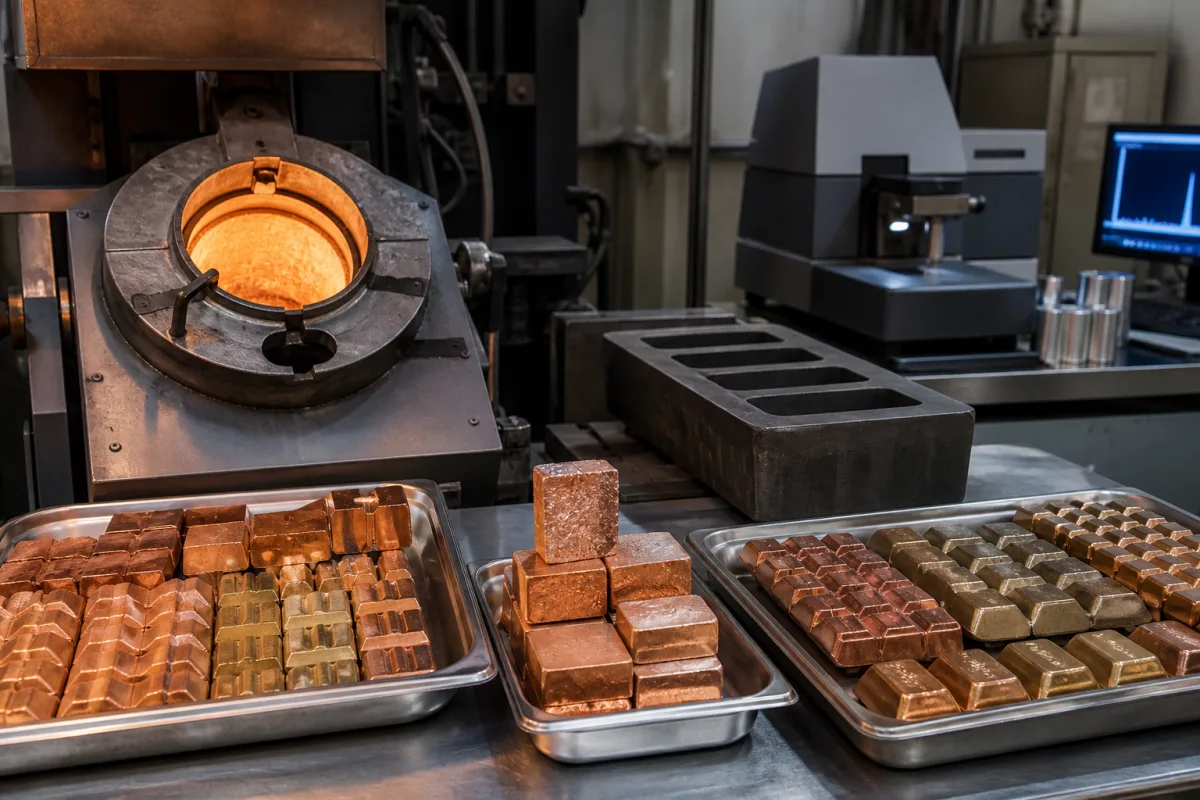
Copper master alloys · Beryllium content and process route, impurity limits, ingot sizes, dilution to target, beryllium exposure limits
A copper master alloy is a copper-based alloy rich in one alloying element, cast as ingots or waffle plates, that foundries melt into copper to reach a target composition more easily than adding the pure element. Ask three things first: the alloying content range and how the alloy is made, the impurity limits and certificate that come with each lot, and how the plant will handle the material if it contains beryllium.
Copper-based master alloys for alloying copper melts, especially copper-beryllium master alloys in ingot form. Finished beryllium-copper strip, rod and wire, aluminium and nickel master alloys, and pure copper cathode are outside this page.
CNFX editorial research · Sources checked October 12, 2026 · 4 sources
Ulba Metallurgical Plant (Kazakhstan) lists its copper-beryllium master alloys by beryllium content and route: carbothermic CuBe3.3 with 3.0–4.0% Be in ingots of 6.5–17 kg (CuBe3.3S up to 6.5 kg); carbothermic remelted CuBe4B with 3.8–4.3% Be (ingots up to 2.7 kg, 2.7–6 kg for CuBe4B-L, 60–120 g for CuBe4BP); synthetic CuBe4A with the same Be range; synthetic CuBe10 with 9.5–10.5% Be; and ingots of 2.0–2.9% Be. [1]
Maximum impurities differ by route: for the carbothermic remelted CuBe4B, Fe 0.12%, Mg 0.05%, Al 0.15%, Si 0.15% and Pb 0.005%; for the synthetic CuBe4A, Fe, Mg, Al and Si 0.05% each and Pb 0.003%. [1] Editorial note: choose the route by the impurity limits your final alloy can tolerate, and ask for a certificate of analysis for every lot.
Editorial calculation: to make 100 kg of melt at an assumed 1.9% Be target from a 4.0% Be master alloy, mass balance gives 100 × 1.9 ÷ 4.0 = 47.5 kg of master alloy and 52.5 kg of copper, before any melting loss; confirm the actual recovery in trials.
The master alloy has to land the melt inside the final alloy's limits. The Copper Development Association's record for wrought copper-beryllium C17200 gives Be 1.80–2.00%, Ni + Co at least 0.20% with Ni + Fe + Co no more than 0.6%, Al and Si each up to 0.20%, and Cu plus named elements at least 99.5%. It lists a liquidus of 1,800 °F (about 982 °C), a solidus of 1,590 °F (about 866 °C), a specific gravity of 8.26 and electrical conductivity of 22% IACS. [3]
Editorial calculation: in the 47.5 kg example, a CuBe4B master alloy at its 0.12% Fe maximum would bring in up to 0.057 kg of iron, about 0.06% of a 100 kg melt (47.5 × 0.0012 ÷ 100 × 100), which counts against C17200's 0.6% limit on Ni + Fe + Co together. [1][3]
Give the supplier the alloying element and content range, production route, impurity limits, ingot weight and shape, quantity and lot size, certificate of analysis requirements, packaging and labelling, and safety data sheet and handling information for beryllium grades.
02
Work back from the wrought alloy the melt must become
ASTM B196/B196M, the US specification for copper-beryllium rod and bar, names three alloys by nominal beryllium content: C17000 (previously Alloy 165) at 1.7% Be, C17200 (previously Alloy 25) at 1.9% Be, and C17300 at 1.9% Be plus 0.4% lead. C17200 is to be furnished whenever the specification is called up without an alloy designation. The rod and bar are supplied solution heat-treated (TB00) or cold-drawn hard (TD04), to be precipitation heat treated after machining or forming, or already precipitation heat treated as TF00 or TH04, and are tested for dimensions, tensile and yield strength, Rockwell hardness, elongation and chemical composition. [4]
Editorial calculation: master alloy mass = melt mass × target Be ÷ master alloy Be, using Ulba's 3.8–4.3% Be (taken here as 4.0%) and 9.5–10.5% Be (taken as 10%) grades, before melting loss; the higher-Be grade cuts the mass to charge, and with it the share of the melt that carries the master alloy's own impurities, so compare Ulba's per-route impurity limits against the final alloy limits that CDA gives for C17200. [1][3][4]
47.5 kg plus a lead addition (Editorial calculation)
19 kg plus a lead addition (Editorial calculation)
03
Handle beryllium-containing grades under exposure rules
The US OSHA beryllium standard for general industry (29 CFR 1910.1024) applies to occupational exposure to beryllium in all forms, compounds and mixtures, except articles containing beryllium that the employer does not process, and materials with less than 0.1% beryllium by weight where objective data show exposure stays below the action level. [2]
It sets a permissible exposure limit of 0.2 µg/m³ as an 8-hour time-weighted average, a short-term limit of 2.0 µg/m³ over 15 minutes, and an action level of 0.1 µg/m³, and requires employers to assess the exposure of each employee who is or may be exposed to airborne beryllium. [2]
Editorial note: melting, sampling, cutting and grinding master alloys of 2–10% beryllium are processing, so the standard's assessment and controls apply in US workplaces; ask the supplier for safety data sheets and for packaging that limits dust and handling, and apply your own jurisdiction's limits elsewhere.
04
A trading group's CuBe and AlBe listings
Listings include copper-beryllium master alloys of about 4% and 10% Be and aluminium-beryllium master alloys, from a diversified trading group.
05
What distinguishes one master alloy lot from another
Judge the impurity row against the final alloy rather than the master alloy: at Ulba's 0.12% Fe maximum, 47.5 kg of CuBe4B adds about 0.06% iron to a 100 kg melt, which counts toward C17200's 0.6% cap on Ni + Fe + Co. [1][3]
Explore company information and manufacturing capabilities, then discuss the scope of your project with a relevant supplier.
Share this page
Compiled and source-reviewed by the CNFX editorial team.
Each manufacturer above links to the page on that company's own website where the product is listed, with the date we checked it. How we source and review
· Page last updated 13 October 2026
Buyer questions
What beryllium content do copper-beryllium master alloys have?
Ulba lists grades of 3.0–4.0%, 3.8–4.3%, 9.5–10.5% and 2.0–2.9% Be. [1]
Do carbothermic and synthetic master alloys differ?
In Ulba's limits, the synthetic CuBe4A allows 0.05% Fe against 0.12% for the carbothermic remelted CuBe4B. [1]
What are the US exposure limits for beryllium?
OSHA's general industry standard sets 0.2 µg/m³ (8-hour TWA), 2.0 µg/m³ (15-minute STEL) and an action level of 0.1 µg/m³. [2]
What beryllium content does C17200 need?
The Copper Development Association lists Be 1.80–2.00% for C17200, with Ni + Co at least 0.20% and Ni + Fe + Co at most 0.6%. [3]
Which copper-beryllium alloys does ASTM B196 cover?
C17000 (1.7% Be nominal), C17200 (1.9% Be) and C17300 (1.9% Be plus 0.4% lead); C17200 is supplied when no alloy is named. [4]
Sources and what still needs a direct check
Sources checked 2026-10-12. Ulba Metallurgical Plant describes its own beryllium master alloys; OSHA's standard is US regulation; the CDA record and ASTM B196 describe the wrought copper-beryllium alloys a melt is made into. Other producers' grades and other countries' limits differ.