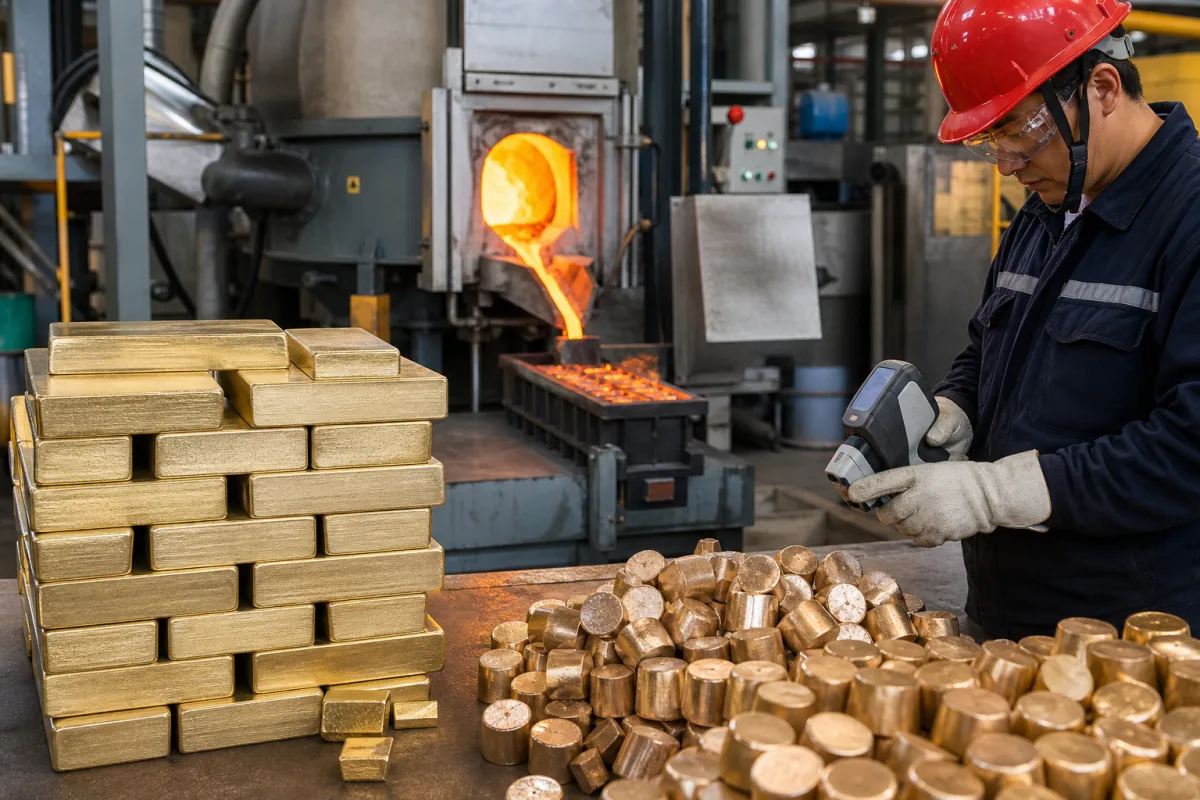
Copper–zinc (brass) remelt ingot: leaded yellow brass and low-lead grades poured for foundries, from refined metal or sorted scrap
Copper–zinc ingot for foundry remelting · leaded yellow brass against low-lead silicon brass, the 0.25% weighted-lead rule for drinking-water parts, ingot made from XRF-sorted scrap, and how much zinc a hot melt gives off
Brass castings can start as brass ingot: bars of copper–zinc alloy already made to a named composition, which a foundry melts with its own returns and pours into sand, permanent or continuous moulds. The ingot maker's work is to hit the grade — copper, zinc, lead and the minor elements within limits — from refined metal, scrap or both, and to deliver it in bars a furnace can charge. Two questions dominate the order: which grade, and in particular how much lead it may carry if the castings will touch drinking water; and how far the ingot's chemistry can be trusted when it was made from recycled brass and will lose zinc again in the customer's furnace.
Copper–zinc alloy ingot made for remelting in foundries — leaded yellow brasses and low-lead or lead-free brasses such as silicon brass — produced from refined copper and zinc or from sorted brass scrap, with its composition limits, lead content for potable-water parts and zinc loss in remelting. Copper–beryllium and other copper hardener master alloys are covered on the Copper master alloy (copper-beryllium) page; continuously cast copper alloy billets for extrusion and forging on the Copper alloy continuous casting billet and Forging-grade copper alloy billet pages; copper cathode on the High-purity copper cathode page; aluminium ingot for remelting on the Aluminium ingot for remelting page. Brass rod, strip and finished castings are outside this page.
CNFX editorial research · Sources checked October 12, 2026 · 5 sources
Leaded yellow brass C85700 against low-lead silicon brass C87850
The Copper Development Association's alloy data show how differently two cast brasses sold as ingot are built. C85700 is a leaded yellow brass in the copper–zinc family; C87850 is a silicon brass with 2.7–3.4% silicon, almost no lead and far more copper. CDA lists sand castings for valve and general applications and ingot among the specifications for C85700, and an ingot specification as well as continuous, permanent-mould and sand castings for C87850. [1][2]
CDA lists uses for C87850 including valve bodies for water, faucets, plumbing fittings and water meter cases, and for C85700 builders' hardware among others. [2][1] Editorial calculation: in °C, C85700 melts between about 913 and 941 °C and C87850 between about 855 and 880 °C, so the two grades also need different pouring practice.
Editorial note: order the ingot by the designation of the casting alloy it must produce (UNS, EN or national), and ask for a heat analysis of every lot covering all limited elements — lead, iron, nickel, aluminium and silicon as well as copper and zinc — not only the copper content.
02
Lead in the ingot and the 0.25% weighted-average rule for drinking-water fittings
In the United States, 40 CFR 143.12 defines lead free for pipes, pipe fittings, plumbing fittings and fixtures as not more than a weighted average of 0.25% lead across their wetted surfaces (0.2% for solder and flux). Each wetted component's lead percentage is multiplied by its share of the total wetted surface area and the results are summed; the lead content of the material used to make the component is what counts, and where a material's lead content is given as a range, the maximum of the range must be used. [3]
Editorial calculation: using the maxima as the rule requires, a C85700 component (1.5% Pb max.) could make up at most 0.25 ÷ 1.5 ≈ 17% of a product's wetted area even if every other wetted part contained no lead, while C87850 (0.09% Pb max.) stays below 0.25% whatever its share. [3][1][2] For an ingot buyer this means the grade, not the casting, decides compliance: the specification maximum on the ingot certificate is the number used in the calculation.
Editorial note: low-lead ingot has to be kept apart from leaded returns and scrap in the foundry, since remelting the two together raises the lead of the next heat.
03
Ingot from XRF-sorted scrap: what sorting delivers and where lead slips through
Kölking and co-workers tested sorting of about 4.3 tonnes of metallic fraction from mixed copper-alloy foundry residues on an industrial X-ray fluorescence chute sorter, then remelted each sorted product into ingots. Metal yields were 96.5–98.3%; the 1.7–3.5% melting losses came from dross, volatilisation (mainly of zinc), non-metallic and oxide impurities and unmelted higher-melting metals such as free iron. [4]
The authors compare the Cu–Zn ingot with specifications that limit lead to 0.1% for CuZn37 and 0.2% for CuZn40: its roughly 1.4% lead would need large additions of new metal to the charge, though it is about 40% below the leaded fraction. They attribute the limited separation of leaded and low-leaded brass to the small difference in composition and the short measurement times of chute sorters, and note that aluminium, silicon and manganese impurities can probably be removed by melt refining such as oxygen blowing. [4]
Editorial calculation: to bring an ingot at 1.4% lead down to the 0.2% CuZn40 limit by dilution with lead-free metal alone, sorted scrap could make up no more than 0.2 ÷ 1.4 ≈ 14% of the charge. A handheld analyser on incoming scrap or on finished bars is a screening check; the certificate should rest on a laboratory heat analysis.
Zinc boils off in the furnace: holding temperature against zinc loss
Zinc's vapour pressure is far higher than copper's, so a brass melt loses zinc whenever it is held hot. Wilk and co-workers measured it by thermogravimetry on brass scrap containing 10.53 wt% zinc, heated at 20 °C per minute to temperatures from 1,080 to 1,240 °C in helium at atmospheric pressure and held for 30 minutes. [5]
The authors found the rate controlled by mass transfer in the gas phase, with overall mass-transfer coefficients of 4.74 to 8.46 × 10⁻⁵ m/s. [5] These were small samples in a crucible under inert gas, aimed at removing zinc from copper scrap, so the percentages do not transfer directly to an industrial furnace; the direction — more zinc lost the hotter the melt is held — applies to ingot making and remelting alike. Editorial note: ask the ingot maker for the zinc tolerance it holds after its own melting, and allow in the foundry's charge calculation for the zinc the ingot will lose again on remelting.
Paste it into your enquiry below or into an email to a maker, then replace every bracket.
Grade: [casting alloy designation — UNS, EN or national]
Lead: [maximum lead; potable-water use and lead-free rule to meet]
Chemistry: [limits for Fe, Ni, Al, Si, Sn, P, Sb; zinc tolerance]
Source: [refined metal, sorted scrap or both; how scrap is sorted]
Form: [ingot or bar mass and dimensions; bundling]
Documents: [heat analysis per lot; laboratory method]
Explore company information and manufacturing capabilities, then discuss the scope of your project with a relevant supplier.
Share this page
Compiled and source-reviewed by the CNFX editorial team.
Each manufacturer above links to the page on that company's own website where the product is listed, with the date we checked it. How we source and review
· Page last updated 13 October 2026
Buyer questions
What is the composition of C85700 leaded yellow brass?
CDA lists 58.0–64.0% copper, 32.0–40.0% zinc, 0.8–1.5% lead and 0.50–1.5% tin, with limits on iron, nickel, aluminium and silicon. [1]
How much lead may a US drinking-water fitting contain?
40 CFR 143.12 allows a weighted average of not more than 0.25% lead across wetted surfaces, using the maximum of any material's lead range. [3]
Can brass ingot be made from sorted scrap?
Yes, but lead is hard to sort out: in one industrial XRF trial the low-lead Cu–Zn fraction still remelted at about 1.4% lead, against 0.1–0.2% limits for CuZn37 and CuZn40. [4]
How much zinc is lost when brass is melted?
It depends on temperature and time; in laboratory tests on 10.53% zinc brass held 30 minutes under helium, 83.82% of the zinc left at 1,080 °C and 99.87% at 1,240 °C. [5]
Sources and what still needs a direct check
Sources checked 2026-10-12. Alloy compositions, melting ranges, conductivity, machinability and uses come from the Copper Development Association's data for C85700 and C87850; the lead-free definition from the US EPA rule at 40 CFR 143.12; scrap sorting and remelted ingot chemistry from Kölking et al. (Waste Management & Research, 2024); zinc evaporation from Wilk et al. (Materials, 2023).