Industry-Verified Manufacturing Data (2026)

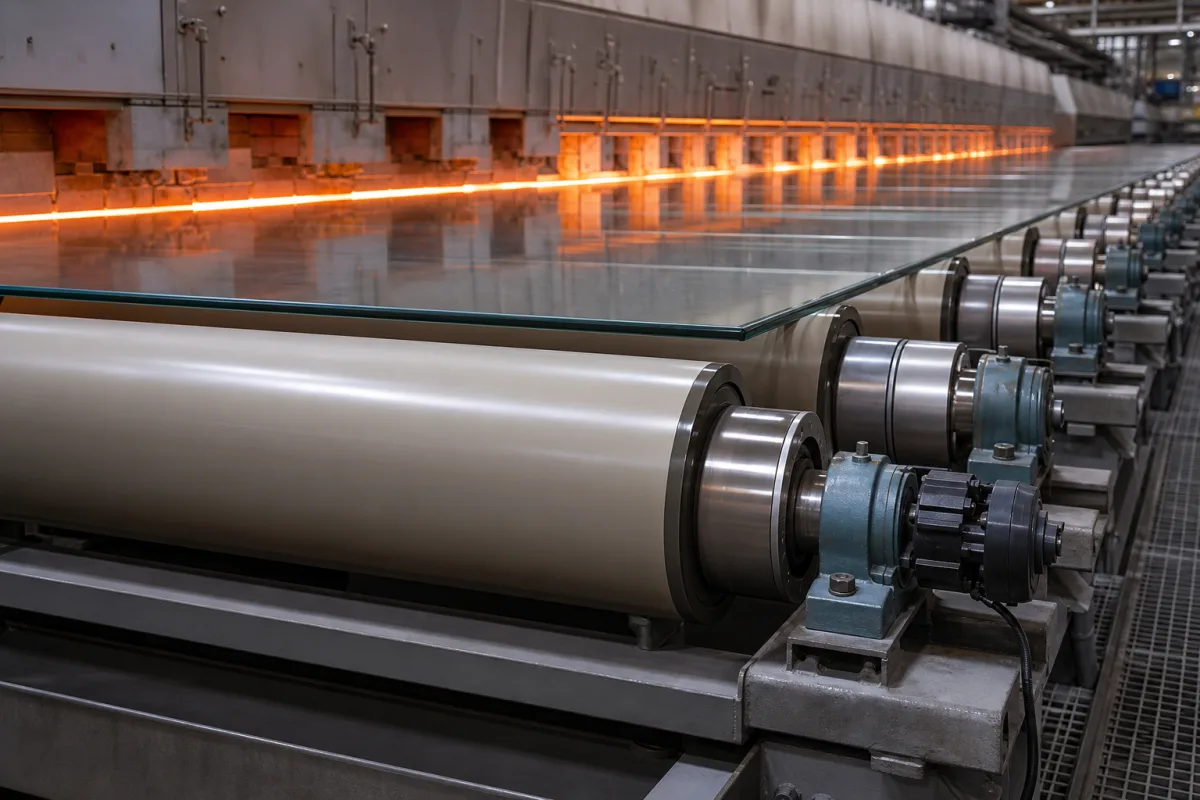
Float Glass Annealing Lehr Roller

Based on aggregated insights from multiple verified factory profiles within the CNFX directory, the standard Float Glass Annealing Lehr Roller used in the Non-Metallic Mineral Product Manufacturing sector typically supports operational capacities ranging from standard industrial configurations to heavy-duty production requirements.

Technical Definition & Core Assembly

A canonical Float Glass Annealing Lehr Roller is characterized by the integration of Ceramic Roller Body and Metal Shaft. In industrial production environments, manufacturers listed on CNFX commonly emphasize Silicon Carbide (SiC) Ceramic construction to support stable, high-cycle operation across diverse manufacturing scenarios.

A precision ceramic roller used to transport and support glass sheets through the annealing lehr.
Product Specifications

Technical details and manufacturing context for Float Glass Annealing Lehr Roller

Definition
The Float Glass Annealing Lehr Roller is a critical component within the glass manufacturing line, specifically in the annealing lehr section. Its primary function is to convey flat glass sheets at a controlled, uniform speed through the annealing zone, where internal stresses are relieved to prevent breakage. These rollers must withstand continuous high temperatures (up to 600°C) and maintain dimensional stability to prevent glass surface defects like roller wave distortion. They are essential for ensuring the production of flat, stress-free, and high-quality architectural or automotive glass.
Working Principle
The roller rotates on its axis via an external drive system, supporting the bottom surface of the glass sheet. As the glass travels along the conveyor formed by multiple parallel rollers, it is gradually cooled in a controlled thermal profile to anneal the glass.
Common Materials
Silicon Carbide (SiC) Ceramic, Fused Silica Ceramic
Technical Parameters
  • The outer diameter of the cylindrical roller body. (mm) Standard Spec
  • The highest continuous temperature the roller can withstand without degradation. (°C) Standard Spec
Components / BOM
  • Ceramic Roller Body
    Provides the primary cylindrical surface for glass contact and transport.
    Material: Silicon Carbide or Fused Silica Ceramic
  • Metal Shaft
    Central axle for mounting, rotation, and torque transmission.
    Material: Heat-Resistant Alloy Steel
  • End Bearing Assembly
    Allows low-friction rotation of the roller on its shaft.
    Material: High-Temperature Bearings & Housing
  • Thermal Expansion Sleeve Optional
    Compensates for differential thermal expansion between ceramic body and metal shaft.
    Material: Graphite or Special Alloy
Engineering Reasoning
0.5-2.0 m/s linear velocity, 600-750°C ambient temperature, 0.1-0.3 MPa compressive load per roller
Thermal shock fracture at ΔT > 200°C/min, creep deformation at >750°C for >1000 hours, surface spalling at >0.5 MPa point load
Design Rationale: Thermal stress exceeding ceramic tensile strength (35-50 MPa for alumina), viscoelastic creep above glass transition temperature of silica binder, Hertzian contact stress exceeding fracture toughness (3.5-4.0 MPa·m¹/²)
Risk Mitigation (FMEA)
Trigger Ceramic-metal CTE mismatch (Al₂O₃: 8.1×10⁻⁶/°C vs Steel: 11.0×10⁻⁶/°C)
Mode: Radial cracking at bearing interface
Strategy: Graded CTE interlayer (Mo-Mn metallization) with 0.05 mm compliance gap
Trigger Silica binder devitrification at >800°C
Mode: Surface glaze formation reducing μ from 0.4 to 0.15
Strategy: Yttria-stabilized zirconia coating (5% Y₂O₃) with 0.2 mm thickness

Industry Taxonomies & Aliases

Commonly used trade names and technical identifiers for Float Glass Annealing Lehr Roller.

Industrial Ecosystem & Supply Chain DNA

Complementary Systems
Downstream Applications
Specialized Tooling

Application Fit & Sizing Matrix

Operational Limits
pressure: Max 0.5 MPa (5 bar) distributed load, 1.0 MPa point load
other spec: Max linear speed: 15 m/min, Roller deflection: <0.1 mm/m, Surface roughness: Ra 0.4-0.8 μm
temperature: Ambient to 700°C (continuous operation), peak 750°C (short-term)
Media Compatibility
✓ Soda-lime float glass ✓ Borosilicate glass sheets ✓ Alkali-free glass substrates
Unsuitable: Molten glass or high-viscosity glass above softening point
Sizing Data Required
  • Glass sheet dimensions (width, thickness, length)
  • Required throughput (tons/hour or sheets/hour)
  • Annealing lehr temperature profile (ramp rates, dwell times)

Reliability & Engineering Risk Analysis

Failure Mode & Root Cause
Thermal fatigue cracking
Cause: Cyclic thermal stress from temperature variations in the annealing lehr (typically 600°C to 200°C), combined with mechanical loading from glass weight, leading to crack initiation and propagation in roller surfaces or bearings.
Bearing seizure or excessive wear
Cause: High-temperature operation degrading lubricants, ingress of glass dust or contaminants, misalignment causing uneven load distribution, or inadequate cooling leading to thermal expansion and loss of clearance.
Maintenance Indicators
  • Audible grinding or squealing noises from roller bearings during operation, indicating lubrication failure or bearing damage.
  • Visual observation of glass marking or scratching on the product surface, suggesting roller surface degradation, uneven wear, or misalignment.
Engineering Tips
  • Implement a predictive maintenance program using infrared thermography to monitor roller surface temperatures and detect hot spots indicative of bearing issues or uneven thermal loading.
  • Establish a strict alignment and balancing protocol during installation and after maintenance, using laser alignment tools to ensure parallel roller positioning and prevent uneven wear and excessive mechanical stress.

Compliance & Manufacturing Standards

Reference Standards
ISO 9001:2015 - Quality management systems ASTM C1036-21 - Standard Specification for Flat Glass DIN EN 572-1:2016 - Glass in building - Basic soda lime silicate glass products
Manufacturing Precision
  • Roller Diameter Tolerance: +/-0.05mm
  • Roller Surface Flatness: 0.1mm per meter length
Quality Inspection
  • Dimensional Accuracy Verification using CMM
  • Surface Hardness Testing (Rockwell C scale)

Factories Producing Float Glass Annealing Lehr Roller

Verified manufacturers with capability to produce this product in China

✓ 96% Supplier Capability Match Found

T Technical Director from Australia Jan 14, 2026
★★★★★
"Great transparency on the Float Glass Annealing Lehr Roller components. Essential for our Non-Metallic Mineral Product Manufacturing supply chain."
Technical Specifications Verified
P Project Engineer from Singapore Jan 11, 2026
★★★★☆
"The Float Glass Annealing Lehr Roller we sourced perfectly fits our Non-Metallic Mineral Product Manufacturing production line requirements. (Delivery took slightly longer than expected, but technical support was excellent.)"
Technical Specifications Verified
S Sourcing Manager from Germany Jan 08, 2026
★★★★★
"Found 26+ suppliers for Float Glass Annealing Lehr Roller on CNFX, but this spec remains the most cost-effective."
Technical Specifications Verified
Verification Protocol

“Feedback is collected from verified sourcing managers during RFQ (Request for Quote) and factory evaluation processes on CNFX. These reports represent historical performance data and technical audit summaries from our B2B manufacturing network.”

14 sourcing managers are analyzing this specification now. Last inquiry for Float Glass Annealing Lehr Roller from Vietnam (1h ago).

Supply Chain Commonly Integrated Components

Powder Feeder

A precision component that meters and delivers ceramic powder to the press mold in controlled quantities.

Explore Specs →
Thermal Expansion Sleeve

A cylindrical component designed to accommodate thermal expansion in roller assemblies during high-temperature processes.

Explore Specs →
Gas Offtake

A structural opening or port in a stack designed to extract or divert exhaust gases from the main flow for monitoring, sampling, or auxiliary systems.

Explore Specs →
Asphalt Storage and Heating System

A system within an asphalt mixing plant that stores and maintains asphalt at required temperatures for mixing operations.

Explore Specs →

Frequently Asked Questions

What are the advantages of silicon carbide ceramic rollers for glass annealing?

Silicon carbide (SiC) ceramic rollers offer exceptional thermal stability, high mechanical strength, and excellent wear resistance at elevated temperatures up to 1600°C, ensuring smooth glass transport and minimal thermal deformation during annealing.

How does the thermal expansion sleeve improve roller performance?

The thermal expansion sleeve accommodates differential expansion between the ceramic roller body and metal shaft during temperature cycling, preventing stress cracks and maintaining alignment for consistent glass sheet support throughout the annealing process.

What maintenance is required for ceramic annealing lehr rollers?

Ceramic rollers require minimal maintenance due to their corrosion and wear resistance. Regular inspections for surface integrity, bearing lubrication checks, and cleaning to remove glass dust or deposits are recommended to ensure optimal performance and longevity.

Can I contact factories directly on CNFX?

CNFX is an open directory, not a transaction platform. Each factory profile provides direct contact information and production details to help you initiate direct inquiries with Chinese suppliers.

Get Quote for Float Glass Annealing Lehr Roller

Request technical pricing, lead times, or customized specifications for Float Glass Annealing Lehr Roller directly from verified manufacturing units.

Your business information is encrypted and only shared with verified Float Glass Annealing Lehr Roller suppliers.

Thank you! Your message has been sent. We'll respond within 1–3 business days.

Need to Manufacture Float Glass Annealing Lehr Roller?

Connect with verified factories specializing in this product category

Add Your Factory Contact Us
Previous Product
Filler Silo
Next Product
Gas Offtake