Industry-Verified Manufacturing Data (2026)

End Bearing Assembly

Based on aggregated insights from multiple verified factory profiles within the CNFX directory, the standard End Bearing Assembly used in the Machinery and Equipment Manufacturing sector typically supports operational capacities ranging from standard industrial configurations to heavy-duty production requirements.

Technical Definition & Core Assembly

A canonical End Bearing Assembly is characterized by the integration of Bearing Insert and Housing / Pillow Block. In industrial production environments, manufacturers listed on CNFX commonly emphasize Chrome Steel (for bearing rings and rolling elements) construction to support stable, high-cycle operation across diverse manufacturing scenarios.

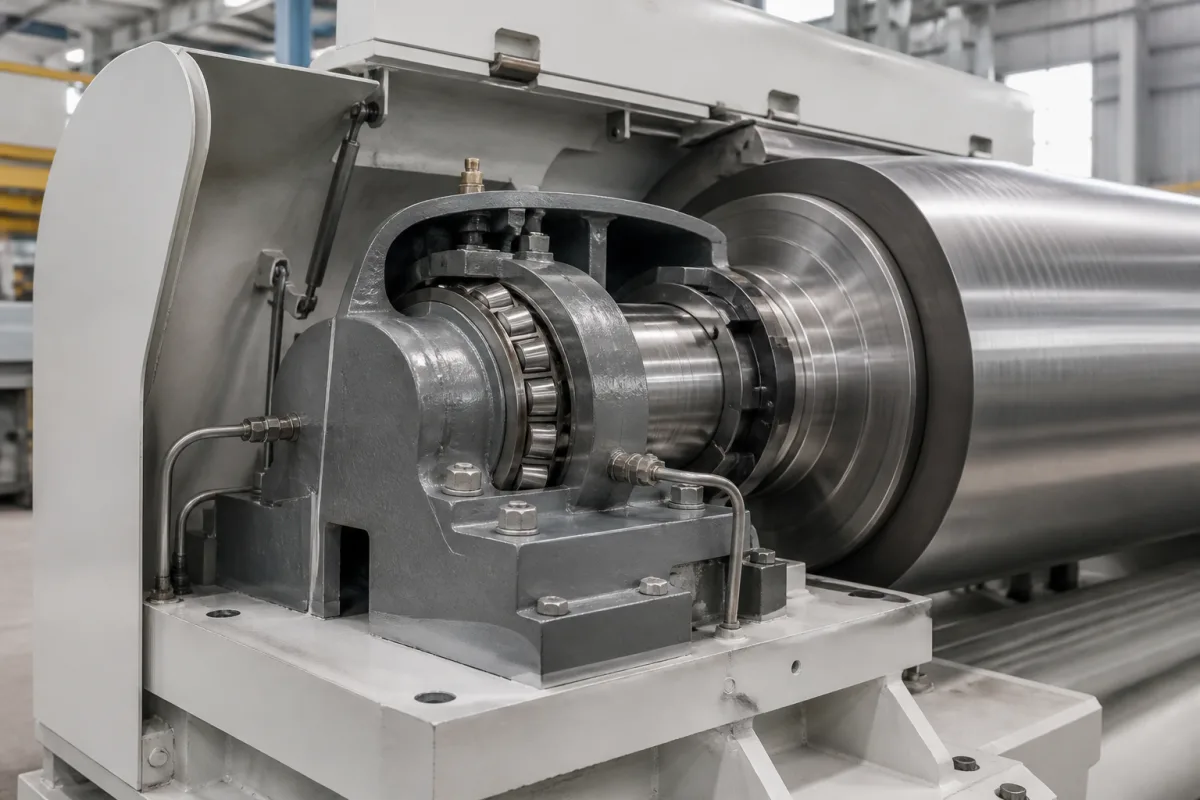
A mechanical assembly that supports and facilitates the rotation of the annealing lehr roller at its terminal point.
Product Specifications

Technical details and manufacturing context for End Bearing Assembly

Definition
The End Bearing Assembly is a critical component of a Float Glass Annealing Lehr Roller. It is mounted at the end of the roller shaft and serves to support the roller's weight, maintain precise axial and radial alignment, and minimize friction during rotation as the glass sheet travels through the controlled cooling zone of the annealing lehr.
Working Principle
The assembly typically consists of a bearing (e.g., roller or ball bearing) housed within a robust casing or pillow block. It transfers the radial and axial loads from the rotating roller to the stationary lehr structure. Lubrication within the bearing reduces friction, allowing for smooth, continuous rotation essential for the uniform transport and annealing of the glass sheet without causing surface defects.
Common Materials
Chrome Steel (for bearing rings and rolling elements), Cast Iron or Ductile Iron (for housing/pillow block)
Technical Parameters
  • Bore diameter (shaft size), Outer diameter, and Width of the bearing. (mm) Standard Spec
Components / BOM
  • Bearing Insert
    The core rolling-element component that facilitates low-friction rotation between the inner ring (fitted to shaft) and outer ring (housed in block).
    Material: Chrome Steel
  • Housing / Pillow Block
    The stationary outer casing that houses the bearing, provides mounting points to the lehr structure, and often includes lubrication ports.
    Material: Cast Iron or Ductile Iron
  • Seals
    Prevents the ingress of dust, debris, and moisture while retaining lubricant within the bearing cavity.
    Material: Synthetic Rubber (NBR/FKM) or Felt
  • Locking Device
    Secures the bearing inner ring to the roller shaft, typically using an adapter sleeve, locking collar, or eccentric locking collar.
    Material: Steel
Engineering Reasoning
0.5-2.5 kN radial load, -20°C to 150°C ambient temperature, 10-100 rpm rotational speed
Radial load exceeds 3.0 kN, temperature surpasses 180°C, rotational speed exceeds 120 rpm
Design Rationale: Hertzian contact stress exceeding 1.5 GPa causes subsurface fatigue cracks; thermal expansion differential exceeding 50 μm/m·K leads to seizure; lubricant viscosity breakdown at 150°C results in boundary lubrication
Risk Mitigation (FMEA)
Trigger Contaminant ingress (particle size >25 μm) into bearing raceway
Mode: Surface pitting and spalling on rolling elements
Strategy: Triple-labyrinth seal design with 0.1 mm clearance and positive pressure purge system
Trigger Misalignment exceeding 0.05° between shaft and housing bore
Mode: Edge loading and premature wear on bearing outer race
Strategy: Self-aligning spherical roller bearing with ±2° angular misalignment capability

Industry Taxonomies & Aliases

Commonly used trade names and technical identifiers for End Bearing Assembly.

Industrial Ecosystem & Supply Chain DNA

Complementary Systems
Downstream Applications
Specialized Tooling

Application Fit & Sizing Matrix

Operational Limits
pressure: Up to 0.5 MPa axial load, 0.2 MPa radial load
other spec: Max rotational speed: 150 RPM, lubrication interval: 500 hours
temperature: Ambient to 300°C (continuous), peak 350°C (short-term)
Media Compatibility
✓ Clean dry air ✓ Mineral-based lubricants ✓ Low-abrasion particulate environments
Unsuitable: High-concentration acidic slurry or corrosive chemical vapors
Sizing Data Required
  • Roller shaft diameter (mm)
  • Required axial load capacity (kN)
  • Operating temperature range (°C)

Reliability & Engineering Risk Analysis

Failure Mode & Root Cause
Fatigue spalling
Cause: Cyclic loading exceeding material endurance limit, often due to improper preload, misalignment, or shock loads.
Lubrication failure
Cause: Insufficient or degraded lubricant leading to metal-to-metal contact, caused by contamination, incorrect lubricant type, or excessive operating temperatures.
Maintenance Indicators
  • High-frequency vibration or audible whining/grinding noises during operation
  • Excessive heat generation detected via thermal imaging or touch, indicating friction or overload
Engineering Tips
  • Implement precision alignment during installation using laser alignment tools and maintain proper shaft runout tolerances to minimize dynamic stresses.
  • Establish a condition-based lubrication program with scheduled oil analysis to monitor contamination levels and lubricant degradation, ensuring optimal viscosity and cleanliness.

Compliance & Manufacturing Standards

Reference Standards
ISO 1132-1:2000 (Rolling bearings - Tolerances - Part 1: Terms and definitions) ANSI/ABMA 7:1995 (Tapered Roller Bearings - Radial Internal Clearance) DIN 5418-1:2016 (Rolling bearings - Spherical plain bearings - Part 1: Boundary dimensions and tolerances)
Manufacturing Precision
  • Bore diameter tolerance: ±0.01 mm
  • Radial runout tolerance: 0.05 mm max
Quality Inspection
  • Dimensional verification with coordinate measuring machine (CMM)
  • Ultrasonic testing for internal defects

Factories Producing End Bearing Assembly

Verified manufacturers with capability to produce this product in China

✓ 92% Supplier Capability Match Found

P Project Engineer from United States Feb 10, 2026
★★★★★
"The technical documentation for this End Bearing Assembly is very thorough, especially regarding technical reliability."
Technical Specifications Verified
S Sourcing Manager from United Arab Emirates Feb 07, 2026
★★★★★
"Reliable performance in harsh Machinery and Equipment Manufacturing environments. No issues with the End Bearing Assembly so far."
Technical Specifications Verified
P Procurement Specialist from Australia Feb 04, 2026
★★★★★
"Testing the End Bearing Assembly now; the technical reliability results are within 1% of the laboratory datasheet."
Technical Specifications Verified
Verification Protocol

“Feedback is collected from verified sourcing managers during RFQ (Request for Quote) and factory evaluation processes on CNFX. These reports represent historical performance data and technical audit summaries from our B2B manufacturing network.”

12 sourcing managers are analyzing this specification now. Last inquiry for End Bearing Assembly from Thailand (32m ago).

Supply Chain Compatible Machinery & Devices

Heavy-Duty CNC Plasma Cutting Machine

Industrial machine for precision metal cutting using plasma arc technology

Explore Specs →
Automated Assembly Line System

Integrated production system for sequential component assembly operations

Explore Specs →
Automated Powder Coating System

Integrated industrial system for applying dry powder coatings to metal substrates.

Explore Specs →
Centrifugal Pump Impeller

Rotating component that transfers energy to fluid in centrifugal pumps.

Explore Specs →

Frequently Asked Questions

What materials are used in this end bearing assembly?

The assembly features chrome steel for bearing rings and rolling elements, with cast iron or ductile iron for the housing/pillow block to ensure durability and smooth operation.

What are the main components of this bearing assembly?

Key components include the bearing insert, housing/pillow block, locking device, and seals, designed to support and facilitate rotation at terminal points in machinery.

How does this assembly benefit annealing lehr operations?

It provides reliable support and smooth rotation for annealing lehr rollers at terminal points, enhancing operational efficiency and reducing wear in high-temperature industrial environments.

Can I contact factories directly on CNFX?

CNFX is an open directory, not a transaction platform. Each factory profile provides direct contact information and production details to help you initiate direct inquiries with Chinese suppliers.

Get Quote for End Bearing Assembly

Request technical pricing, lead times, or customized specifications for End Bearing Assembly directly from verified manufacturing units.

Your business information is encrypted and only shared with verified End Bearing Assembly suppliers.

Thank you! Your message has been sent. We'll respond within 1–3 business days.

Need to Manufacture End Bearing Assembly?

Connect with verified factories specializing in this product category

Add Your Factory Contact Us
Previous Product
Encoders
Next Product
End Carriages